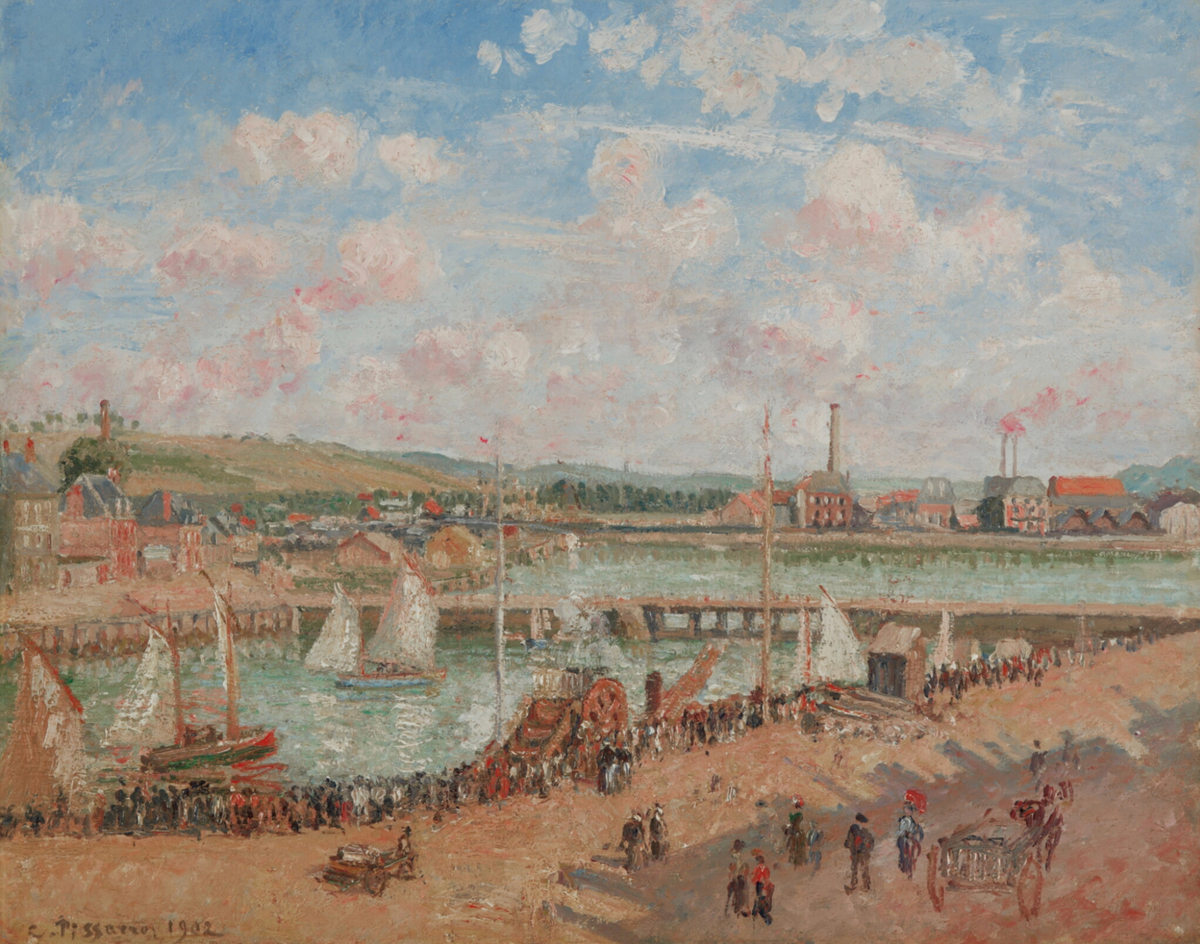
Seven heirs of the Jewish banker Salomon Flavian, whose collection was looted by the Nazis Paris in 1941, have asked a Paris court to retrospectively cancel the sale of a landscape by Pissarro. Darse de pêche et bassin Duquesne (fishing dock and Duquesne basin, 1902), which depicts the port of Dieppe in western France, was sold at Sotheby’s Londonon 25 June 2024 for £1.2m.
The Sotheby’s catalogue listing for the work did mention it had been owned by Flavian in the 1930s and registered in the Répertoire des biens spoliés (repertory of looted art) released by the French government in 1947. The same information is reported in the Pissarro Critical Catalogue of Paintings, written by Joachim Pissarro, the great-grandson of the artist, and published in 2005.
Nevertheless, Sotheby’s catalogue indicated that the work was “offered for sale pursuant to a settlement between the current owner and heirs of Salomon Flavian”. Their consent, Sotheby’s explained in court, had been obtained by Mondex Corporation, a Toronto-based firm focused on the return of art looted during the Holocaust.
However, in a court hearing on 18 September, the seven plaintiffs said this agreement was signed by only two relatives and that they were not consulted. They are demanding the contract be annulled.
According to the legal files, via a contract signed with the seller, heirs Gilles and Nicolas Flavian, represented by Mondex, waived all their rights to the painting as part of the sale.
Four months later, members of the family who had not been informed of the sale received a letter from Mondex in which it said that it had accepted in their name a “relatively modest” 8% share of the net sale price “in exchange for their cooperation”. Dated 17 October 2024, the letter, seen by The Art Newspaper, also contained an “account statement”, detailing expenses to be covered by the family and mentioning a “16% commission” due by the two heirs who had signed the contract.
Wrongfully registered as loot?
Melina Wolman, Mondex’s attorney, told the court that the firm believes the work was not in fact seized by the Nazis and was wrongly registered as looted. “It was on the basis of that finding, and in the interests of rigour and intellectual honesty, that Mondex adopted this position”, James Palmer, Mondex’s founder, told The Art Newspaper.
“Had Mondex been persuaded that the artwork had in fact been looted, it would naturally have aligned itself with the claimants”, Wolman said in court, complaining that the company was the “victim of a relentless harassment”. The company, whose processes and hefty commissions have resulted in disputes in the past, “felt that it was being unfairly targeted, because it was joined to the proceedings despite the fact that it was neither the seller nor the purchaser of the artwork, nor had it acted as an intermediary in its sale”, Palmer says. He also says that his company had not received any payment for the transaction. He did not comment further on the specifics of any financial arrangement.
Mondex and Sotheby’s said that their belief that Darse de pêche et bassin Duquesne was not looted is based on research by Mary Kate Cleary, a curator of provenance at the Princeton University Art Museum, which was commissioned by the sellers of the work.
Cleary concluded that the view of Dieppe was not one of the 45 paintings and sculptures of the Flavian collection that had been seized in 1941. No mention of the work could be found on the confiscation lists of the Einsatzstab Reichsleiter Rosenberg (ERR), a Nazi taskforce that looted hundreds of thousands of works during the Second World War. Based on indications of Paul Rosenberg’s catalogue raisonné of Pissarro’s work published in 1939, and notes found in his archives, Cleary concluded that the dealer might have in fact sold the work around 1938 to the famous British collector Edward Le Bas.
However, Corinne Hershkovitch, the plaintiffs’ lawyer, said that works were regularly removed from the ERR’s lists in co-operation with unscrupulous dealers. Hershkovitch considered that Rosenberg’s notes after the war were imprecise. She pointed out that his catalogue entry was faulty, as it did not mention that Flavian was the owner of the work since 1935. And she suggested that Rosenberg’s catalogue raisonné may have confused Darse de pêche et bassin Duquesne with another Pissarrot hat was acquired by Le Bas. She questioned Cleary’s decision to have conducted a study based solely on Rosenberg’s archives, “without comparing them to Flavians’ archives”, which could have filled the holes in the provenance.
Cleary did not reply to a request for comment.
Sotheby’s lawyer in the case, Remi Sermier, meanwhile, disputed the court’s jurisdiction on a sale made in London between two clients with “’no relationship with France”.
A verdict on the case is expected on 19 November.