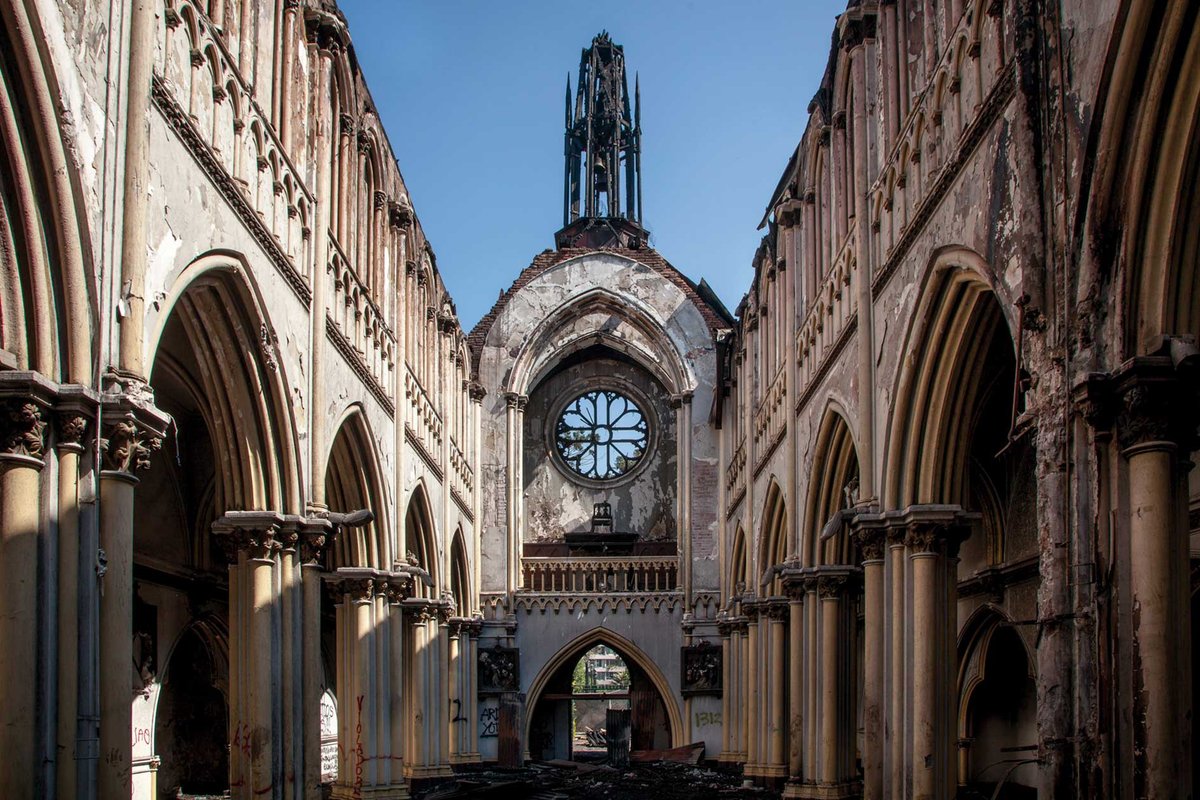
A beloved Catholic church in Santiago, Chile, will become a national shrine to Our Lady of Fátima, giving the historic structure a second life after it was targeted in arson attacks in 2020. A new restoration project costing around $5.4m—funded through donations—will attempt to bring back the grandeur of the building and its badly damaged stained-glass windows, inspired by Sainte-Chapelle in Paris.
The Church of San Francisco de Borja was built between 1872 and 1876, following a design by the British architect Hovender Henry. The church served as the chapel for San Borja Hospital, which was demolished in the 1970s, and managed by the Daughters of Charity of Saint Vincent de Paul. Built in the Neo-Gothic style, the church—then called Sacred Heart of Jesus—featured stained-glass windows and a rose window commissioned from the famed Atelier Dagrant in Bordeaux, France.
The restoration of the church will contribute to the life of the neighbourhoodÁlvaro Chordi Miranda, auxiliary bishop of Santiago
These were the oldest signed stained-glass windows in Chile, the religious artform having arrived in Latin America after the region gained its independence from Spain in the early 19th century. “The emerging countries wanted to project modernity; part of that was modifying cities with new architecture, and that architecture had stained-glass windows,” Andrea Araos, project coordinator at the Latin American Centre for Stained Glass, tells The Art Newspaper.
In 1967, the demolition of the San Borja Hospital and its chapel was announced as part of a redevelopment project in the area. The intervention of the University of Chile’s architecture faculty halted demolition of the church; the building was subsequently handed over to the care of the national police in 1975 and later renamed San Francisco de Borja.
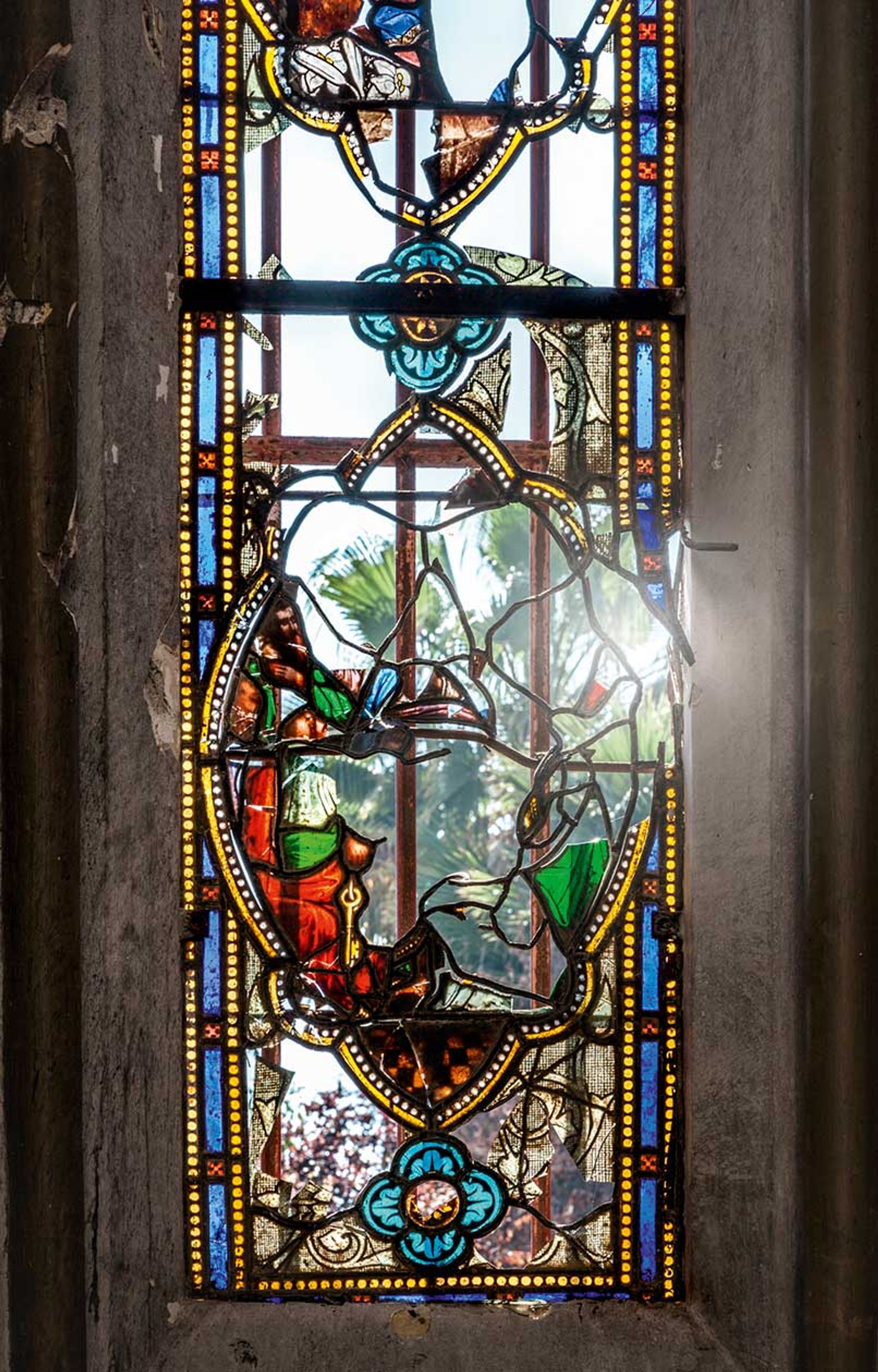
The stained-glass windows, inspired by Sainte-Chapelle in Paris, are in a dire state Photo: Daniella Toledo; courtesy Latin American Centre for Stained Glass
Countrywide protests
The church was used for police officers’ weddings and their children’s baptisms for decades, until social unrest led to a fire damaging the church’s 38 famed stained-glass windows in January 2020. A second protest-related fire in October of that year damaged its roof, altar, apse and nave.
The demonstrations started in October 2019 in response to the spiralling cost of living. Churches were an easy target for rioters, as they would burn immediately; other buildings were more resistant to fire.
With no funds to restore the church, the police handed it over to the Chilean government. It has stood damaged for years. But in May, the Ministry of National Assets granted the Archdiocese of Santiago a free 30-year concession to finally restore it. The archdiocese now plans to transform the church into a shrine to Our Lady of Fátima.
“The restoration of the church will contribute to the life of the neighbourhood, to the community,” Álvaro Chordi Miranda, the auxiliary bishop of Santiago, tells The Art Newspaper. “We mustn’t forget its origins as a hospital church. We saw the option of creating a shrine to Our Lady of Fátima, who is associated with reconciliation and peace. Some people have already donated money upon hearing the news.”
The archdiocese plans to launch an architectural competition later this year for the restoration project for the new National Shrine to Our Lady of Fátima in the Church of San Borja. The shrine will feature an image of Our Lady of Fátima donated to Chile by the Sanctuary of Fátima in Portugal.
“The image travelled throughout the country during the pandemic, visiting homes and parishes with a very good reception,” says Carlos Maillet Aránguiz, the director of the architecture competition and an adviser to the Archdiocese of Santiago. “As a result, it will reside permanently in Chile.”
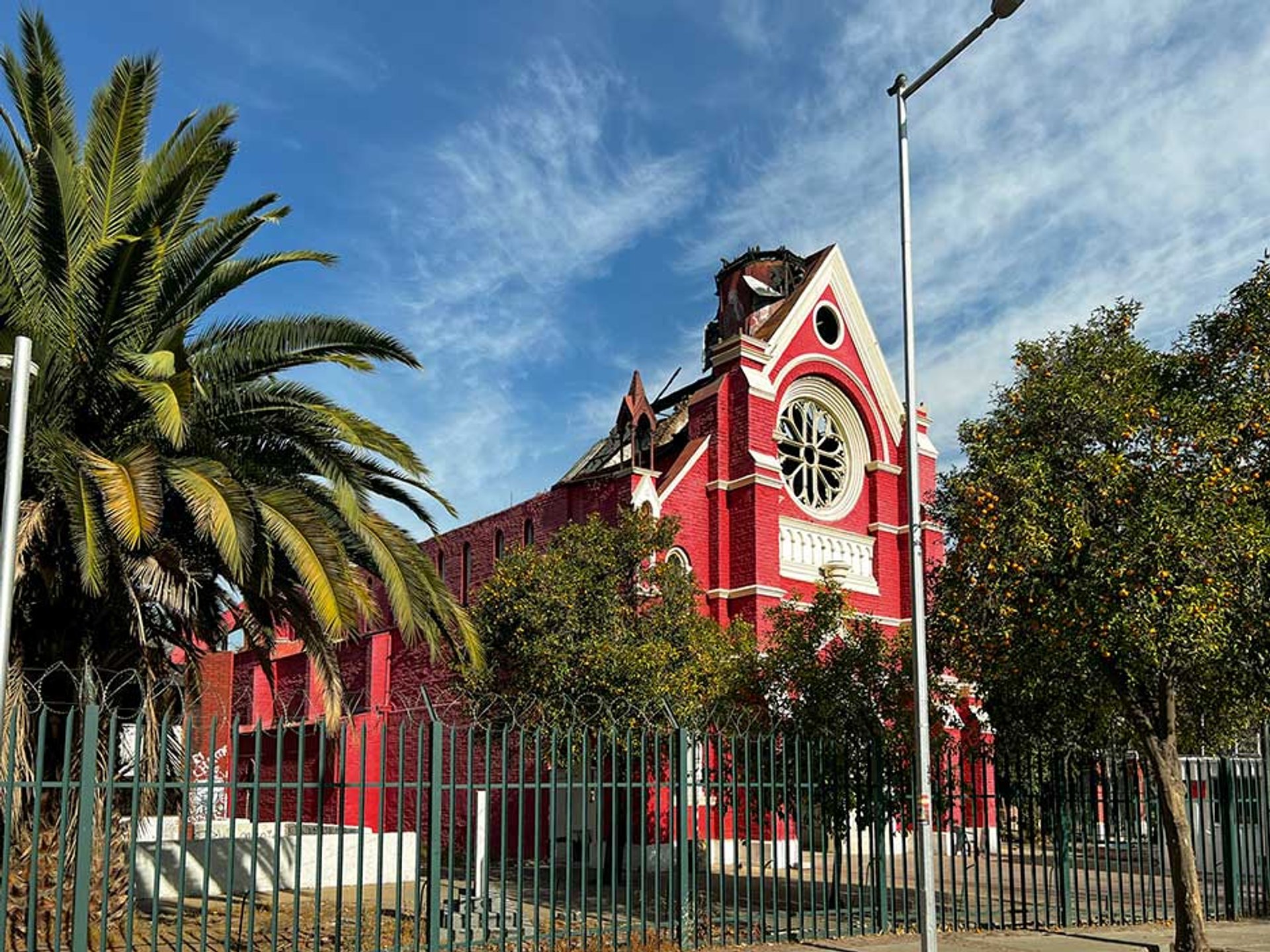
The church as it stands today Photo: Graciela Ibáñez
Unesco-aligned project
It is not yet known how the church’s historic stained-glass windows will be replaced. Maillet would like to restore what has been salvaged and reinterpret what is missing, while Araos says it’s impossible to restore what was there and sees the damage is irreparable.
The church was built using brick masonry, and “it also has some iron bars, which is why the walls held up well during the attacks”, Maillet says. “It’s what’s known as reinforced masonry.”
The restoration project, which covers an area of about 2,500 sq. m, is aligned with Unesco’s guidelines for the protection of cultural heritage. It follows the conservation of two nearby 19th-century churches that were also targeted by arson attacks, in 2019 and 2020. The first to reopen was the Church of the
Veracruz, built in the 1850s. Its 1879 neighbour, the Church of the Assumption, reopened in May 2025.
“The fact that we’re open gives the neighbours the feeling that everything is alright,” says Ana Bermúdez, who works at the Church of the Assumption. “People don’t just come to pray. The senior citizens’ club meets here, and we have workshops and other activities. For the neighbourhood, being open is like a light that’s on.”
The Church of San Francisco de Borja also has a close relationship with its neighbourhood. “They are a community that wants to reclaim the church for religious purposes,” Maillet says. “The neighbours and their families have been connected to this space their entire lives. And the police looked after the church for many years, so they are also part of the community.”