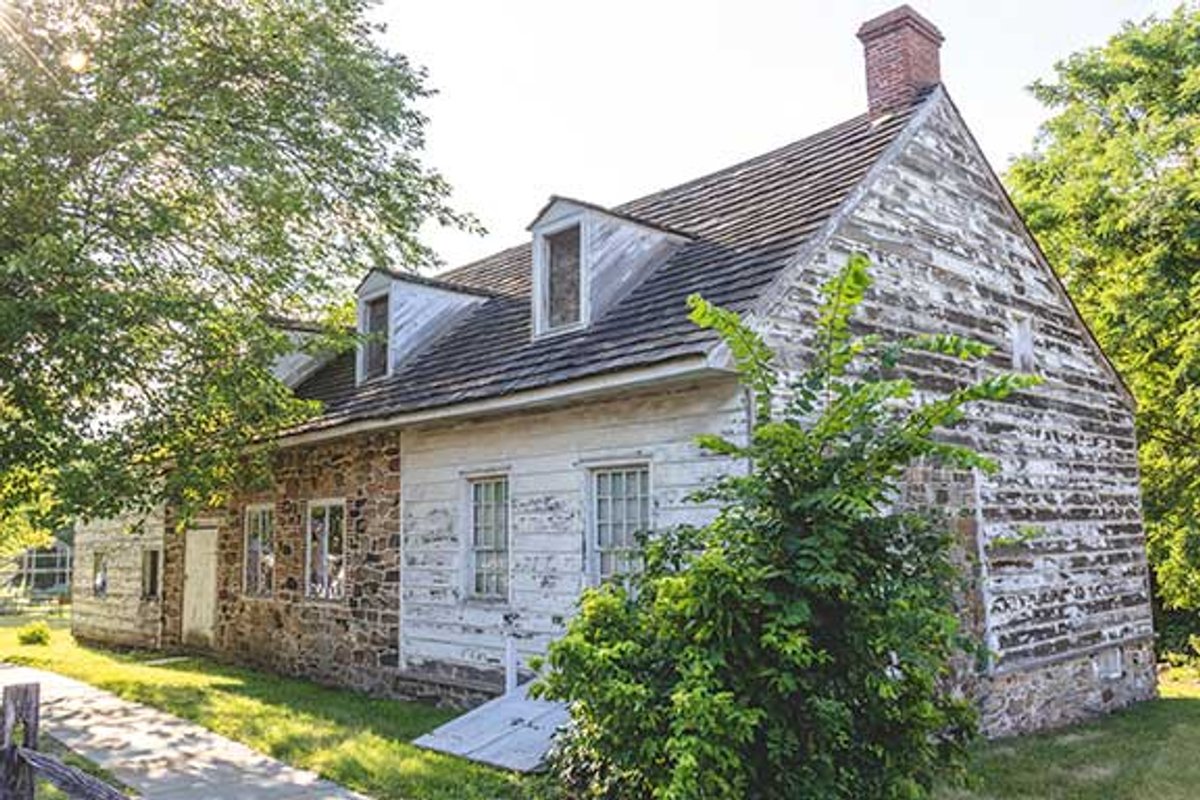
The centuries of change witnessed by Staten Island’s Britton Cottage are visible in the strata of materials that make up the over 350-year-old house. At the centre is a fieldstone structure dating to 1670 and the early days of New York City’s colonisation. Flanking it are mid-18th-century wood-frame additions with weathered clapboard. Most significant in its years of transformation is its location. Once it was in the waterfront neighbourhood of New Dorp Beach; since 1965, it has been preserved at Historic Richmond Town. The planned construction of a parkway, under the infamous urban planner Robert Moses, had threatened it with demolition.
“Richmond Town, who had stewardship of the house at the time, had to scramble to dismantle parts of it that couldn’t be moved whole and move the frame parts that could be,” says Russell Powell, a restoration carpenter who has been working with Richmond Town since the 1980s.
The cottage is one of around 30 historic buildings that are part of the museum complex, all but ten of which were relocated there to protect them from being lost to development or deterioration. With the support of more than $2.1m in funding announced in September 2025 through the New York City Council, Britton Cottage is now undergoing a major restoration to open to the public for the first time since 1967. It gets its name from its most famous owner, Nathaniel Lord Britton who, with his wife, fellow botanist Elizabeth, co-founded the New York Botanical Garden (NYBG) in the Bronx.
One of the earliest people associated with the cottage is Obadiah Holmes, a judicial clerk when the area was under British control. His connection has led to speculation that its stone section is one of New York’s oldest surviving public buildings. It passed through different hands over the years, with Britton inheriting it from his mother in 1894. Some of his early botanical fieldwork was on Staten Island. He later served as the NYBG’s first director and authored the encyclopaedic Illustrated Flora of the Northern United States and Canada (1896-98).
“We’re taking a holistic approach to restoration that respects that these buildings are texts that have been added to over the history of residence and construction,” says Corbet Walser, a buildings restoration and preservation officer at Historic Richmond Town. He adds that the museum is now studying archival materials and physical evidence to assess the next steps in revitalising the house. “We’re taking what’s there, and where things are missing we’re trying to extrapolate what would have been there by using this information and additional research.”
Once the Britton Cottage is open to the public, there are plans for exhibitions on botany, complementing the adjacent Britton’s Meadow of native flora that hosts educational programmes on ecology. Staff are also considering how it can be part of next year’s bicentennial of the abolition of slavery in New York in 1827, as Isaac Cubberly, one of the home’s 18th-century owners, was an enslaver.
“Looking at that history and making sure all of the people who lived in the houses that are on our site are included in our retelling of their history is important to us,” says the curator Gabriella Leone. “There are so many threads we can weave through, the possibilities are really endless.”