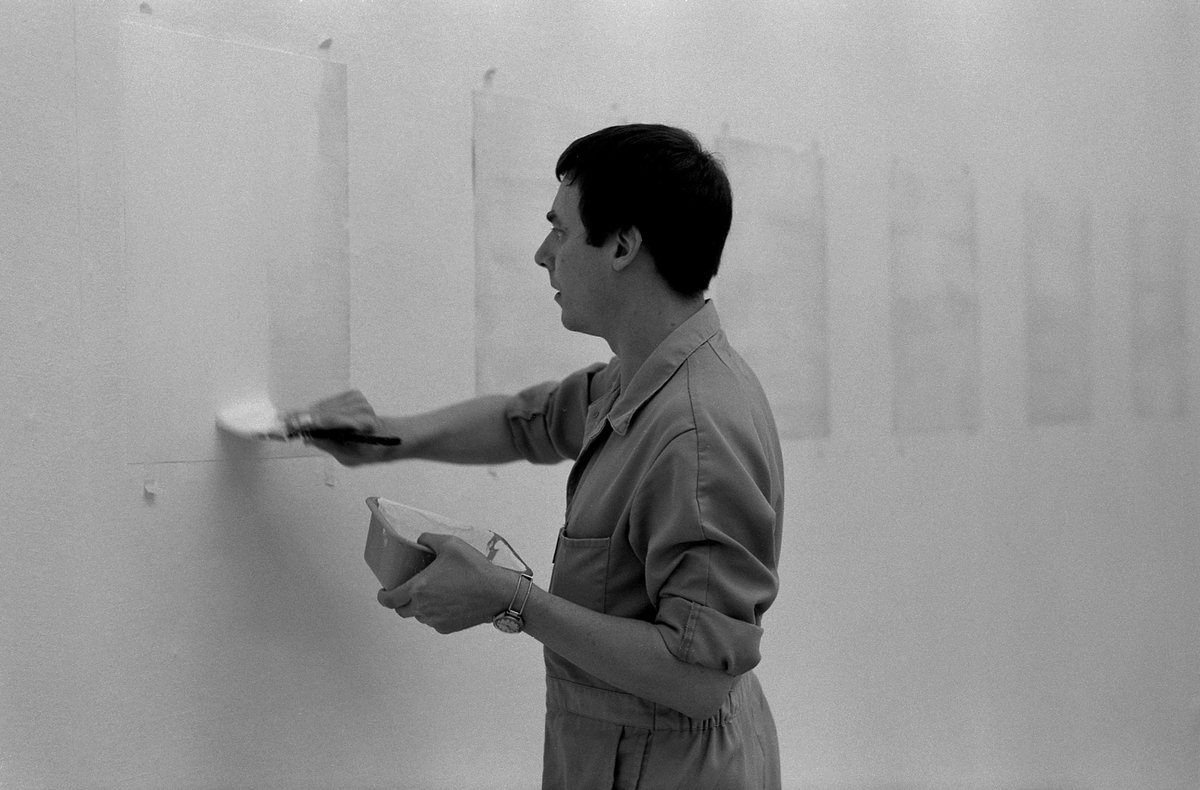
Known for his austere white canvases, Robert Ryman (1930-2019) spent his career testing the limits of what the discipline of painting could be. More than 30 years after his last major UK exhibition, the late American artist is the subject of Robert Ryman: The Real Thing at the Barbican. Bringing together works made from the mid-1950s through to the early 2010s, the show aims to introduce Ryman to a new generation of British audiences, while challenging the perception of an artist whose practice has often been reduced to the shorthand of “white paintings”.
“For the past decade, painting has been a prominent strand of the Barbican’s programme,” says the exhibition’s curator Wells Fray-Smith. Ryman, she adds, is “one of the most beloved painters of the 20th and 21st centuries”, yet opportunities to see his work in Britain have been scarce.
Born in Nashville, Tennessee in 1930, Ryman moved to New York in the early 1950s intending to pursue music as a jazz saxophonist. While in the city, he worked for years as a guard at the Museum of Modern Art (MoMA) and taught himself to paint. Ryman’s eventual practice departed from conventional ideas of what a painting should do. Rather than depicting an image or conveying a narrative, he became interested in the conditions of the work itself: pigment, surface, scale, light and space.
Anything but simple, Ryman’s art asks us to slow down and look carefully
‘Rhythm and possibility’
White was his dominant colour, allowing its relative neutrality to make these other elements more apparent. “The ‘seeming simplicity’ of a Ryman painting belies a vast complexity of expression, emotion, rhythm and possibility, for creating a work that appears simple is one of the most difficult artistic feats,” says Susan Dunne, a senior director at David Zwirner, which represents Ryman’s estate. “To Ryman, a painting’s presentation, its relationship to the wall and space that it occupies, is integral to the work itself. Anything but simple, Ryman’s art asks us to slow down and look carefully.”
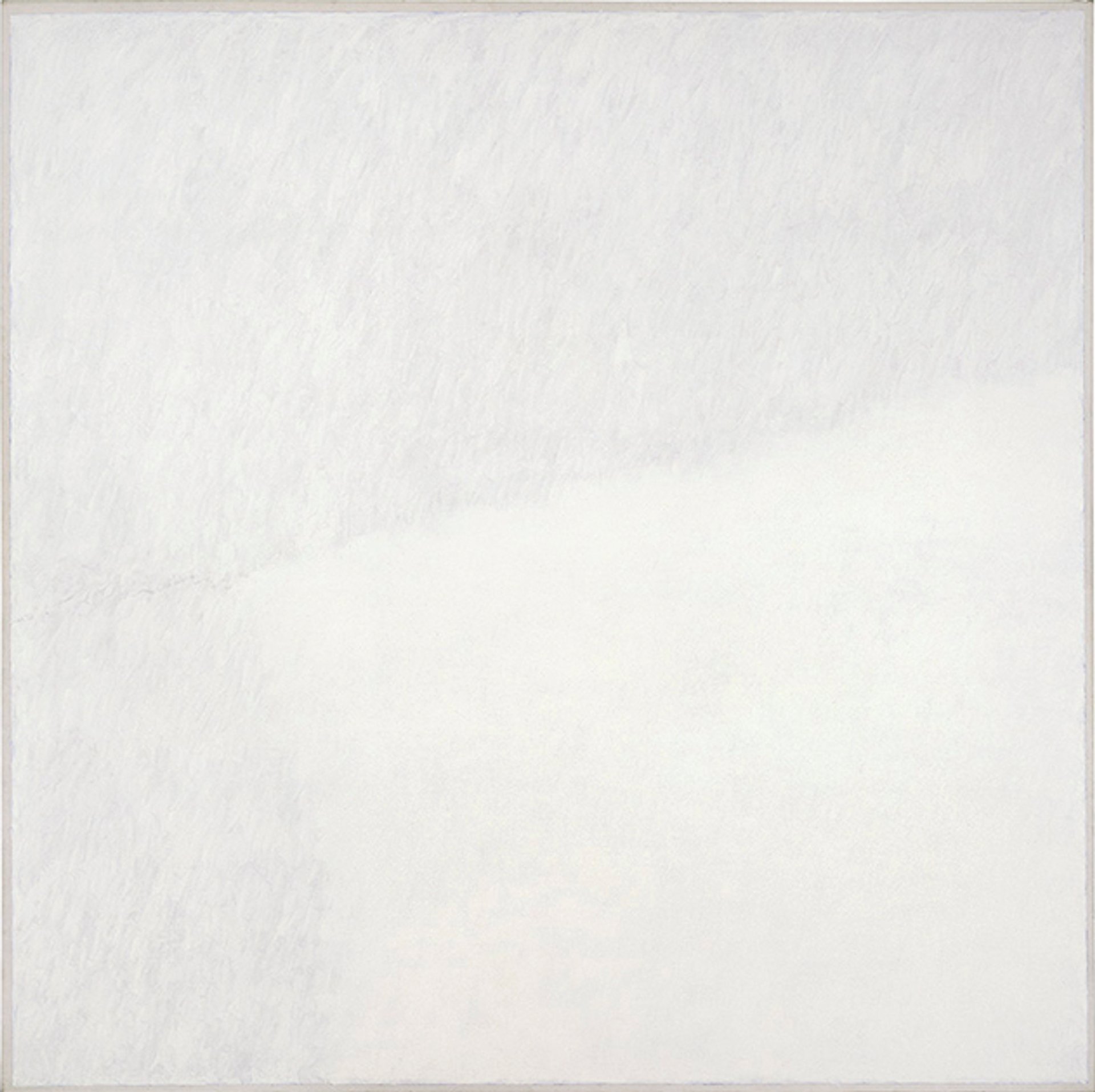
Robert Ryman’s 12ft by 12ft Surface Veil II (around 1970) rarely travels due to its size Photo: David Heald; © 2026 Robert Ryman/DACS, London
Among the exhibition’s highlights is Untitled (Orange Painting) (1955 and 1959), which he began while working at MoMA. “Ryman considered this to be his first-ever ‘professional’ painting,” Fray-Smith says. “The piece is flaming orange with an acid-green underpainting and very surprising. Ryman often excluded the work from his own exhibitions because he found the colour ‘shocking.’”
The piece, however, proved significant to the artist. “I’ve always thought that if I ever wanted to paint a white painting it would be in the order of the way this painting was done, because this is an orange painting but there are many nuances and many oranges (and black and green),” Ryman once said about the work.
Another highlight is Surface Veil II (around 1970), a 12ft by 12ft work that rarely travels due to its size. The work was so large that Ryman laid it unstretched on the floor, drawing a square in blue chalk to paint within. When the canvas was subsequently stretched, the bars extended beyond the chalk line, leaving a narrow margin of unpainted material.
Beyond the monochrome
In curating the show, Fray-Smith wanted to challenge the perception of Ryman as austere or monochromatic. The exhibition also features pieces that incorporate additional materials and supports, including works on canvas, wallpaper, aluminium, Plexiglas and copper, as well as paintings from a more experimental period in the 1960s in which colour plays a role.
The installation will reinforce Ryman’s insistence on direct experience and sustained looking. In one section, the works are shown without wall texts or interpretation, with contextual information instead provided in a handout. “The gift of Ryman’s work is that it asks for us to pay attention,” Fray-Smith says. “While text and interpretation are important in introducing our audiences to Ryman and giving useful context to the work, it engages a cognitive ‘thinky’ brain that Ryman did not think was wholly necessary to have a meaningful experience with painting.” By removing these didactics, the museum hopes to inspire closer inspection of the works and their surroundings, allowing visitors to focus less on what something might mean.
To this end, Fray-Smith hopes visitors will leave with “a fresh sense of Ryman and his work”—and, crucially, with greater confidence in their own responses to art. Ryman’s achievement was not simply to make paintings with less; it was to make the act of looking itself part of the subject.
• Robert Ryman: The Real Thing, Barbican Art Gallery, London, until 28 February 2027