

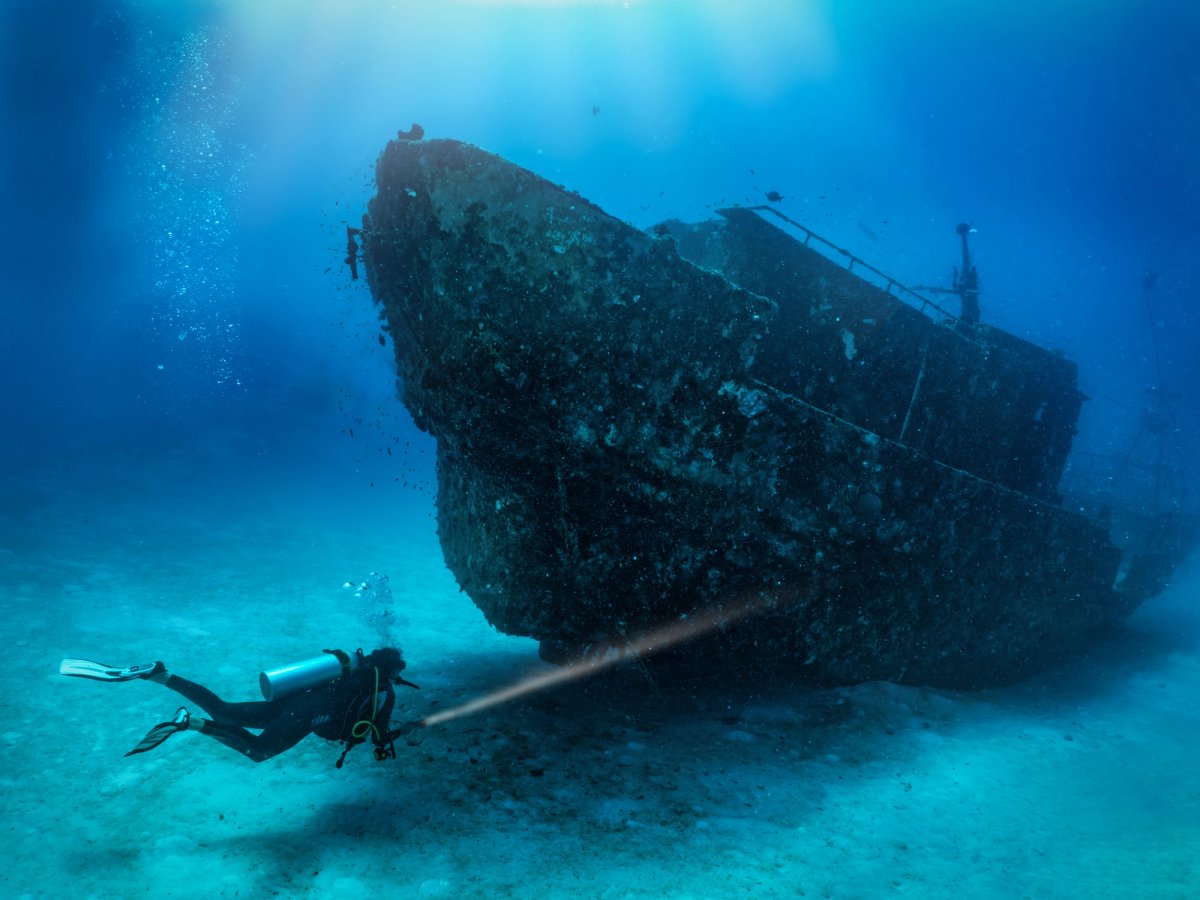
In 2011, the E/V Nautilus expedition discovered an ancient merchant ship at the bottom of the Black Sea, west of Ereğli, Turkey. Sunk more than 2,000 years ago, it might have been in better condition if bottom-trawling fishing boats had not repeatedly scraped their nets along the seafloor, right through the site. In their wake, the ship’s ancient amphorae lay damaged and the hull timbers had been dragged from where they lay. Unfortunately, this is not an isolated incident.
In a recent study, Rory Quinn of Ulster University, Northern Ireland, and colleagues compiled data on known shipwrecks—some 150,000 records—and the movements of fishing vessels to reveal which underwater heritage sites are most at risk globally from deep-sea mining and trawling. Writing in The International Journal of Nautical Archaeology, the team note that few shipwrecks lie in zones that could soon be exploited for deep-sea mineral mining—an industry in its early stages—but also that only 0.2% of wrecks worldwide lie in areas classified as fully protected, where mining would be prohibited.
More alarmingly, 95% of wrecks are found in shallower waters, without protection, where bottom-trawling nets can scour sites, both known and unknown. Although the vast majority of trawling occurs away from wrecks, the danger remains. One way to combat the threat, the researchers write, is to make fishing crews’ existing informal behaviour of avoiding shipwrecks—which can damage their equipment—a legal requirement.
Good luck with that. Underwater cultural heritage has long been a weak spot in heritage legislation. While Unesco’s 2001 Convention on the Protection of the Underwater Cultural Heritage binds parties to not disturb or damage submerged heritage, key states—including China, the UK and the US—have not ratified it. Some have chosen to adopt their own legislation instead, but this leaves the high seas vulnerable. Meanwhile, the 1982 UN Convention on the Law of the Sea barely mentions archaeology.
It’s enough to make you wish for the release of a culture-conscious kraken. After all, a wealth of understudied heritage lies beneath the waves, from shipwrecks, harbours and sculptures, to trade goods, ceremonial sites and sunken cities. Each is a tale waiting to be told. And it is not just fishing and mining—there is also pollution of various kinds (some underwater sites are so blanketed in garbage they have become difficult to survey and monitor), treasure hunting and uncontrolled tourism.
Acidification surge
And that’s before we mention climate change. Writing in the journal Communications Earth & Environment, Luigi Germinario of the University of Padua, Italy, and colleagues have recently researched how increasing ocean acidity impacts ancient stone. They found that with rising carbon dioxide emissions, there could be an “exponential surge” in the coming decades, causing irreplaceable ancient remains to effectively dissolve.
The team subjected a digital recreation of a marble sculpture (found underwater at the sunken Roman city of Baiae) to three different computer-
simulated scenarios. Each reflected how different ocean acidity levels would affect the submerged object over the course of 500 years. At pre-industrial
levels of acidity, the statue’s surface remained virtually unchanged. At the acidity levels predicted by the end of this century, the statue lost more than 1mm of its surface, its finer details removed. At the most extreme level tested, more than 1cm of surface vanished, leaving the statue heavily eroded. Exposed to these same extreme acidity levels, less durable stones, such as porous limestone, could suffer “catastrophic erosion” over the course of a century—an outcome that under current conditions would take thousands of years.
On top of all this, creating detailed 3D records of heritage sites at sea requires scarce and complex equipment, often available only in prototype. Luckily, this may be about to change. Investigating a partially buried wreck in the Baltic, Dennis Wilken of Kiel University, Germany, and colleagues found a way to make high-resolution 3D scans of its features quickly and cheaply. Their test, described in the journal Archaeological Prospection, covered two hectares in just two hours with adapted equipment that research vessels already usually carry on board. For experts wanting to discover or monitor archaeological sites beneath the seafloor, it could be a game-changer. And with underwater heritage facing an uncertain future, innovations like this will be needed to turn the tide.
