

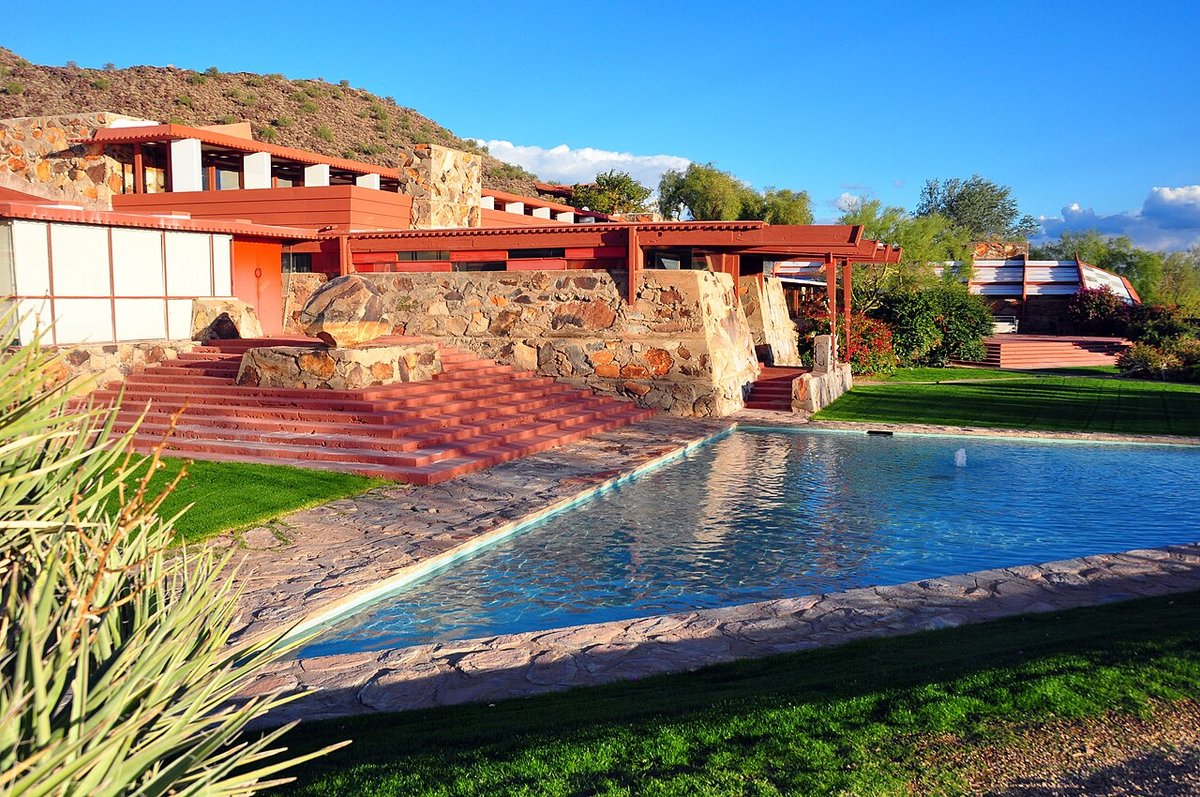
Taliesin West in Scottsdale, Arizona—Frank Lloyd Wright’s former home in the Sonoran Desert—closed to the public last week following the death of a visitor, who was struck by part of a roof that had dislodged from a building on the property.
The Scottsdale Fire Department revealed that a Brazilian national, Rogério Renato Mateucci, had been struck by an acrylic fragment during a walking tour on the afternoon of 16 October, during which wind gusts had reached 32mph. Mateucci, who was pronounced dead at the scene, was the rector of the Pontifical Catholic University of Paraná in Brazil. He had travelled to the US to participate in an event at Arizona State University.
One of Mateucci’s colleagues, Vidal Martins—who was not present on the tour but later saw Mateucci’s body at the scene—provided a photo to The Arizona Republic that showed a curved, translucent roof panel lying on the rocks of the property. He believes this was the object that struck Mateucci. Martins also questioned how the roofing had been attached and urged for security measures to be taken.
A former Taliesin West employee, who spoke to the local news on condition of anonymity, said he had witnessed two other objects breaking loose from the roof. Over the summer, the anonymous source had recorded a video of a similar panel coming partially loose during a monsoon. “I don’t think that there is money being funnelled into the proper channels to ensure that the building is safe,” he said.
Police are investigating the death as a weather-related accident. The Frank Lloyd Wright Foundation (FLWF), which manages the site, says it will not release further details out of respect for the deceased’s privacy and to allow authorities to complete their investigation. The site will remain closed until further notice.
“The foundation extends its deepest condolences to the family and loved ones of the individual who died following an accident at Taliesin West,” Joe Spector, the chief executive of the FLWF, said in a statement. The foundation did not comment when asked about reopening the site or any safety measures it plans to take before it does.
Taliesin West, a Unesco World Heritage Site and National Historic Landmark, was established in 1937 as Wright’s winter home and studio. It also served as an architecture school. The sprawling 491-acre site in the foothills of the McDowell Mountains features a series of structures built with local stone, desert sand and concrete. The complex is known as an emblematic example of Wright’s concept of “organic architecture”, the harmonisation of architecture with the landscape. Shortly after Wright’s death in 1959, Taliesin West became the headquarters of the FLWF and began offering guided tours.

The original roofs at Taliesin West were made from canvas stretched across wooden beams. The translucent and lightweight material could be opened or closed to regulate airflow and temperature, and was removed and stored when Wright and his students left the site during the summer. In the late 1950s, when Taliesin West was gradually adapted for year-round use, the canvas roofs were replaced with fibreglass panels, and later with insulated acrylic panels.
Earlier this year, the director of preservation of the FLWF, Rebecca Barron, said in an interview that an energy audit in 2011 had found that the acrylic roofs were not energy efficient. Over the past decade, the foundation has been developing a plan to replace the acrylic panels—which were “nearing the end of their serviceable life”, Barron said—with modern fabric roofs that could both withstand the desert climate and honour Wright’s original vision.
