Italy’s parliament is considering legislation that would, for the first time, establish a formal process for restituting art and cultural property seized by the Nazis and Italian authorities from victims of racial persecution during the Holocaust era.
Introduced by a lawmaker from Brothers of Italy, the party led by the country’s prime minister Giorgia Meloni, the proposal has been hailed by as “an act of civilisation” by representatives of heirs of those whose property was stolen, and would bring Italy in line with Germany, Austria, France, the Netherlands, the UK and Switzerland, the latest European country to establish its own restitution mechanisms.
The bill grants the government powers to establish a five-member committee to examine the provenance of works that were confiscated, looted or sold under duress as a result of racial persecution between 1933 and 1945. The committee would assess individual cases and issue decisions on restitution to the original owners, their heirs or—if no living heirs are identified—the broader Jewish community in Italy.
If enacted, the bill, which is currently being examined by the lower house’s culture committee, would give the government six months to establish the restitution system.
“Introducing this bill does not merely mean finally bringing Italy into line with the highest international standards... but means, first and foremost, fulfilling a historic duty,” Federico Mollicone, a key Meloni ally who introduced the bill in March, tells The Art Newspaper.
“We are not merely talking about property claims, but about restoring human dignity, memory and the fundamental principles of our constitution,” says Mollicone, who is the president of the culture commission in Italy’s lower house of parliament.
Seized works in state museums
State-sponsored looting, confiscation and forced sale of Jewish-owned art and cultural heritage became increasingly commonplace following the fascist dictator Benito Mussolini’s 1938 introduction of racial laws that prohibited Jewish books, excluded Jews from public office and introduced limits on Jewish property ownership. The dispossessions increased from 1943, when Italian and occupying German Nazi forces began arresting and deporting Jews to concentration camps.
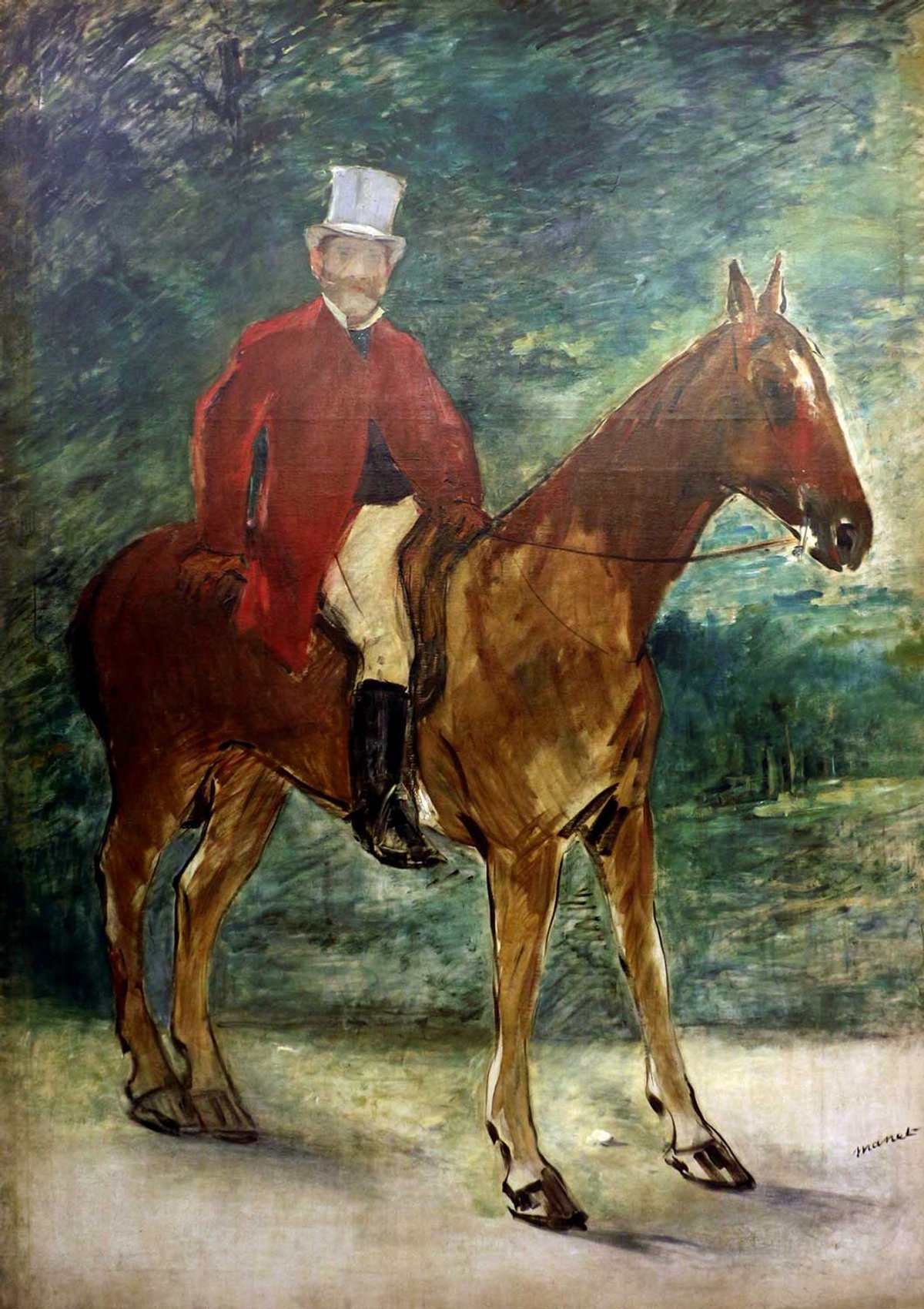
Some of the seized works subsequently entered the collections of Italian museums, where four publicly known disputed works are currently displayed, according to Katharina Hüls-Valenti, an expert in provenance research at Parma University. They include Edouard Manet’s Portrait de M. Arnaud à cheval (1875), which Hüls-Valenti says was sold under duress in 1935 by its owners, the family of German painter Max Liebermann, and donated to the Galleria d’Arte Moderna in Milan in 1958. Hüls-Valenti says that Liebermann’s heirs had sought restitution but had encountered resistance from the museum.
Asked to respond to those allegations, Paola Zatti, a curator at the Galleria d’Arte Moderna, said in a statement to The Art Newspaper: “The painting was sold by Liebermann’s wife in 1935 (incidentally, to a Jewish antiques dealer), but there is no evidence that she was forced to do so.”
Zatti added that, in accord with a lawyer representing Liebermann’s heirs in Germany, the museum had agreed to display a label explaining the work’s ownership history. The text, Zatti said, “clearly highlights the tragic moment when the work was sold by its Jewish owners” and helps visitors appreciate the “circumstances under which [the work] left Germany”.
Another painting, Cristo portacroce (around 1508-09) by Girolamo da Romano, was requisitioned by France’s pro-Nazi Vichy government in 1941 from the family of Federico Gentili di Giuseppe, an Italian Jewish businessman and art collector living in Paris. It was auctioned to a private collector and then bought by Milan’s Pinacoteca di Brera museum in 1998. Following a request by the heirs, US authorities seized the work while it was on loan to a Florida museum in 2011.
The real number of Holocaust-era seizures currently held by museums, Hüls-Valenti suggests, could be closer to dozens. “We really don’t know for sure,” she says. “Better research is required.”
Italy endorsed the 1998 Washington Principles, which established guidelines for the restitution of Nazi-looted art. A 2001 enquiry led by Tina Anselmi, a former Italian government minister, found evidence of systematic expropriation from Jews. It found evidence of 7,847 seizure warrants issued up to April 1945 for property including houses and land, businesses, bank deposits, insurance policies, jewellery, paintings and furniture.
Despite the report’s findings, Italy, a global leader in securing the restitution of its own national heritage, has been slower than other European countries to seek justice for dispossessed Jews. France created a commission for restitutions and compensation in 1999. The UK established the Spoliation Advisory Panel in 2000 to evaluate claims to works held by British national institutions.
Delay due to several factors
“Italy is obviously a central country in the world of art... and yet on this issue of the Holocaust restitution it had barely scratched the surface in addressing it,” says Gideon Taylor, the president of World Jewish Restitution Organisation (WJRO).
Experts point to various reasons for the delay in Italy’s response, including a national reluctance to confront the country’s fascist past, insufficient political will to prioritise the restitution of Jewish-owned cultural heritage, and a lack of transparency about provenance in museums. They say poor cataloguing has contributed to an assumption that few works would be affected by a law.
Complicating matters, Italian law recognises works held in Italian museums as inalienable parts of the national heritage. The bill addresses this hurdle by indicating that the final restitution decision would automatically remove the work from the public domain. Further, restituted works would no longer be subject to the protections of Italy’s heritage code, meaning they could permanently leave the country. The bill also indicates that existing statutes of limitations would not prevent restitutions.
The commission would accept claims from legitimate owners, their descendants or heirs, and the Union of Italian Jewish Communities (UCEI) or individual Jewish communities. It would include a member nominated by Italy’s art police and have to rule within 180 days of a claim. The bill is intended to help heirs seeking restitution from both public and private collections.
Italy’s parliament adopted the bill following the submission of a report evaluating the country’s restitutions record commissioned by the WJRO and written by the lawyer Lorenzo Casini, a former chief of staff at the culture ministry who now heads a public research institution in Lucca. It was written with the support of six leading experts, including Hüls-Valenti, the Parma professor.
“Museums don’t necessarily hide their works, but there isn’t full understanding of just how important transparency is and how helpful it would be for all these works to come to light,” Casini says. “Besides addressing the tragic wounds left by looting and filling the legislative gap in Italy, the law is specifically designed to bring those artworks to light.”
Speaking to parliament’s culture commission in June, Casini praised the bill but suggested areas for improvement, proposing widening the commission’s remit from art to other cultural heritage—including manuscripts, books, archives and ceremonial objects—and advising that the commission and researchers would require additional funds to carry out their work.
“The next step could hopefully be to seek funding once the law has been passed,” Casini tells The Art Newspaper.
Federico Mollicone says lawmakers will “ensure” the culture ministry’s upcoming funding plans include “adequate resources to support research projects on provenance, the digitisation of archives, and the training of dedicated experts”. He highlights culture minister Alessandro Giuli’s “strong commitment to this issue”.
He also predicts the bill will have a smooth passage into law, noting that there is “wide political consensus” on redressing injustices from racial persecution. Brothers of Italy has roots in the post-fascist parties that rose from the ashes of the Second World War.
“Our goal is to complete the parliamentary review and pass the bill in the coming months,” Mollicone says. “We want to bring this historic reform to a successful conclusion within this legislative session.” A general election is due to take place before the end of next year, with analysts suggesting it may be brought forward to the spring.
Paolo Gnignati, UCEI’s head of legal affairs, says the bill’s arrival in parliament is significant. “The regulations on restitution are something that can be meaningful to specific individuals because they have financial and personal implications,” he says. “But they are also, fundamentally, an act of civilisation.”