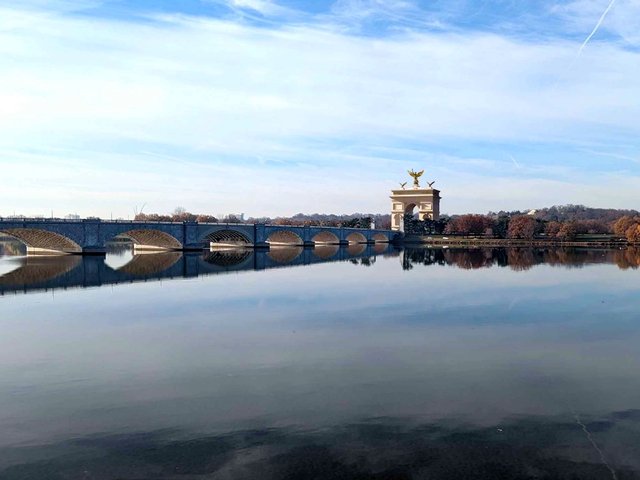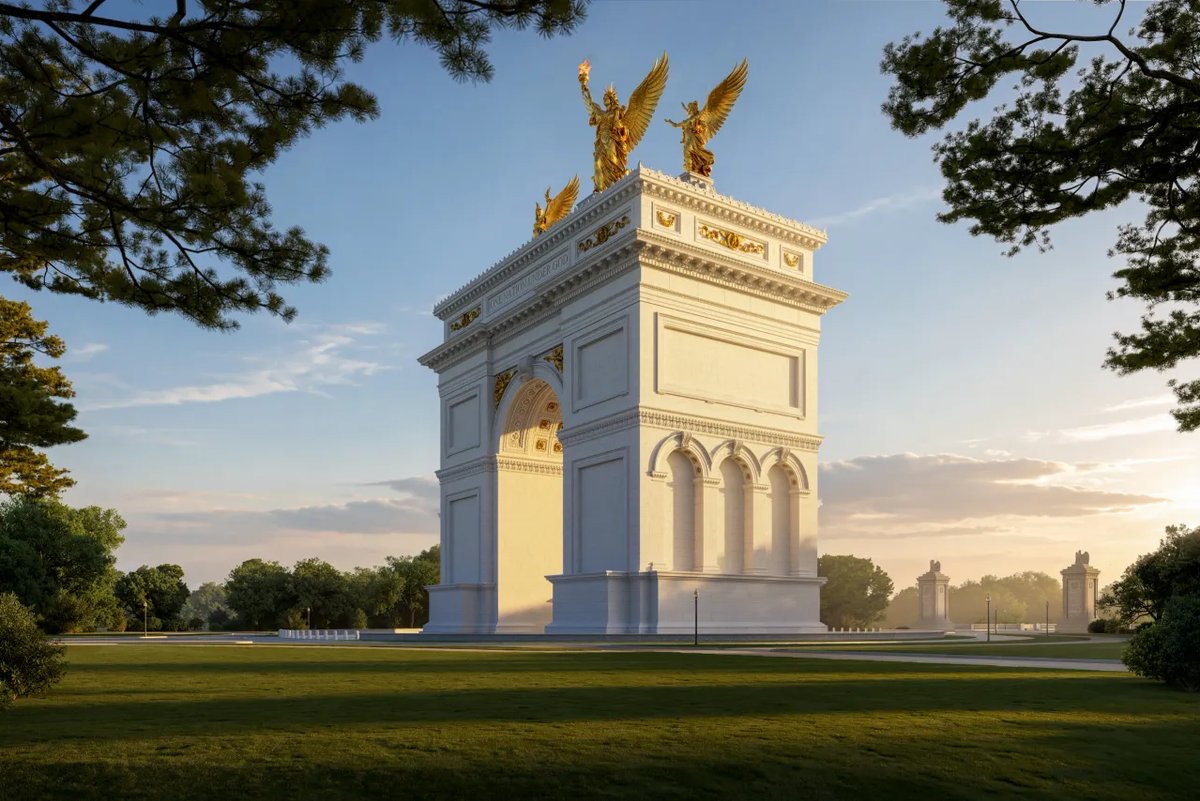
Moments after the National Capital Planning Commission (NCPC)—a review panel stacked with Trump administration appointees—approved plans for a Triumphal Arch at Memorial Circle in Washington, DC, on Thursday night (5 November), a federal judge blocked construction on the project for 14 days.
The move obstructs the government’s stated aim of starting work on one of US president Donald Trump’s pet building projects immediately, despite lawsuits and public protests, and allows a court case brought by a Vietnam War veteran and the attorneys general of Washington, DC, and Virginia to continue.
In her 33-page decision, Judge Tanya S. Chutkan outlined the government’s shifting justifications for building the arch, which have included a desire to celebrate the 250th anniversary of the signing of the Declaration of Independence, a more than century-old congressional act to commemorate the end of the Civil War, and even supposed national security concerns. “These arguments are unavailing,” she wrote.
She also found that “harm is certain” to be inflicted on both Washington, DC, and Virginia if construction on the arch is allowed to go ahead, as it would interrupt traffic at a vital artery into the capital for years and result in unknown damage and expense.
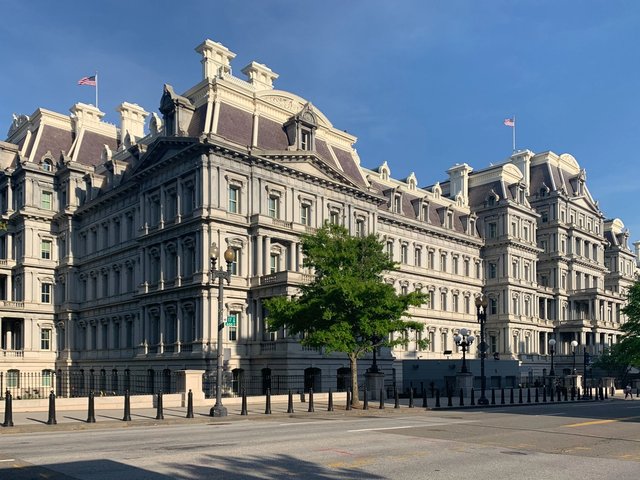
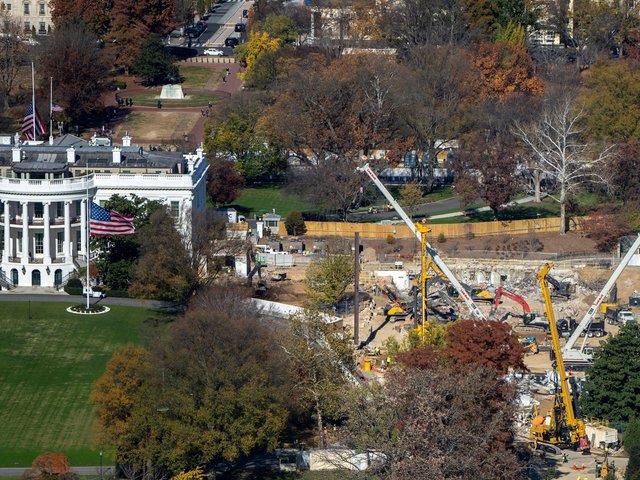
Trump has pushed to fast-track the project, so that it could be mostly completed before he leaves office in 2028. His efforts to leave his mark on the capital include the bulldozing of the historic East Wing of the White House to make room for a 1,000-seat ballroom, a slapdash relining of the Reflecting Pool on the National Mall, and plans to paint the Eisenhower Executive Office Building white.
In another move to secure his design legacy, Trump signed an order on Thursday that aims to make the Oval Office—which he has decorated with gilded adornments—into a national monument. “It will not be allowed to be touched by anybody, destroyed, ripped down by stupid people in order to build something in a slightly different shape," Trump told reporters without a trace of irony. Presidents can create national monuments, based on the 1906 Antiquities Act, but this refers to federal lands set aside for preservation.
Trump’s grand plans have so far been helped by the fact that the committees overseeing preservation and design review for the capital are packed with appointees loyal to the president. This was most evident in Thursday’s meeting of the NCPC, where chairman Mark Paoletta—who also serves as general counsel of the Office of Management and Budget and deputy director of the Consumer Financial Protection Bureau—continually presented the government’s legal arguments in favour of building the arch.
When a smaller contingent of non-administration commissioners, led by DC city council chair Phil Mendelson, moved to delay the vote on the arch to December, vice chair Stuart Levenbach—who also works in the Office of Management and Budget as chief statistician—noted that "the project proponent is under a time constraint and wants the decision today".
No explanation was given for what that time constraint involved however. In the end, the NCPC voted along loyalist lines, with the eight administration-appointed members voting to approve the arch plans and four voting against.
The vote came at the end of more than eight hours of public comments from more than 100 speakers, including public officials, veterans and families of fallen soldiers—many of them calling in from an all-day protest taking place at Memorial Circle.
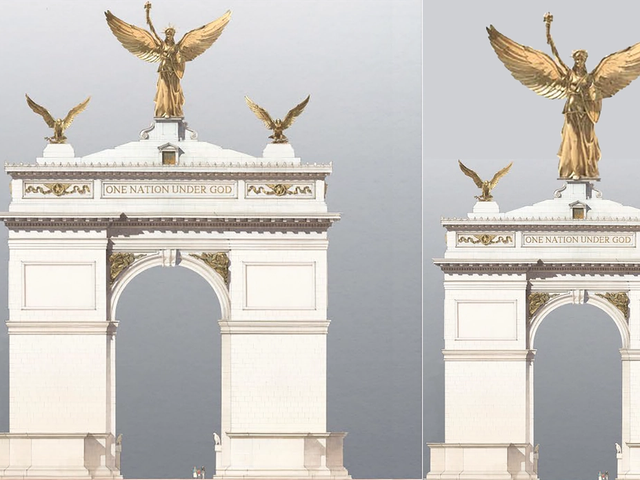
Most of their testimony was excoriating, and many urged the commission not to kowtow to the self-aggrandising whims of the president. Congressman Jared Huffman, the ranking Democrat on the House Natural Resources Committee, said the arch lacks congressional authorisation and goes against the Height of Buildings Act and other preservation laws. He warned that those working to move forward with the arch “will put themselves at legal risk".
"I urge all officials and firms involved with this illegal project to consider the legal hazards they may be facing by advancing it because, in case you hadn't heard, we'll soon have a new congress that takes the rule of law very seriously," said Huffman, referencing the outcome of the recent US midterm elections.