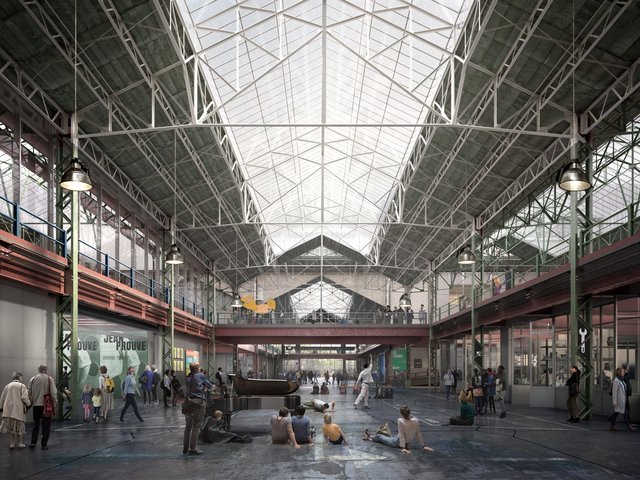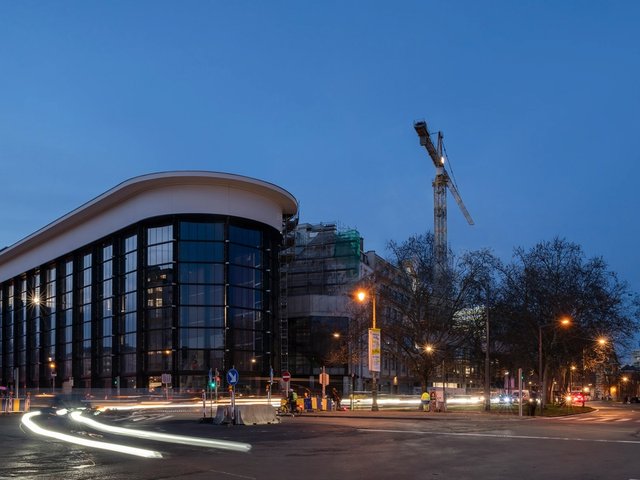
The much-anticipated Kanal, billed in press materials as Europe’s largest museum development, opens tomorrow (28 November) in a former Citroën garage and showroom on the banks of Brussels’s Charleroi–Brussels Canal. The institution aims to establish Brussels as a major international centre for Modern and contemporary art, and also to provide new truly public, inclusive institution for the city’s residents.
The Brussels-Capital Region acquired the site, which dates back to 1934, in 2015 with the intention of creating a major cultural centre. The work was then carried out by an international team featuring noAarchitecten, EM2N and Sergison Bates. The resulting complex spans 40,000 sq. m.
Three new structures, called “houses”, have been inserted into the former garage. Upon entering from the Quai de Willebroeck, visitors find on their left the “Rassembleur”, as the team calls it, which is home to an auditorium and offices. Opposite, on the right, is Kanal Architecture, which is intended to house the CIVA architecture centre and its archives. The transfer of the archives has been delayed following a fire in July. Further along on the right is Kanal-Centre Pompidou, a museum dedicated to modern and contemporary art. This latter space will feature work from the collection of Paris’s Centre Pompidou, with which Kanal signed an agreement in 2017. The agreement, valid until 2031, gives Kanal access to works from the Paris museum's collection, alongside curatorial expertise and support with exhibitions and programming.
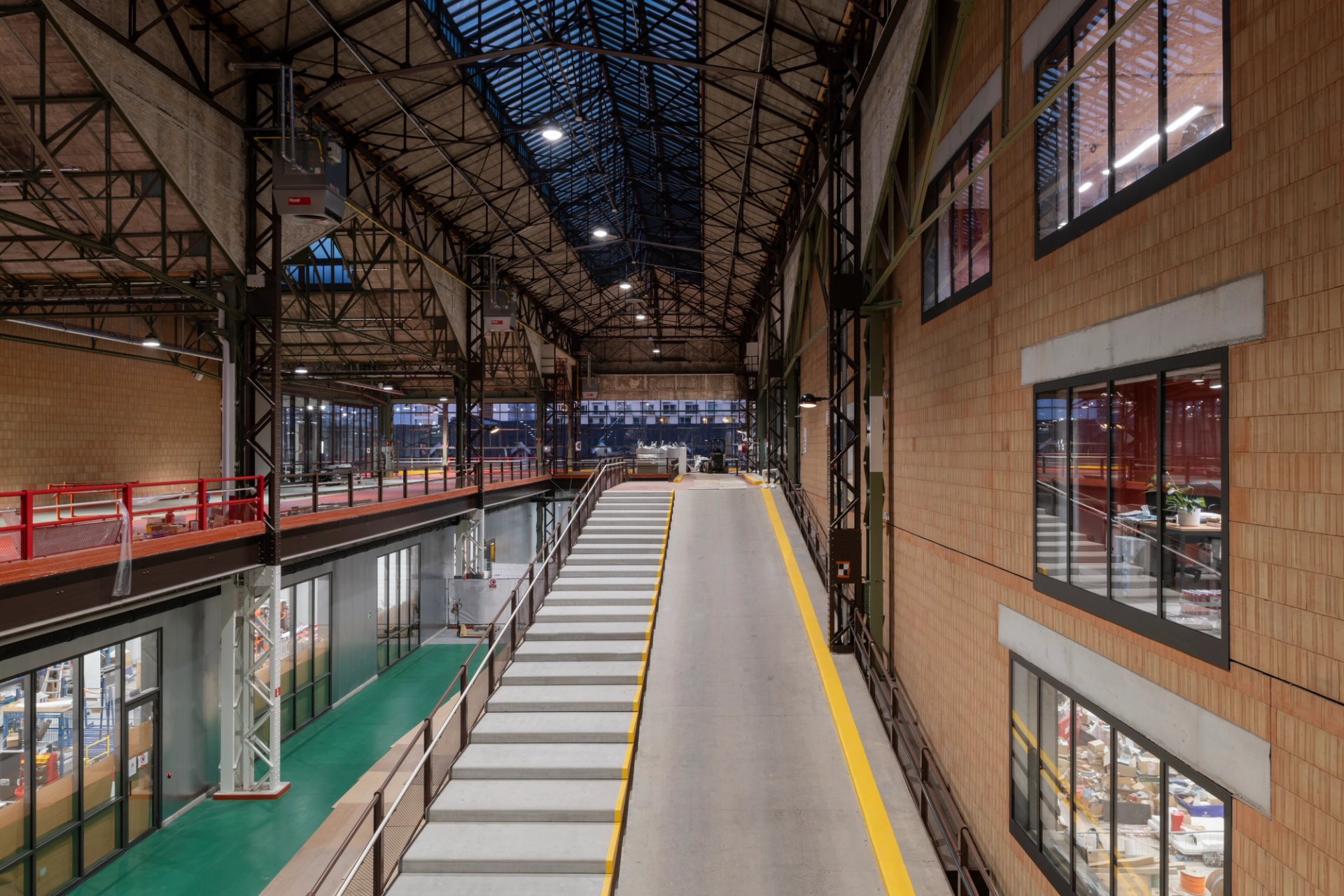
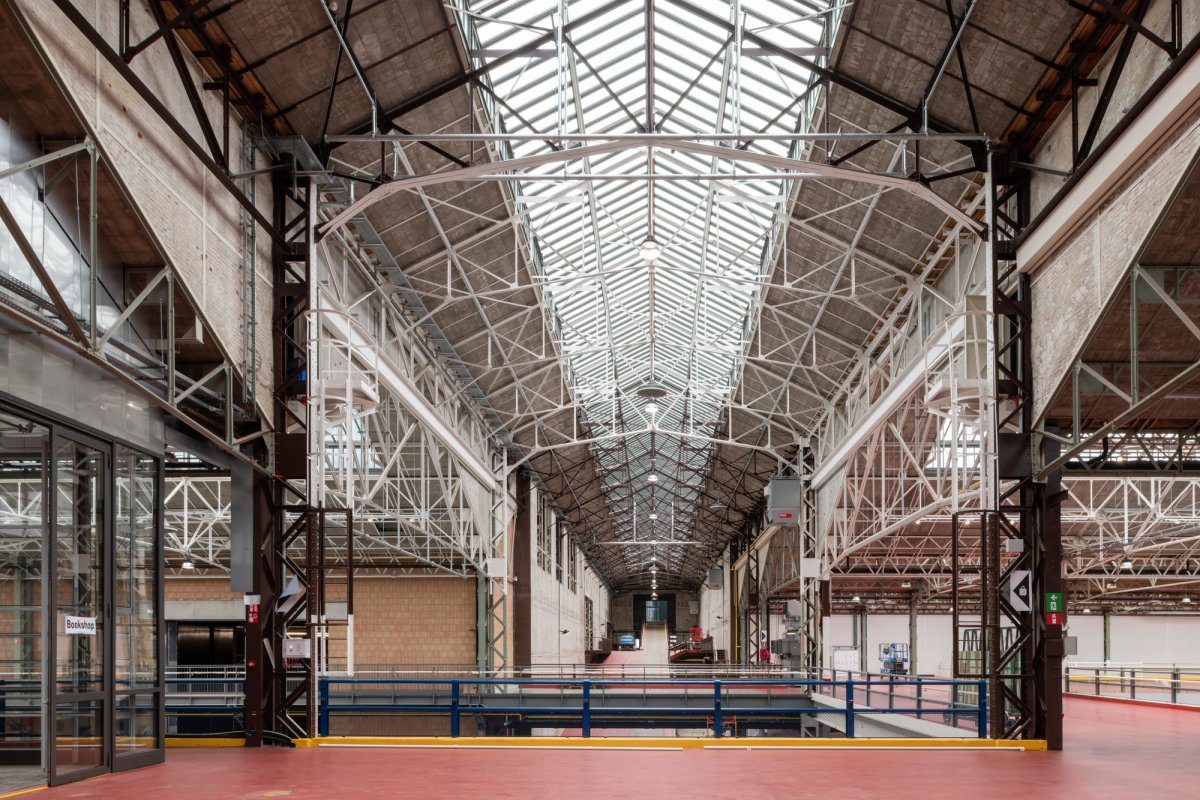
An interior view of Kanal
Photo: Koen Van Damme
More than 20,000 sq. m within the broader Kanal project is devoted to freely accessible public space. The complex also includes creative studios, observation points, a rooftop bar, a bakery, a restaurant and Carrosserie (French for bodywork), a bistro whose counter is made from shaped car-body sheet metal, finished with a chameleon-effect paint. Work on the site is complete, though construction related to the redevelopment of Place Sainctelette surrounding it is still under way and scheduled to continue until the end of 2027.
Questions over funding
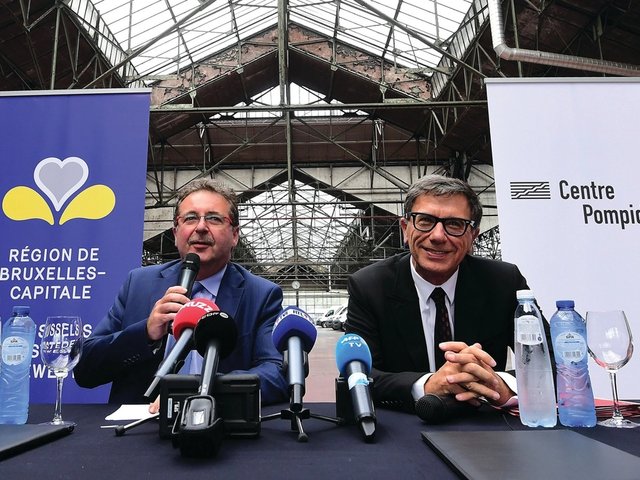
The run-up to Kanal’s opening has not been without controversy and challenges. Kanal’s managing director, Yves Goldstein, announced earlier this year that he would step down and he is due to leave his position on Monday (30 November). A statement from the Brussels-Capital Region, the executive body that established the museum, said in September: “The parties acknowledge a difference of opinion regarding the future of Kanal.” His replacement is yet to be announced.
There have meanwhile been years of debate over the institution’s cost, funding and institutional partnerships. The initial investment budget of €150m (€125m for the works and €25m for studies), set out by the Brussels-Capital region in 2017, rose to around €230m. In May 2026, the region granted the Kanal Foundation, established in 2017 to operate the institution, a €60m loan to help complete the construction works and ensure the museum could open as planned. The budget provided for the ongoing operating of the museum, initially projected at €35m a year, was reduced to €28m in 2026 and is projected to fall to €24m in 2027, €22m in 2028 and €10m in 2029. Brussels’ regional government has previously told The Art Newspaper that private investors will be needed from 2028.
The five-year partnership with the Centre Pompidou will cost around €2m a year. Critics have questioned the expense and the decision more generally of partnering with a Paris institution rather than with Brussels-based organisations. Regional politician Benjamin Dalle has described Kanal as a “top-down political project”, arguing that it should have started with local artists and communities. The Fédération des arts plastiques has raised concerns about the place of Belgian artists in the programme, acquisitions and support for emerging practitioners. Kanal has been approached for comment.
Redzisz, however, has defended the museum’s role as a cultural resource for Brussels and its community. “This museum has an obligation to speak as much to locality as to contribute to global debate,” she told The Art Newspaper in October. That approach is reflected in Kanal–Centre Pompidou’s main inaugural exhibition, in which loans from Centre Pompidou mix with others from international institutions as well as works from the Kanal Foundation. The foundation has a particular focus on contemporary artists connected to Belgium—such as Sammy Baloji, Edith Dekyndt and Aglaia Konrad.
The show, titled A Truly Immense Journey, features 350 works across three levels. Marcel Duchamp’s Boîte-en-valise, lent by a Belgian private collector, is placed in dialogue with a version of Alberto Giacometti’s L’Homme qui marche I. Kader Attia’s Untitled (Ghardaïa) (2009), a model of a city made from couscous, borrowed from Tate, is shown alongside two portraits of Leonie Ngoie, a Belgian woman of Congolese descent, photographed by the Belgian artist Chrystel Mukeba against an Art Nouveau backdrop by the Belgian architect and designer Victor Horta.
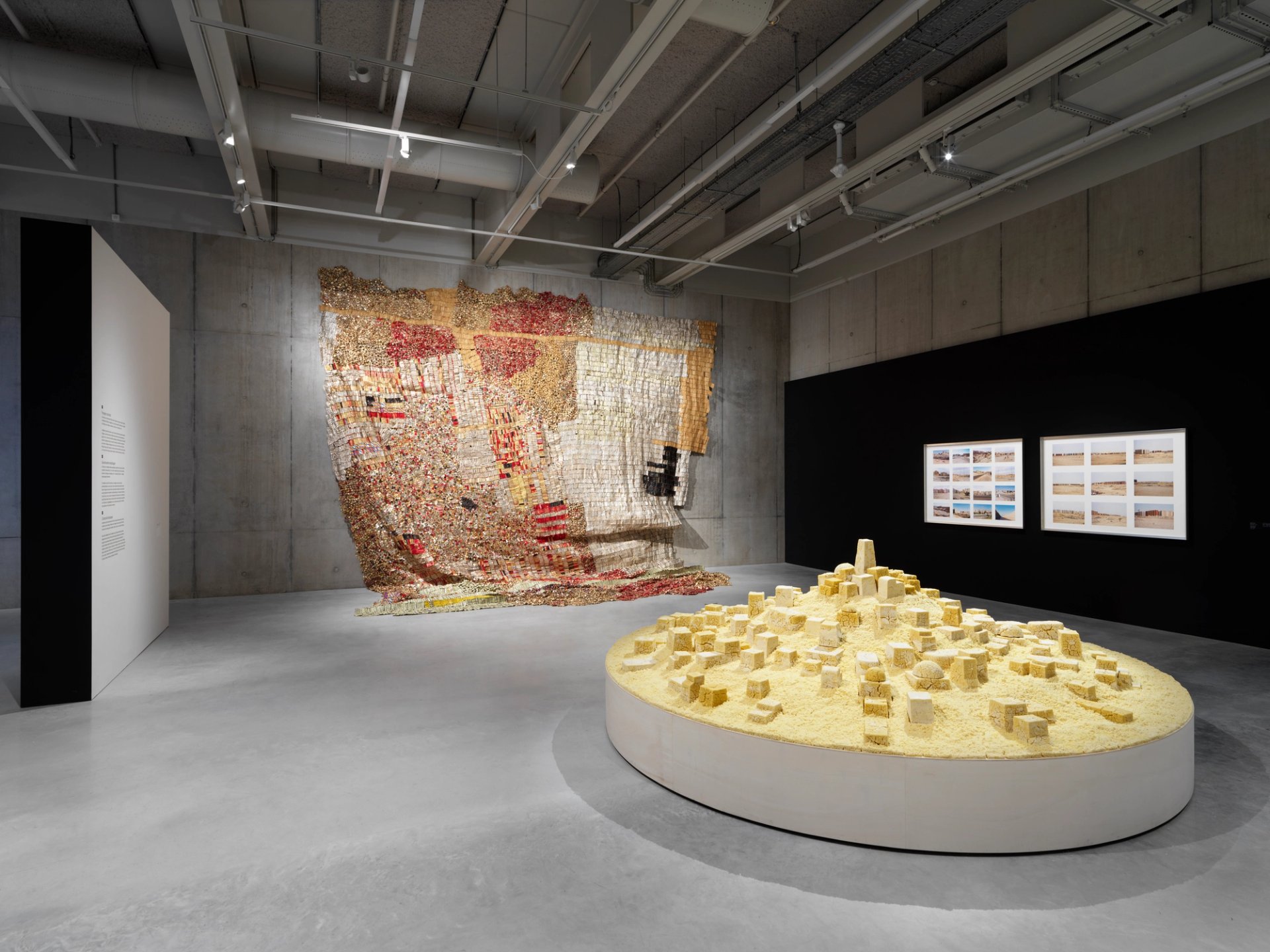
An installation view of A Truly Immense Journey, featuring 350 works across three levels
Photo: Dries Van den Brande
Other exhibitions and projects are spread across the Kanal-Centre Pompidou house. No Show, orchestrated by the Brussels-based artist duo Deborah Bowmann and musician Maoupa Mazzocchetti, brings together around 20 artists from the Belgian capital, all of whom are under 40. Clémentine Deliss’s Department of Traps features 70 objects and paintings, including nets, snares, decoys and trompe-l’œil works, deriving from 11 Brussels museums.
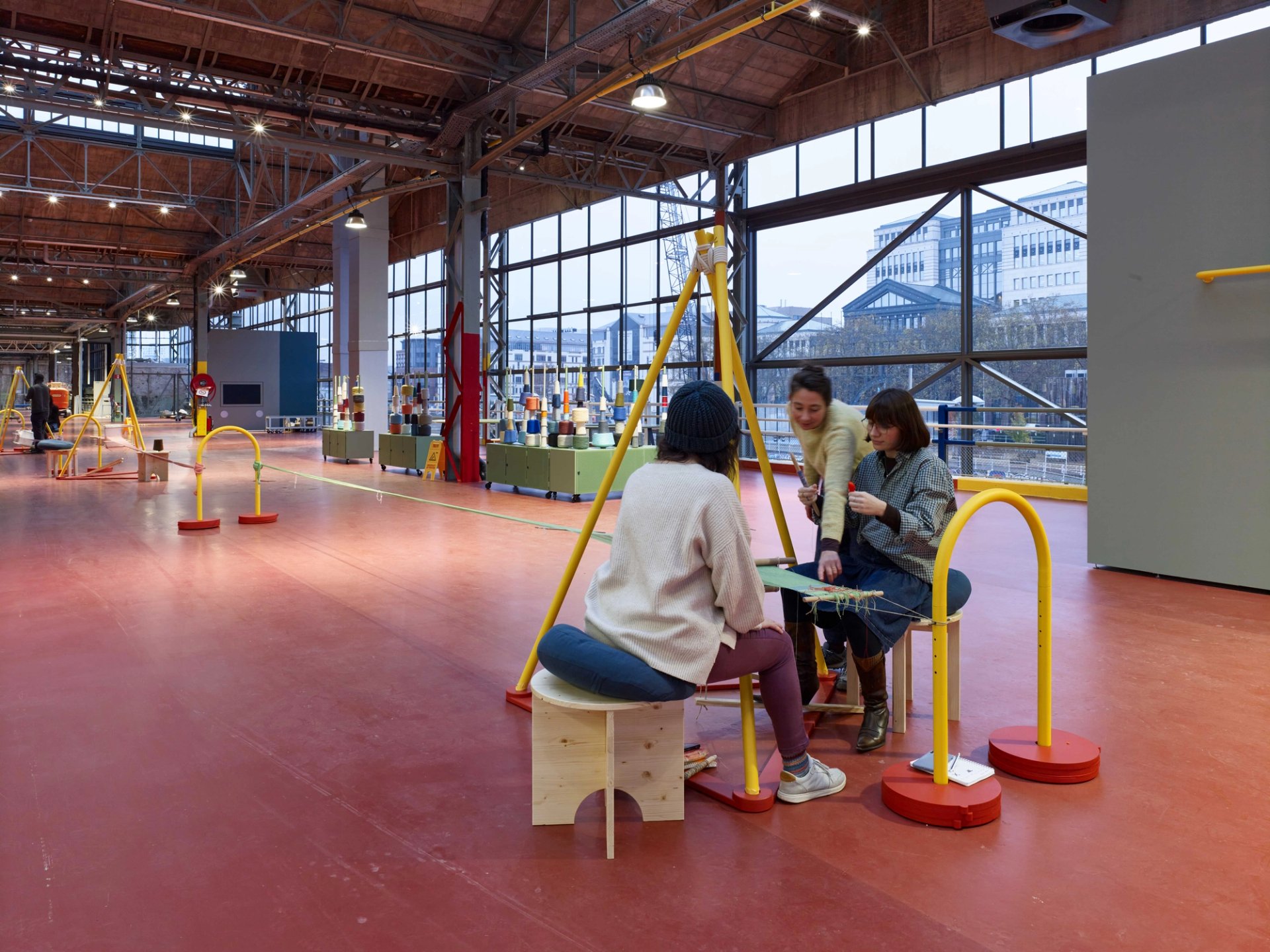
Otobong Nkanga’s installation in Hall 2 encourages audience involvement
Photo: Kristien Daem
A key part of the museum’s strategy is to involve the public directly in its programme. The Antwerp-based Nigerian artist Otobong Nkanga, for instance, has created an installation of wooden looms in Hall 2, inviting participants to weave together and contribute to a collective work of art. Nearly 200 pupils from four neighbouring schools have, meanwhile, contributed to writing exhibition labels. “Inclusivity is the best way for the public to make the place their own,” Kasia Redzisz told The Art Newspaper in January.
By 2030, Kanal expects to attract 550,000 visitors a year.