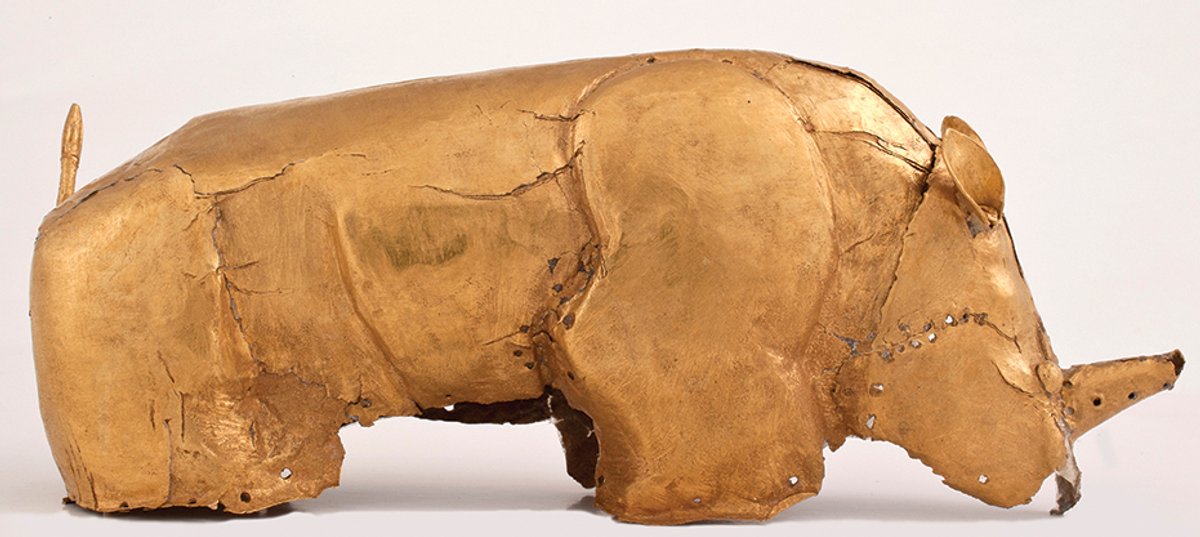
One of Africa’s pre-colonial treasures, the Mapungubwe gold collection, discovered in the 1930s near what is now the South Africa-Zimbabwe border, will take pride of place in a new museum opening in Pretoria, South Africa, in mid-2019. The 13th-century collection, will be “a manifestation of the creativity of Africa” when it goes on show in the four-storey tower building of the new 280m rand ($19.7m) Javett Art Centre at the University of Pretoria (Javett-UP), says its director, Christopher Till.
The university led the excavations of graves at the hill site of Mapungubwe, where the evidence of an early Medieval civilisation defied apartheid narratives of an “empty land” before European settlement. The finds of gold anklets, bracelets, beads, a sceptre and wooden forms tacked with gold foil, including the famous sculpture of a rhinoceros, have been described as the “crown jewels” of South Africa and travelled on rare loan to the British Museum in London in 2016.
Till, a veteran of the South African art scene who previously founded and led the Apartheid Museum in Johannesburg, hopes to display the collection with up to 250 gold artefacts from West Africa that were shown at the now-defunct Gold of Africa Museum in Cape Town, which he directed. Till is also assembling an exhibition of 100 iconic South African works of art.
The centre is named after the retired businessman and collector Michael Javett, whose family foundation will help to fund the museum’s running costs for the next ten years. Designed by the South African architects Matthews & Associates, the building will include nine exhibition spaces for the Javett and university collections. Its central gallery will double as a bridge over a major road, intended to connect the campus with the city.
The centre is seen as Pretoria’s answer to Cape Town’s burgeoning gallery scene, and underscores the role of privately-funded museums in the country at a time when public institutions are struggling for support. Till says: “There’s an enormous excitement that there’s something coming to the city with this scale and intent.”