Malines/Amsterdam
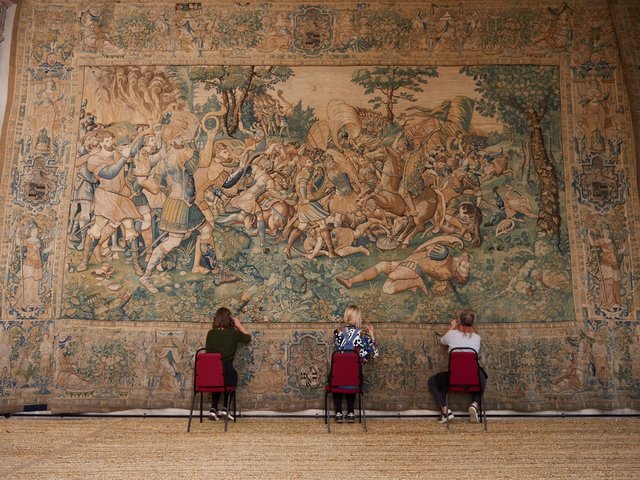
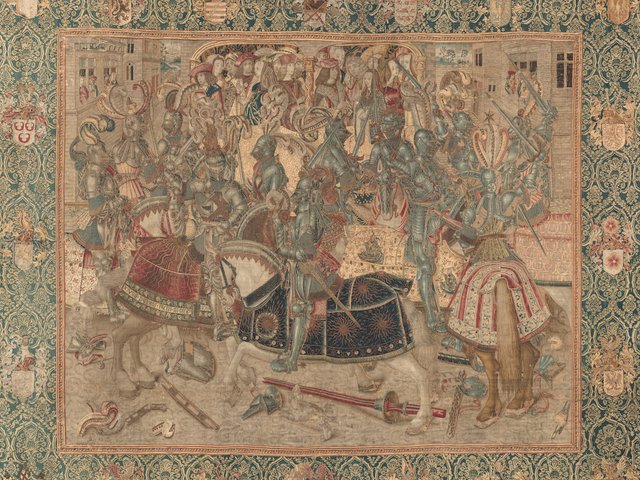
Begun under the patronage of Isabella I, Joan of Castille and Margaret of Austria, the Spanish royal tapestry collection reached its peak under Charles I and Philip II. For many years the Flemish tapestries, many based on compositions by artists such as Bosch and Bernard van Orly, together with eighteenth-century Spanish ones woven at the Real Fabrica de Tapices in Madrid, hung in the Old Alcazar of Madrid. Given their remarkable state of preservation it is surprising to learn that they were packed up and taken on royal journeys, to be used as improvised wall decoration. The tapestries are quite outstanding: the vivid, almost clashing colours of some of the backgrounds and borders a brilliant counterpoint to the Bosch-derived central scenes. Sixteen newly restored Brussels tapestries from the collection have been on tour this year and can be seen at the Stichting de Nieuwe Kerk Amsterdam in July and August, in an exhibition organised with the Rijksmuseum. The conservation work has been funded by the Flemish state while the exhibition has been part-sponsored by medieval art and tapestry dealer Bernard Blondeel of Antwerp. It celebrates the restoration of the tapestries at the Royal Manufacturers of Tapestry Gaspard de Wit in Malines. The project began in 1990 with a visit to the Manufacturers by a team from the Patrimonio, while research for the conservation was headed by Guy Delmarcel. The Manufacturers, based in the Tongerlo Abbey, are the only operating tapestry workshop in that region of Flanders. Most of the tapestries were cleaned by aerosol-suction and not by water. This treatment takes from fifteen to thirty minutes. Actual restoration was kept to a minimum and viewed from a normal distance any new work is intended to blend into a neutral coloured. This technique has been used by Manufacturers De Wit since 1980, and was employed here quite extensively on the Bosch tapestries.
The tapestries were relined using bleached linen, washed twice at 90 degrees Centigrade. Contrary to frequent modern practice, the lining was attached with the tapestry laid flat, decreasing the effects of distortion due to old linings. The catalogue accompanying the exhibition is published by the Gaspard De Wit Foundation.