

Digital Editions
Newsletters
Subscribe
Digital Editions
Newsletters
Art market
Museums & heritage
Exhibitions
Books
Podcasts
Columns
Art of Luxury
Adventures with Van Gogh
Venice Biennale
Art market
Museums & heritage
Exhibitions
Books
Podcasts
Columns
Art of Luxury
Adventures with Van Gogh
Venice Biennale
Focus
archive

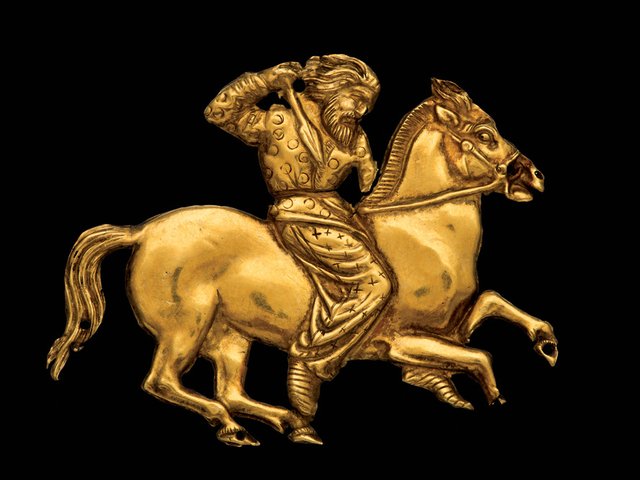
In focus: Scythians, Warriors of the steppes

The Scythians' tombs have yielded hundreds of gold and silver objects

Cristina Ruiz
31 March 2014
Share

The Scythians were a fierce nomadic people who travelled east from their original homeland in the Altai Mountains, where present-day Kazakhstan, Russia, Mongolia and China meet, to roam the wide expanses of Central Asia from the seventh to the third centuries BC. Constantly on the move, the Scythians left no buildings or monuments behind, but their tombs, or kurgans, have yielded hundreds of delicately worked objects in gold and silver. Many of these were produced by itinerant Greek craftsmen who travelled to the north coast of the Black Sea to meet the Scythian demand for extravagant burial goods. Despite the Scythians’ migration, animals native to the Altai region and unknown in the Central Asian steppes, such as the golden eagle, the spotted leopard, the snow leopard and the red deer, are regular motifs in Scythian art.

Their eventual demise is believed to have come at the hands of the Sarmatians, a new wave of migrant warriors from Eastern Asia, who flourished from around the fifth century BC to the fourth century AD in what is today Ukraine and southern Russia. The Scythians and Sarmatians initially lived in relatively peaceful co-existence before clashing in the third century BC, in a battle for control of territory that the Sarmatians appear to have won. Like the Scythians, the Sarmatians left sumptuous burial mounds, often recycling Scythian kurgans to bury their own dead. Archaeological evidence suggests that both cultures may have given rise to the Greek myth of the Amazons; the graves of females armed for battle have been found in southern Ukraine and Russia.

Originally appeared in The Art Newspaper as 'Warriors of the steppes'
Subscribe to our daily newsletter

FocusAntiquities & ArchaeologyTombsBurialWar & Conflict
Share
Subscribe to The Art Newspaper’s digital newsletter for your daily digest of essential news, views and analysis from the international art world delivered directly to your inbox.
Newsletter subscribe
Information
About
Contact
Cookie policy
Data protection
Privacy policy
Frequently Asked Questions
Subscription T&Cs
Terms and conditions
Advertise
Sister Papers
Sponsorship policy
Follow us
Instagram
Bluesky
LinkedIn
Facebook
TikTok
YouTube
© The Art Newspaper

Related content

Heritagecomment
19 January 2023

'Scythian gold is at the heart of Russia’s identity war'

Art historian and curator Konstantin Akinsha asserts that Russian attempts to claim succession from the ancient Scythians date back to the 18th century

Konstantin Akinsha
Antiquities & Archaeologyarchive
30 September 2003

American troop opens fire on senior cultural adviser to Coalition Provisional Authority touring Iraq's archaeological sites

There on an official visit to gauge the level of damage done by looting, Pietro Cordone came out of the incident unscathed, although his interpreter was killed

Cristina Ruiz and Jason Edward Kaufman