On 14 September 1822 the French scholar Jean-François Champollion burst into his brother’s room, thrust a bundle of notes at him, exclaimed “je tiens mon affaire, vois!”—which crudely translates as “I’ve got it!”—and collapsed on the floor in a dead faint. As he explained in a famous letter to the French Academy, whose members had worried at the subject for decades, he had cracked the code of the ancient Egyptian hieroglyphs: monuments, temples, palaces and tombs, silent for almost two millennia, were about to speak again.
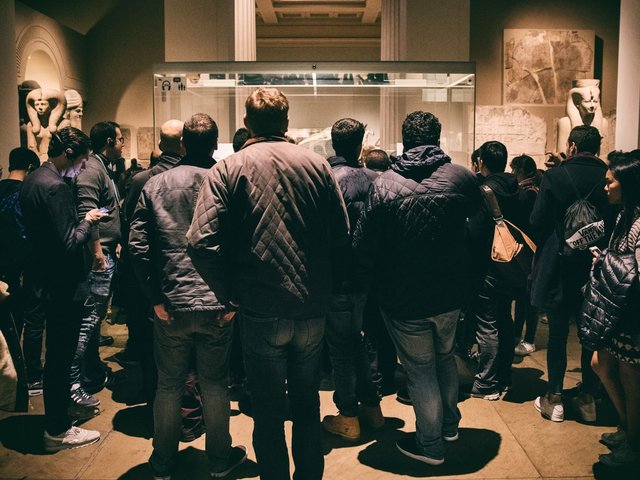
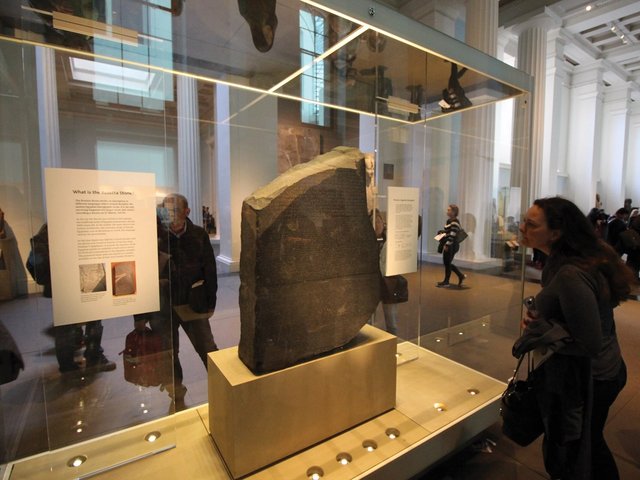
The kernel of the British Museum’s new major exhibition Hieroglyphs: Unlocking Ancient Egypt, is the Rosetta Stone, one of the world’s most famous museum objects and often a sore disappointment to visitors. Its significance was first spotted in 1799 by a young French soldier as a wall was demolished to reinforce fortifications. The text is very dull indeed, but as it was repeated in three languages—ancient Egyptian, demotic Egyptian and Greek—the black basalt became the code breaker’s key.
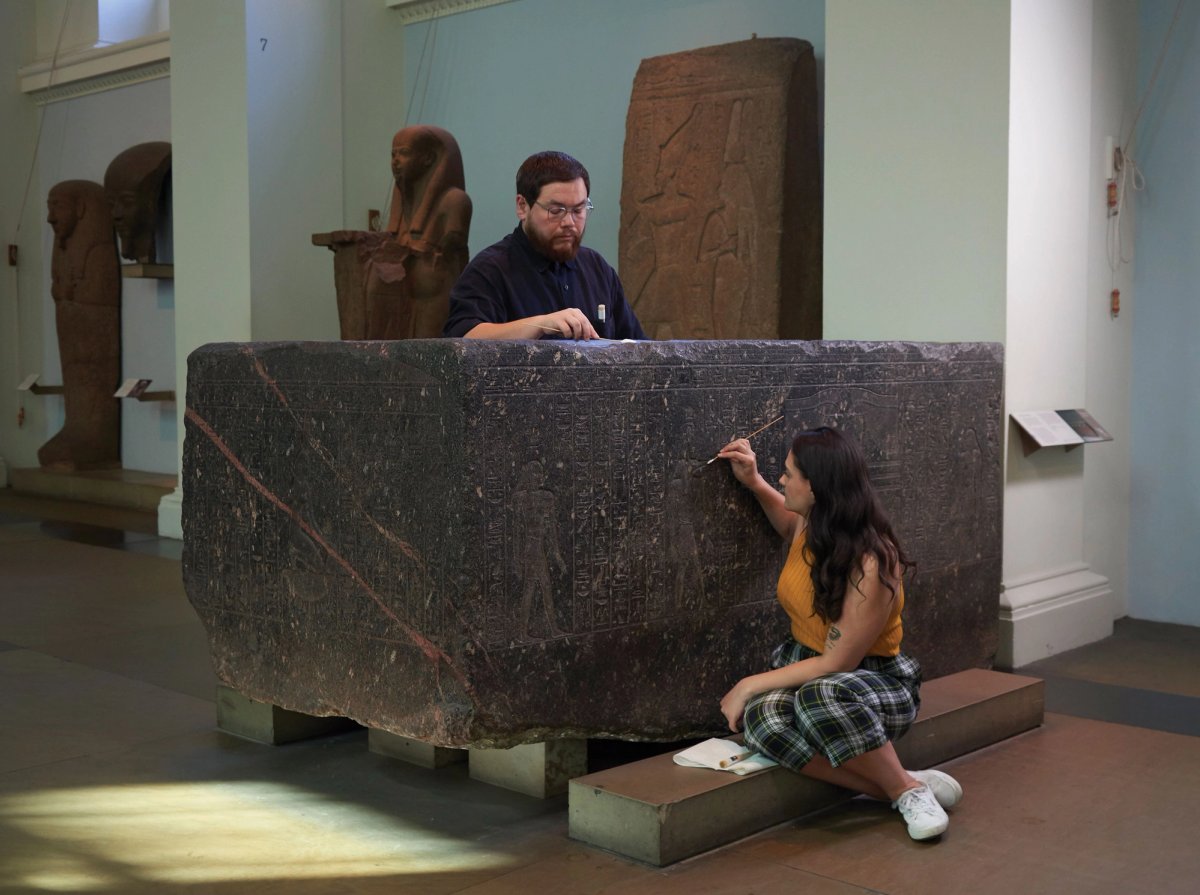
An exhibition marking 200 years since the deciphering of hieroglyphs could have been as dry as one of the mummy bandage exhibits, but is actually a tale of loot, bitter scholarly rivalry, sex and magic (Arab scholars, scrupulous recorders of hieroglyphs, were convinced they held alchemical formulae). Conservators will work during the exhibition on a massive black sa
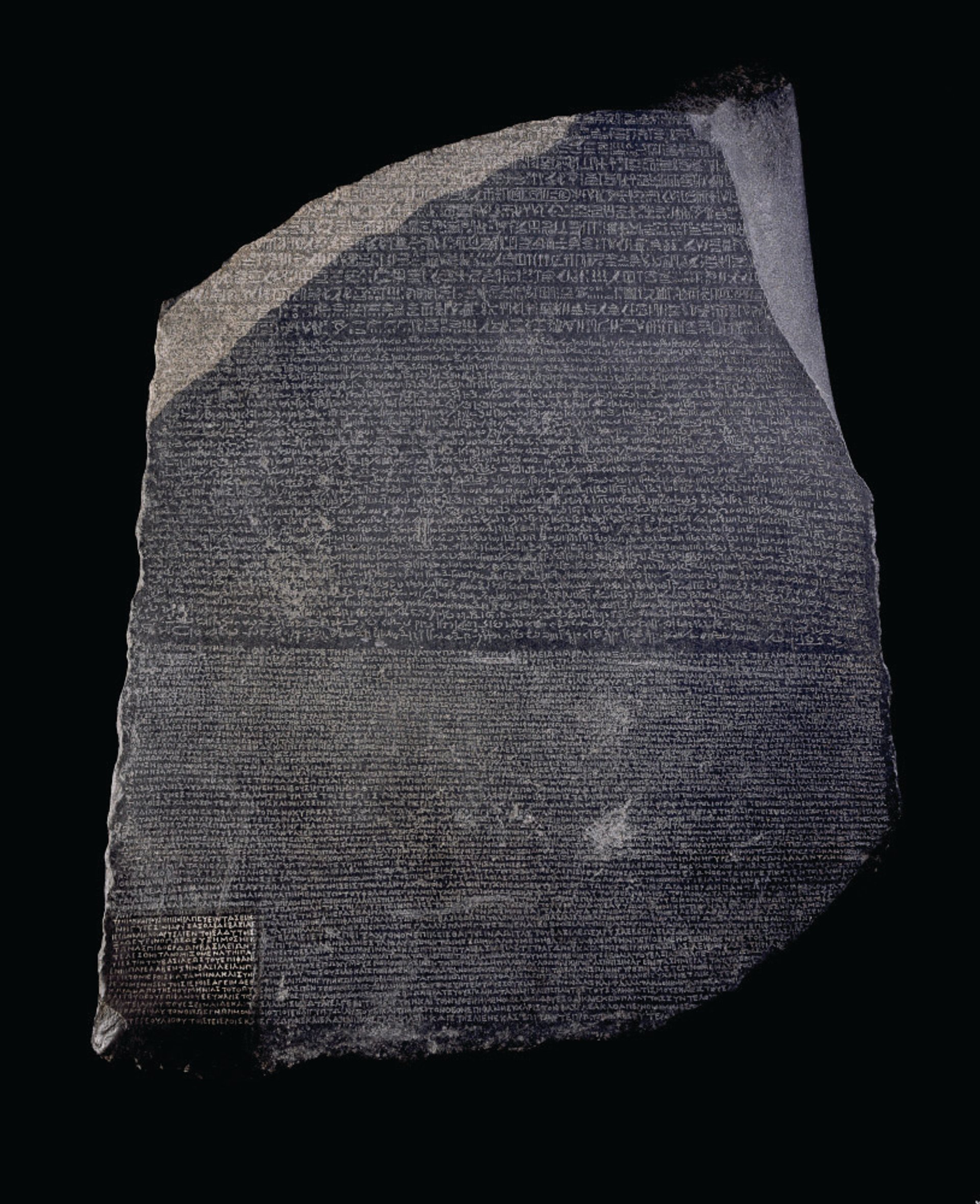
The Rosetta Stone was the key to deciphering Egyptian hieroglyphs © Trustees of the British Museum
rcophagus, believed for centuries to be a magic bath curing the pains of love; the British in Egypt later built a venereal disease hospital on the spot where it was found.
Champollion was a child prodigy who grew up to speak a dozen languages including ancient Greek, Hebrew, Arabic, Latin and Coptic. He recorded that he spoke to himself in Coptic, which is descended from the spoken language of ancient Egypt. He is the undoubted star of the hieroglyphs story, but the British Museum gives back credit to an English polymath, Thomas Young, dubbed “the last man who knew everything”. Young and Champollion were both on the right track, knew of one another, published some earlier work and occasionally exchanged notes. But to the victor the spoils, Champollion got there first. He became a media star, touring and giving lectures including live translations from monuments in Egypt, before dying in Paris in 1832 aged 41, three years after Young.
The exhibition will include loans from many international museums and scholarly institutions—but none from Egypt. The peppery former Egyptian antiquities minister Zahi Hawass has used the exhibition as an opportunity to demand the return of the Rosetta Stone; the story of the stone is not over yet.
• Hieroglyphs: Unlocking Ancient Egypt, British Museum, London, 13 October-19 February 2023