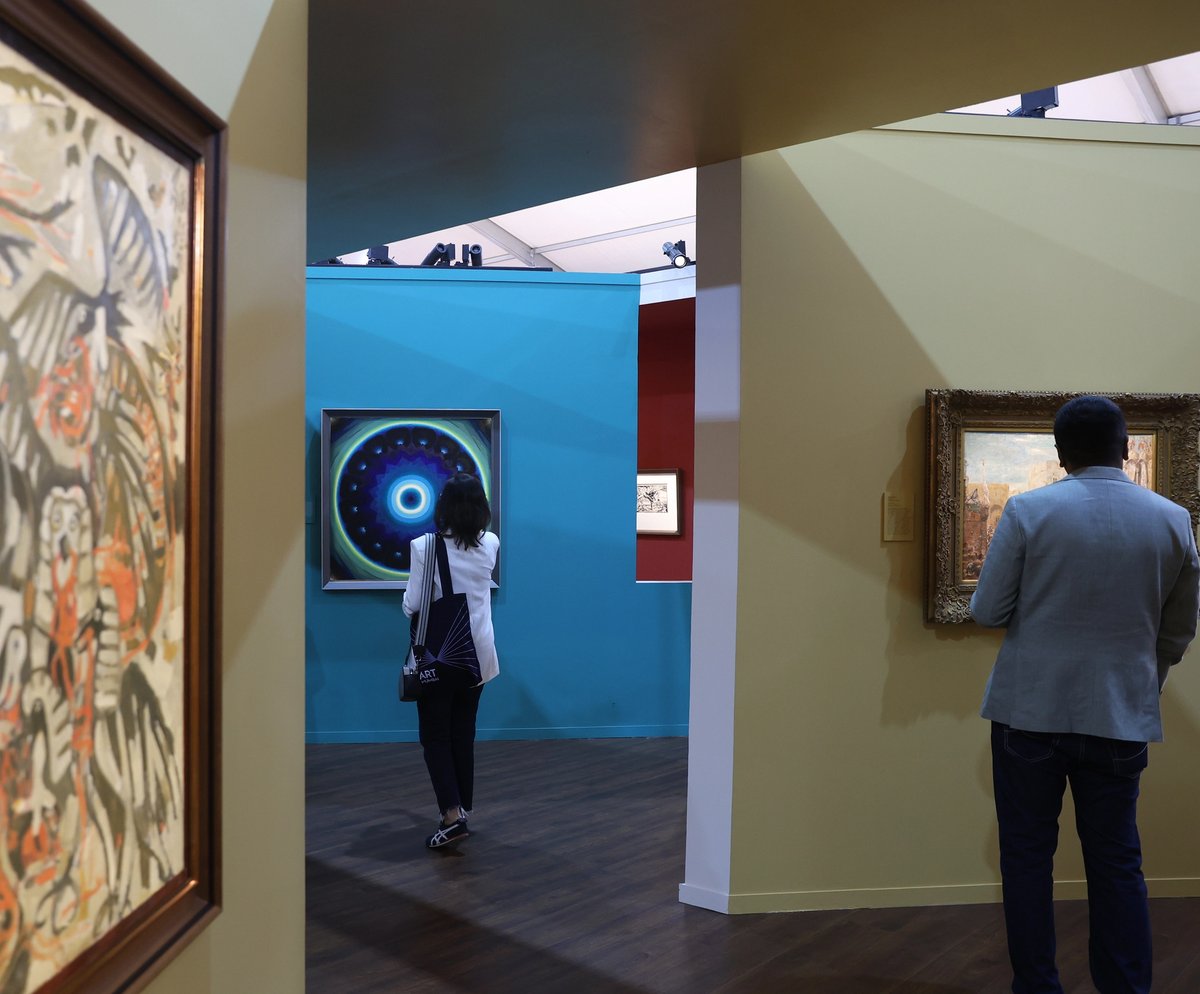
The third edition of Art Mumbai (13-16 November) was held as confidence in the South Asian art market reached an all-time high. Another stellar year of auctions has garnered records for India’s most famous Modernists—almost a dozen artists, from Tyeb Mehta to VS Gaitonde, established new best prices, while MF Husain’s Gram Yatra (1953) became the first Indian painting to sell in excess of $10m.
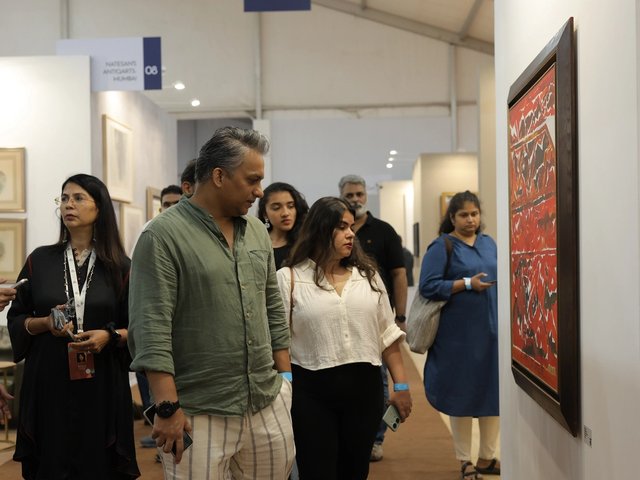
The surge in private wealth helping to fuel this rise endures: according to the Hurun Rich List 2025, India gains a millionaire household every 30 minutes, and minted 24 new billionaires in the past year. Punitive US tariffs and sluggish domestic consumption might have knocked off 9% off the combined wealth of India’s richest, but heirs to several of these fortunes were spotted in the aisles, including Yash Birla and Isha Ambani Piramal. As Art Mumbai’s co-founder Conor Macklin noted, the crowd on opening day was “dripping in diamonds”.
Contemporary boom
Skyrocketing prices for Modern masterpieces at auction are making “contemporary art look much more affordable,” said Aparajita Jain, partner of Nature Morte, India’s largest contemporary art dealership. The Delhi- and Mumbai-based gallery’s sold around 90% of its stand by the end of the preview day (14 November), topping out at a new steel tong sculpture by Subodh Gupta at $300,000, to a collector in Ahmedabad, a city in northwestern India with a population size nearing that of London’s.
Many of India’s leading contemporary galleries—which presented works beginning around $1,000 and rarely surpassing $65,000—reported healthy sales. Those shifting at least 75% of their stands within the fair’s opening day included Tarq, Chemould Prescott Road, Chatterjee & Lal, Experimenter and Vadehra Art Gallery.
The recent lowering of India’s goods and service tax (GST) on art from 12% to 5%—implemented partially to soften the effects of US tariffs—is providing an extra boost to the market, although as the Chatterjee & Lal’s co-founder Tara Lal noted, some ever-frugal collectors are now asking for that to be factored into a further-discounted final price.
‘A real estate phenomenon’
India’s market is undoubtedly in rude health: the auction turnover of South Asian art is expected to double that of 2007, its last peak. But is this swell in sales being met by a maturing market? Key to this question is whether the crop of buyers that have emerged in recent years will develop into serious collectors who can sustain the ecosystem when the present boom inevitably ends.
Many of the region’s institutionally minded collectors were spotted at the fair, including Anu Menda, head of the RMZ Foundation, the Devi Art Foundation’s Lekha Poddar, Nupur Dalmia, whose the forthcoming Ark Baroda will open next year, and India’s biggest collector, Kiran Nadar, while representatives from the Los Angeles County Museum of Art (Lacma) and the Guggenheim Abu Dhabi were also in attendance.
But their numbers remain relatively low, and few promising newcomers appear to be joining their ranks. As one Mumbai dealer said, “this present boom is a real estate phenomenon”. They refer to the dozens of luxury skyscrapers sprouting up in the once-industrial neighbourhoods of Worli and Lower Parel, whose double- and triple-height penthouses are skewing Mumbai’s long-standing reputation for small homes unsuited for large art collections.
The prominent local collector Udit Bhambri noted that “the notion of a 50 crore rupees [around $5.6m] annual budget was almost unheard of until a few years ago. And with that amount, you can either spend it on one master or dozens of contemporary works”. But, he adds, “for the most part the tastes of most buyers are decorative—nothing too dark or too gruesome”. Another Mumbai dealer at their stand noted that the fair is predominantly “still a lot of people shopping for their bathrooms".
There are also fears that the recent rise of private buyers is fast outpacing the region’s institutional infrastructure and is leading to an imbalanced ecosystem. “I worry the market is becoming flooded with a lot of mediocre work,” warned the Mumbai dealer Ranjana Steinruecke, speaking at an exhibition in her gallery of small, introspective sculptures and drawings by Nicolas Durvasula. “I don’t think we’re ready yet. Further understanding and context needs to be cultivated.”
Despite the frenzy at auction for 20th-century masterpieces, Art Mumbai’s Modern section saw slower action. This is partly due to the varying quality of works on show, and dealers raising prices to match auction results. As Macklin noted, “prices have gone all over the shop”.
While the depth of bidding for high-value Indian Modernist works at auction is increasing, the pool of buyers at the top end remains thin. As one London dealer noted, “many exhibitors in the Modern section were waiting on the same few key figures to show up”.
Several works that are less commercially viable, either in scale or subject matter, did not sell, including an imposing duo of canvases by Rameshwar Broota at Akar Prakar. Nonetheless, its director Reena Lath shifted several other works, including a green canvas by Ganesh Haloi for around $130,000, a landscape by SH Raza and works by Ganesh Pyne and Gauri Bhanja to the Kiran Nadar Museum of Art in New Delhi. Lath said she was "very happy" by the end of the fair, with sales made across the weekend to "lots of new buyers".
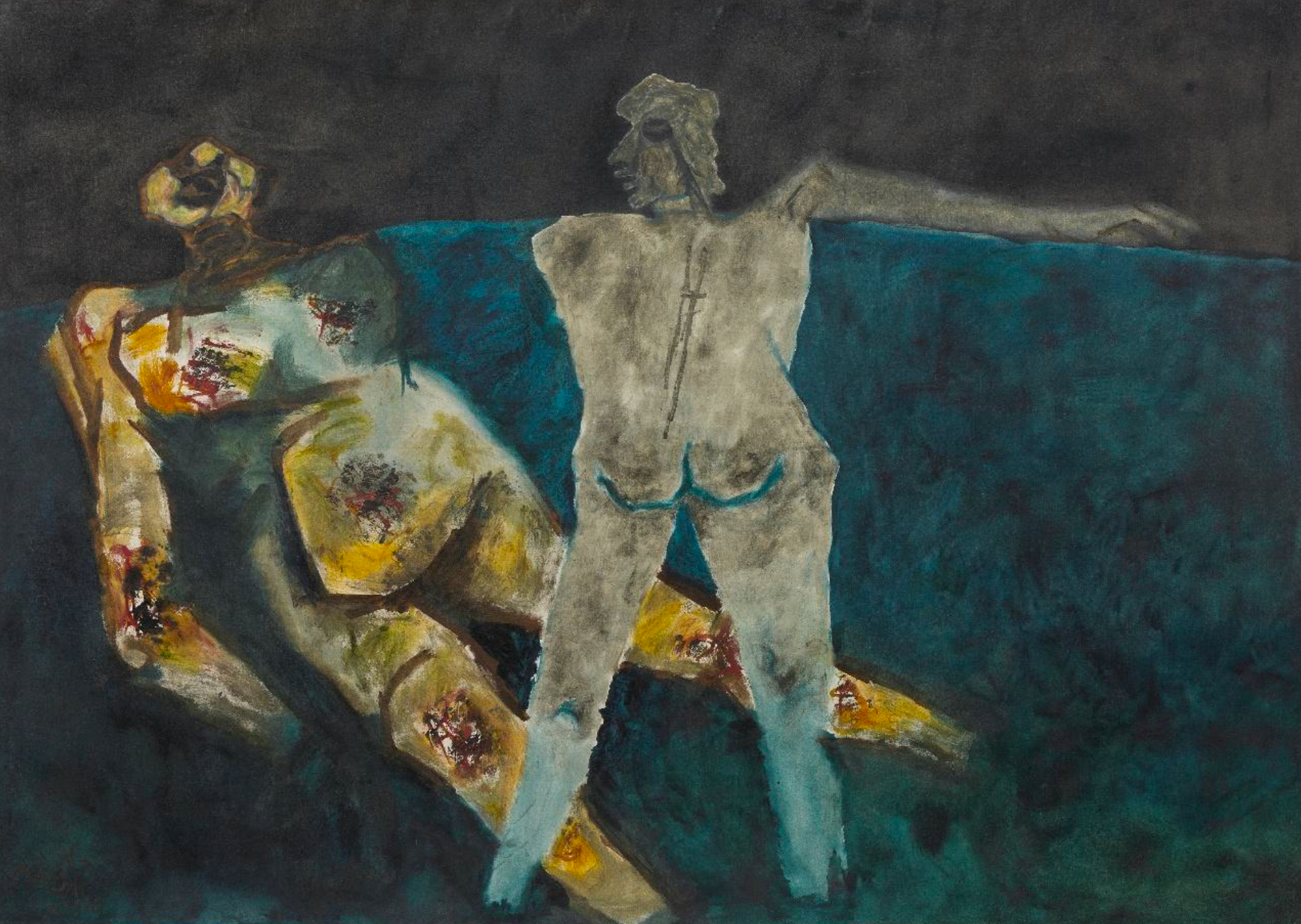
MF Husain, Untitled (1970), shown at DAG's Art Mumbai 2025 stand
Courtesy of DAG
Even a household name like Husain can struggle. At DAG, one of India’s leading secondary market galleries, a large, brooding painting by Husain from his Mahabarata series, depicting a martial scene from the Sanksrit epic, was not placed. This is despite the works's stellar exhibition history, having been shown at the 1971 São Paulo Biennale. “It’s not an easy sell," said DAG’s chief executive Ashish Anand. "It's a difficult, gory subject. Not the typical Husain everyone knows."
Still the rising prices for prime Modern work—and its dwindling availability—is pushing up interest and prices in other fields, such as Anglo-Indian art, and broadening tastes, Anand says. A clear sign of confidence in the market’s trajectory, the gallery also displayed a standout work it has held in its inventory for a decade: the only known sculpture by Amrita Sher Gil, one of India’s most famous 20th-century artists. The black stone relief of a panther is priced “well above $5m”.
International galleries
Overseas galleries not exclusively focusing on South Asian art were a small but growing contingent at Art Mumbai. This year, Lisson, Sundaram Tagore, Leila Heller and Gallery Isabelle took part for the first time, while Continua, Ben Brown and Thomas Erben returned.
Sales for many of these galleries, which largely presented stands of bright and legible work, were initially slow. As Hugo Cobb, a director at Ben Brown Fine Arts, said: “buyers are doing a dance right now, coming back two or three times, then with an interior decorator, but not closing the deal”. This appeared to have paid off by the fair’s close, with Cobb reporting “strong sales, including to new Indian clients”.
This was due, in part, to the fair’s organisers securing bonded status for the first time this year, which allows for import duties to be paid only for works that are sold and will stay in India. Macklin noted that the process will be "streamlined" for future editions.
Some dealers in this section also reported that the fair’s organisers arranged for their clients to visit the stands of international galleries that initially reported slower sales. By the end of the fair, Lisson sold three large works, one each by Anish Kapoor, Olga de Amaral and the Antwerp-based Nigerian artist Otobong Nkanga, who will show at the forthcoming Kochi Biennale. The gallery noted that some of these were made to new Indian clients, but did not disclose prices.
Newcomers and new fields
One sign of India’s market maturation is the presence of promising newcomers. Taking part in the fair this year was Subcontinent, a Mumbai gallery that opened in March, and which largely focuses on the secondary market and overlooked historic practices. On its stand were six paintings by Winifred Strangman, a fairly obscure British painter of botanical scenes who was working in India at the beginning of the 20th century. Her market is showing the first signs of a reappraisal, marked by an increasing presence at auction.
"People increasingly want to their collections to begin before the Bombay Progressives," said the gallery's co-founder, Keshav Mahendru. "There is a growing curiosity for the unknown, and a flight to quality, rather than the presence of zombie investors—all of which points to maturing of the ecosystem."
Subcontinent is one of three galleries to open in Mumbai this year, along with Fulcrum and Muziris Contemporary. Mahendru noted that all three of these galleries are led by individuals with a decade-plus of industry experience. "These are seasoned professionals, rather than speculators, who believe in this market."
In its Fort gallery, Subcontinent is exhibiting the tribal artist Jangarh Singh Shyam, whose market also appears to be reviving after a lull. His auction record was made in 2023 at just over $91,000. Works on sale are between $3,000 to around $30,000; Mahendru noted that so far, much of Shyam's work coming to the block is not the best quality. "Collectors of his work will hold onto it until the market is stronger, there is a lot to be uncovered."
The rise of tribal art was evident across the fair, and speaks to a widening of tastes and genres. For the first time at an art fair, one of the category's leading collectors, Mitch Crites, collaborated with the Jaipur gallery ICA to sell works from his collection.
"I've been shouting for 50 years that Indian tribal art is as important as Aboriginal or African tribal work, but only in the past four years have auction houses and dealers really started to take notice," Crites said. The stand sold out by the end of the fair, topping out a colourful painting by Jodhaiya Bai Baiga for around $39,000. "Today these works are worth lakhs [hundreds of thousands], soon they will be in crores [tens of millions]," Crites added.
Other galleries specialising in tribal art also found a warm reception at the fair, such as Ojas Art from New Delhi, which reported selling 90% of its stand. With the next Indian Pavilion at Venice Biennale 2026 dedicated to Indigenous tribal art, the category is expected to gain further prominence.
Art Mumbai hitting its stride
As India’s star rises, the potential of its art market is stressed. DAG’s Anand noted that the art markets of China and the US stand at roughly 0.1% of their respective national GDP. "Should India’s art market do the same, it will grow to around $4bn."
Art Mumbai continues to grow too, welcoming more than 80 exhibitors this year. Having fended off competition from India Art Fair, which cancelled its proposed Mumbai event, Art Mumbai has cemented its place as a leading event for the region. Future editions will now prove whether it can compete on a global stage.