Museum of Contemporary Art North Miami
Until 16 March 2026
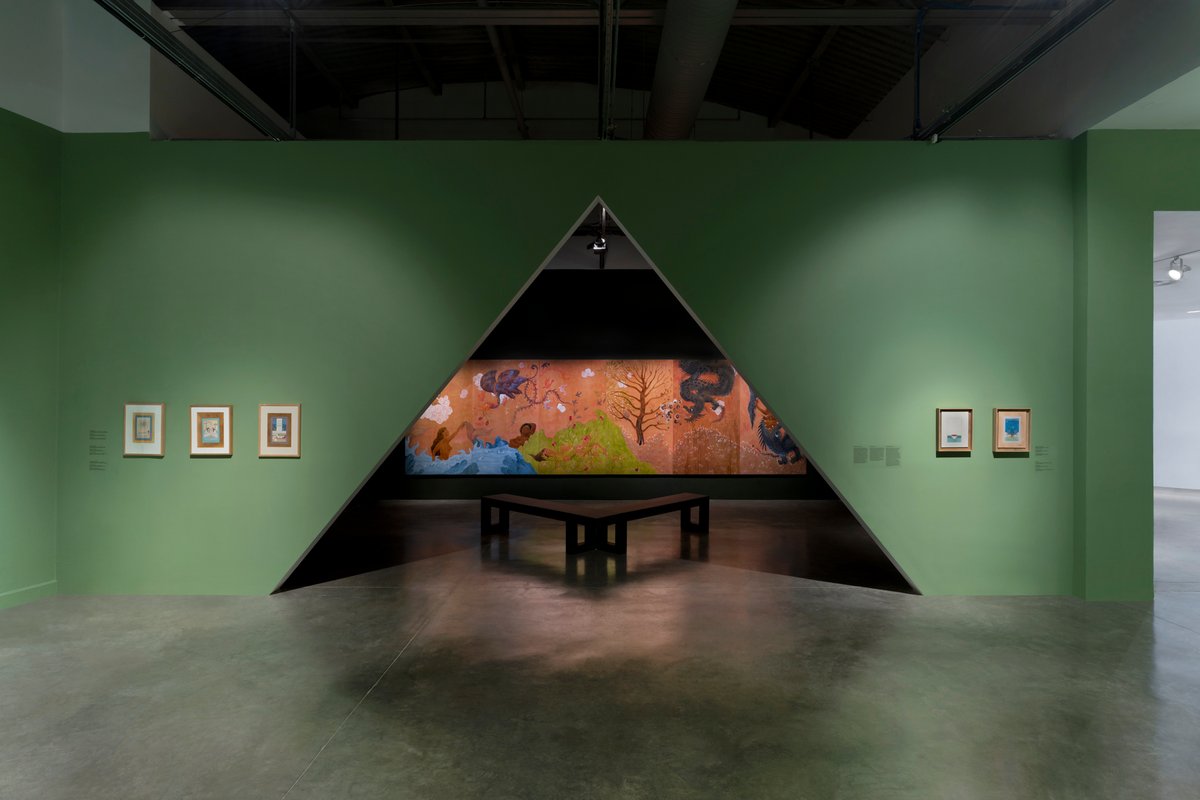
The first major retrospective devoted to the Karachi-born, Brooklyn-based artist Hiba Schahbaz, The Garden, features works spanning 15 years of the artist’s practice—including loans from private collections, work from her studio and newly commissioned pieces. It was curated by Jasmine Wahi and is anchored by the idea of the jannat, the Paradise Garden, a motif rooted in Islamic tradition and Sufi poetry.
Much of the exhibition’s success stems from Schahbaz’s trust in Wahi’s curatorial voice. The show is rooted in the elements—earth, water, fire and air—which gently guide visitors through an immersive and sensual journey. “It’s not something I could have done on my own,” Schahbaz tells The Art Newspaper. “I’ve watched Jasmine evolve as a curator and seen what she’s capable of. I can be pretty hands-on with curatorial decisions, but for this project, I really wanted to step back and let her lead.”
Drawing on the geometry and symbolism of Persian and Mughal char-bagh (four-part garden) design, the show unfolds as a contemplative landscape that oscillates between personal and cultural memory. “Each painting holds memories, emotions and moments,” Schahbaz says, “particularly the interior spaces I depict, which resonate with an intense emotional clarity.”
Trained in the Indo-Persian miniature tradition at the National College of Arts in Lahore, and later at the Pratt Institute in New York, Schahbaz works primarily with water-based pigments and tea on handmade paper. Her materials evoke a deep sense of ritual and care. Her soft, self-referential paintings centre the female figure, frequently her own. “I am the subject I know best,” she says.
Over time, Schahbaz’s practice has evolved from small formats to much larger works. This shift in scale occurred during a period of physical recovery, when she could not stand for long stretches to work. To continue painting, she began piecing together multiple small sheets into larger surfaces, using sturdier paper. This practical adaptation allowed her to scale up. A striking example is the 2020 watercolour, tea and gouache Strength, which is painted across multiple large sheets and depicts a woman calmly staring at a lion whose gaze is turned towards the viewer. The lion, a symbol of courage, epitomises the fearlessness conveyed by this image of a woman of colour taking up space.
A giant painting for Miami
Among the works commissioned for her Museum of Contemporary Art (Moca) North Miami show is a 45ft-by-14ft mermaid painting, which Schahbaz described as a labour of love. Created in a city surrounded by water and on the front lines of climate change, it offers a moment of reflection, humility and gratitude.
Miami’s sea air and tropical lushness feel familiar to Schahbaz, who grew up on the Arabian Sea. “The community, the cultures, the beauty—it feels like a homecoming,” she says. The 13 mermaids in the painting “are meant to be ephemeral and transient, existing in this moment. The paper cutouts at Moca took up to 14 days to install. I began making these just for my studio, and they have never been for sale. They bring me joy, and my hope is that they elevate anyone experiencing them.”
Of all the art institutions in Miami, Moca has developed a reputation for presenting works by women artists of colour; its other big solo show this season is devoted to the Miami-based Peruvian Dominican artist Diana Eusebio. The Garden is also the first museum exhibition in Miami pairing a South Asian curator with a South Asian artist. The museum, Schahbaz notes, “has been a generous collaborator—open, attentive and willing to make space for artists and curators to shape the work”.