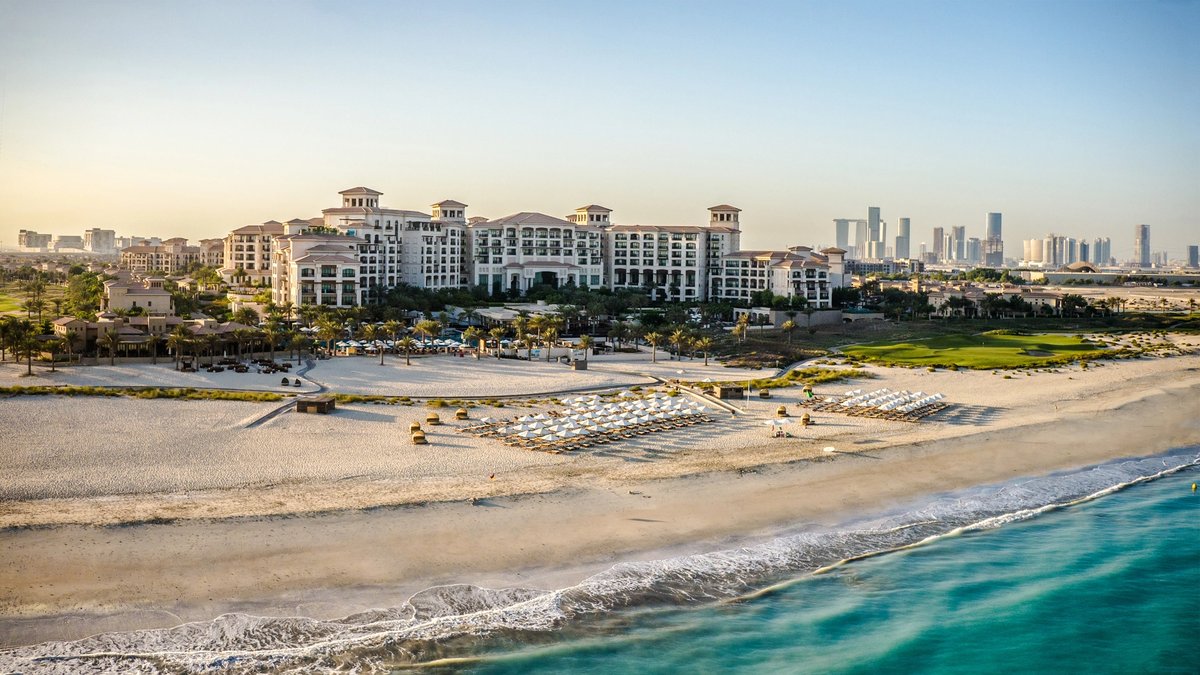
A dramatically-lit stage set on the beach served as the sale room for Sotheby’s inaugural Collectors’ Week (2-5 December) in Abu Dhabi. The five-part live auction brought waves of opulence in the form of jewellery, handbags, cars and real estate, and landed a solid $133.4m total.
A Hermès Birkin Voyageur, one of just five such handbags owned by the late actress and singer Jane Birkin, and featuring a handwritten note inside, warmed the crowd up. The auction house sold another example for $10m earlier in July, so it was not surprising that bids rose to $2.9m, against an estimate of $240,000 to $440,000.
Perhaps even less surprising, given the region’s established and growing love for luxury, was the $8.8m result for a 31.68 carat “orangey pink” diamond, known as The Desert Rose, against a $5m-$7m estimate. A bidding war was elicited for a 1930 Tiffany & Co sapphire-and-diamond ring, which fetched $596,000 (est $350,000-$550,000).
Generating less visible excitement from the floor, but nevertheless fetching an impressive $11.9m, was a Patek Philippe four-piece set of double-dialled grand complication watches, which became the second most valuable watch sold in Sotheby’s history. This “prestigious jewels and watches” portion of the sale achieved a white-glove result, with the $25.4m total, and sat squarely within its $17.4m-$31.6m estimate.
The auction house appeared committed to scale, supported by its significant backing from the Abu Dhabi Investment Office, but avoided unnecessary risk. Estimates felt modest, and even cautious at times: 50 items were being sold privately, including the world’s largest “fancy deep green diamond”, and no art was up for sale.
Overall, the lots were all sold apart from one piece of real estate and a couple of cars. This result is considerably stronger than the 67% sell-through rate by lot made in the house’s inaugural Saudi Arabia sale earlier this year, which included fine art.
“There is still a lot to learn,” said Josh Pullan, the head of Sotheby’s Global Luxury Division, ahead of the auction. “We view this as a long-term vision. We are here to grow a market, and that takes time.”
If growth is the long-term goal, creating a buzz was seemingly one of the short-term ambitions. Sotheby’s described the week, which was set in the suitably stylish St Regis Saadiyat Island Resort, as the largest debut for any new market in its history. It was also its first major event in the emirate since Abu Dhabi’s sovereign wealth fund invested $1bn in the company last year.
Timing helped. The week also saw the Formula One Etihad Airways Abu Dhabi Grand Prix, the Middle East and Africa Summit 2025, and the opening of the Zayed National Museum, straight off the back of UAE National Day (2 December).
Bidding at the sales themselves felt most active below the $500,000 mark, with the battle for the largest lots mainly undertaken by a handful of determined phone bidders. Buyers were from 35 countries, a quarter of whom were from the UAE, according to Sotheby’s. However, given that 80% of Abu Dhabi’s population is estimated to be expats, using sales data to assess the demographics of domestic collecting will long be a challenge.
“The energy and level of engagement say a lot about how strong the appetite for luxury is in the region and how naturally this interest is shifting toward art,” says Elen Levitt, a cultural strategist with Art Abu Dhabi. “The audience here is becoming more sophisticated and curious, you can really feel that.”
From Banksy to an ancient beast
Art education was certainly on the agenda, even if art sales were not. Talks and masterclasses struggled to attract early-morning crowds, but footfall was strong to the first phase of the auction house’s millennia-spanning Icons exhibition: featuring Banksy’s infamous self-shredding Girl Without Balloon and the Mesopotamian Guennol Lioness limestone figure (around 3000BC-2800BC), which sold for $57.2m in 2007. The second leg of the show will tour to the company’s New York Breuer building later this month (13-21 December).
The company’s push into expanded retail models was also on display, including its new Sotheby’s Bespoke initiative, led by the senior vice president for luxury private sales, Paul Redmayne, which allows clients to design custom pieces of jewellery when existing items on the market do not quite hit the mark.
Frieze’s recent partnership with the Abu Dhabi Art fair, coupled with the $6bn pumped into the emerging cultural quarter, points to wider and international commitment to develop audiences and collectors across the region. For now, Sotheby’s seems content not to chase the art market too aggressively in the emirate, and let luxury categories shine.