Experts are using artificial intelligence (AI) to help reassemble a priceless fresco by the early Renaissance artist Cimabue that was reduced to tens of thousands of fragments when earthquakes devastated a 13th-century basilica in central Italy nearly 30 years ago. The project has revived hopes for the full recovery of a masterpiece hailed by Italy’s prime minister, Giorgia Meloni, as a symbol of national pride.
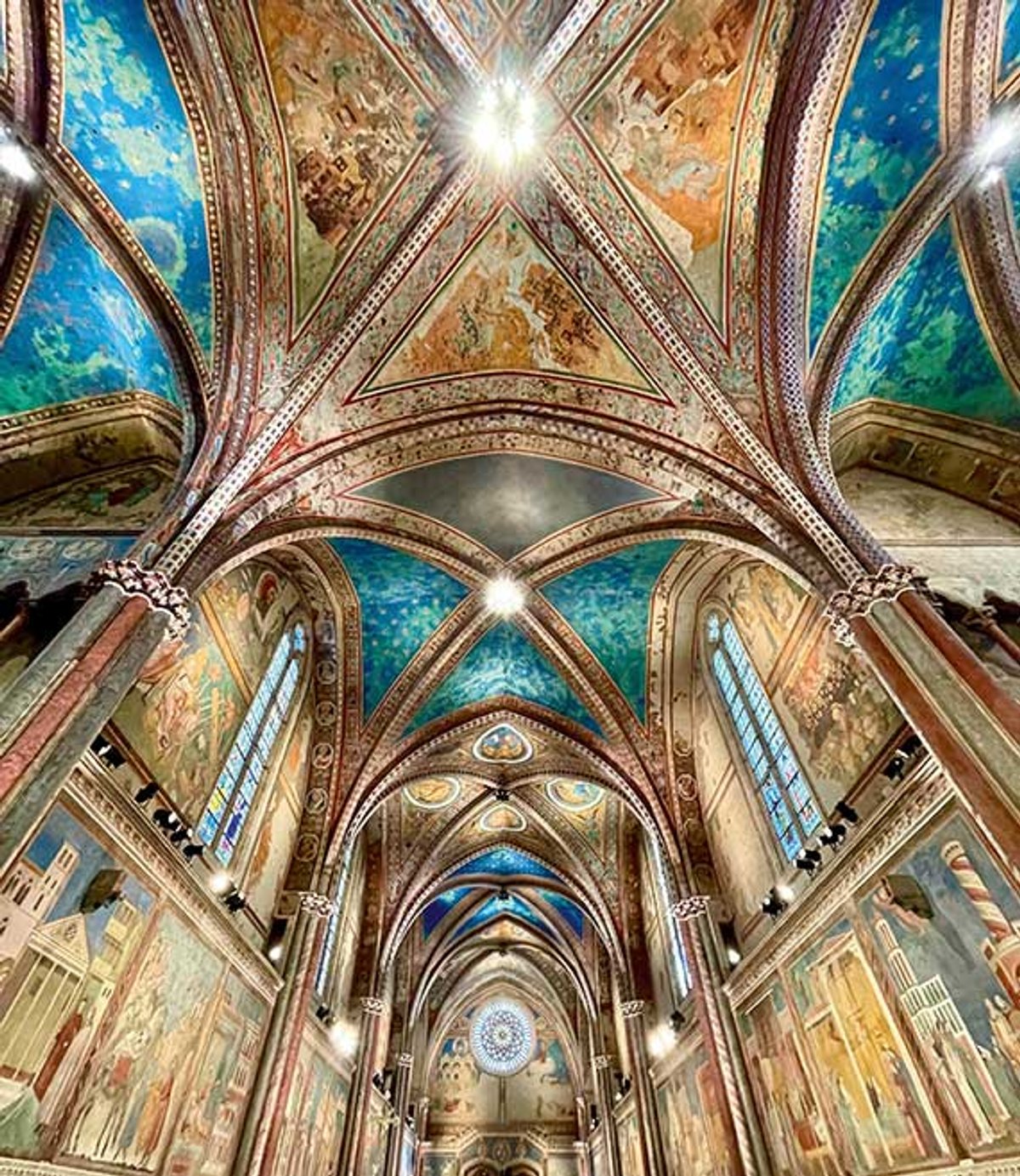
The Basilica di San Francesco in Assisi, a Unesco World Heritage site, was severely damaged when two powerful earthquakes measuring 5.7 and 6.0 struck in quick succession in 1997, killing four people and damaging a cycle of frescoes by Giotto depicting the life of Saint Francis. Among the most badly affected works was Cimabue’s fresco adorning a vaulted ceiling, composed of four curved triangular sections, each portraying one of the evangelists—Saints John, Luke, Matthew and Mark—against architectural scenes labelled Asia, Greece, Judea and Italy (here written in the archaic form of “Ytalia”).
Writing on Facebook in 2019, three years before becoming prime minister, Meloni remarked: “Centuries before national unity, the ITALIAN painter represented our homeland in this way, with the inscription ‘YTALIA’.”
Three of the four sections, those depicting Saints John, Luke and Mark, were shattered into relatively large pieces but largely reconstructable, allowing restorers to piece them back together. The fourth section, representing Saint Matthew, collapsed completely, leaving a gaping hole in the vault, and disintegrated into around 120,000 tiny fragments. Each fragment was painstakingly collected, scanned and catalogued. A neutral-coloured curved panel now fills the void in the ceiling, with just roughly 30 fragments subsequently reattached.
Now, a joint project headed by the Galleria Nazionale dell’Umbria in Perugia, which has officially worked with the Basilica’s guardians for the past decade, and the engineering department of Perugia University aims to determine whether AI can help reconstruct the shattered section.
Working from a photograph
The team, which includes officials from the Soprintendenza, the culture ministry’s conservation wing, is also working from a high-resolution photograph of the ceiling taken shortly before the 1997 quake. “The idea is to see if we can somehow find a way to piece together that enormous quantity of fragments based on their shape and colour,” Costantino D’Orazio, the director of the Galleria Nazionale dell’Umbria, tells The Art Newspaper.
According to D’Orazio, the idea originated with Culture Minister Alessandro Giuli, a Meloni ally, during a visit to the basilica in June. Around 15 staff members from the three institutions are now conducting a feasibility study that D’Orazio says should last at least six months. He indicates it is too early to say whether existing AI tools could be adapted for the task or bespoke technology would be required. The basilica’s own restorers would be ultimately responsible for reconstructing the work, he says.
In the meantime, the Galleria Nazionale has collaborated with Ikare, a Florence-based architectural imaging firm, to create a video projection that digitally reconstructs the missing section on the neutral panel. The €5,000 for the project, D’Orazio says, was primarily spent on renting projection equipment installed in the basilica’s right transept.
Stefano Giannetti, the co-founder of Ikare, explains that the projection was created using a 3D rendering created from the pre-earthquake photograph. It was, he says, a highly complex project because experts had to pinpoint the exact location from which the photo was taken, factor the curvature of the vault into the projection design, and integrate the projection with surviving coloured fragments on the vault. “To achieve a consistent result, I had to turn colours off and on in a long series of tests,” he says. “We weren’t aiming for simple lighting effects but to restore the sense of the fresco as a whole, in the name of cultural heritage.”