Erik Bulatov, the Soviet-born artist who became a key figure in the underground movement of the 1970s and 80s, known for philosophical works combining Communist Party slogans with radiant, expansive landscapes, died in Paris on 9 November. His use of ideological texts layered over light-filled skies left space for multiple interpretations, enabling his works to be publicly displayed even in Vladimir Putin’s heavily-censored Russia.
Bulatov belonged to a small circle of nonconformist contemporary artists, including Ilya Kabakov, Oleg Vassiliev and Viktor Pivovarov, who tested the limits of Soviet artistic dictates. Though subject to state pressure, they operated with a degree of freedom by illustrating children’s books. The group became known in the 1970s, after the end of Nikita Khrushchev’s Thaw, as the Sretensky Group, named after the boulevard in central Moscow near their studios.
Bulatov’s most expensive work, the monumental 1975 canvas Glory to the CPSU, juxtaposing the phrase over a serene sky of blue and white clouds, evokes Russian iconography, Soviet symbolism, and Sots Art, the Soviet equivalent of Andy Warhol’s Pop Art. The painting sold for $2.1m in London in 2008 at Phillips de Pury & Company, now Russian-owned Phillips. In 2025 The Art Newspaper Russia ranked Bulatov the most expensive living Russian artist, surpassing the former Sots Art duo Vitaly Komar and Alexander Melamid.
“Many people do some things for the state and earn the ability to do what they want for themselves,” Bulatov told The New York Times in 1986 in a report on the underground art world, which described the strict controls the Soviet state exerted over exhibiting and exporting art, as well as the cracks beginning to appear under Mikhail Gorbachev’s leadership.
A rare sale to the west
That year, Bulatov’s Picture with the Mark of Quality—its title referencing a Soviet symbol placed on top-tier export goods—was purchased in Moscow through Soviet authorities by a Western collector who had seen it at the Chicago International Art Exposition, to which it had been temporarily authorised for export. At the time, direct foreign sales of Soviet art were still prohibited.
Bulatov and his wife Natalia moved to New York in 1989 and in the early 1990s settled permanently in Paris. In his memoirs, recorded during a hospital stay and published in Moscow in 2025 as Erik Bulatov Tells his Story, he reflected on Glory to the CPSU, calling it his “most successful painting of that time”. At first glance, he said, the work resembles a propaganda poster, but its intentions run deeper.
“It turns out that the slogan ‘glory to the CPSU’ is written not on the sky, but on the surface of the painting,” he explained. “This flat surface establishes the boundary of the red letters’ dominion, beyond which they have no power. The letters, which initially seem like a grid separating us from the sky, become a system of windows and portals through which we can seemingly pass. Thus, all three elements that constitute the full spatial possibilities of the painting are used here: the letters represent relief painting, the sky represents the window painting, and the surface represents the boundary between them. Moreover, words are an image of social space, the surface is the boundary of social space, and the sky is the space on the other side of the social boundary. For me, this painting is a formula for freedom.” Another of his celebrated works juxtaposes the word svoboda (freedom) in white against a blue sky layered above the repeated phrase “freedom exists” in black, a visual paradox questioning the very idea it asserts.
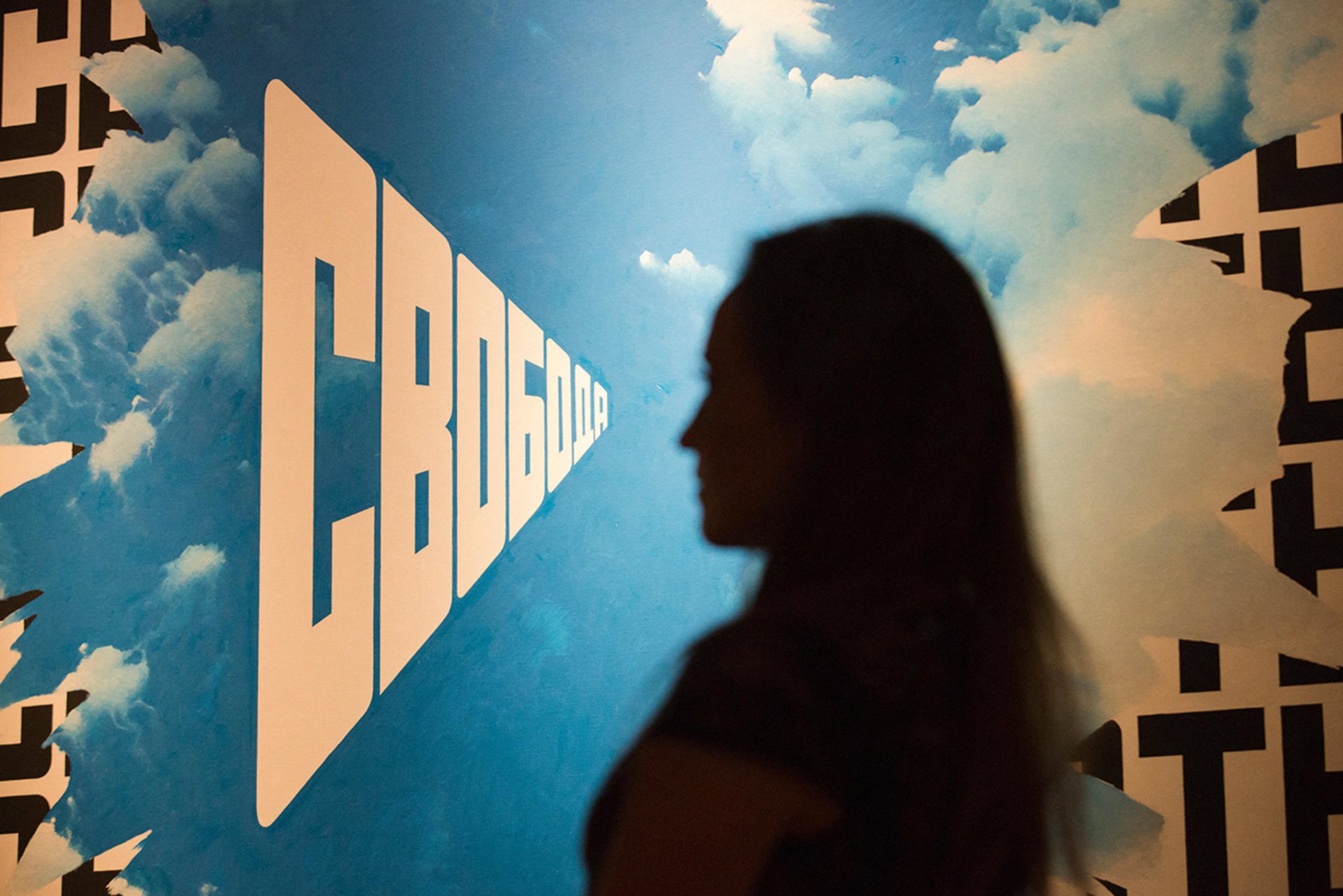
A gallery visitor in front of Freedom is Freedom II (2000-01), one of several paintings by Bulatov that feature large-scale text against a background of dreamy skies
Ukartpics/Alamy Stock Photo
Bulatov was born in 1933 in Sverdlovsk, now Yekaterinburg, the city where the Romanovs were executed and where Boris Yeltsin rose to power before ultimately paving the way for Vladimir Putin. Like many of his generation, he grew up knowing almost nothing of his family’s ancestry; social origins were often concealed or erased in the Soviet Union. His father Vladimir was a party worker sent to Sverdlovsk, and his mother, Raisa, born in Poland, came to Moscow as a supporter of the October Revolution. She later “began to understand that not everything was so simple in the USSR”, Bulatov said. The family returned to Moscow during his childhood, where he began drawing at an early age. His “happy childhood”, he said, ended abruptly on 22 June 1941 with the German invasion of the Soviet Union.
Bulatov studied at the Surikov Art Institute in Moscow, where the graphic artist Vladimir Favorsky became a major influence. Bulatov was also deeply affected by his encounters in the 1950s with Robert Falk, the avant-garde painter who had lived in France before returning to the USSR. “Unfortunately, those discovering Falk’s paintings today cannot experience the same impression they had on those who saw them in the 1950s, during [his] lifetime,” Bulatov wrote. He met Falk through his mother’s connections within the remnants of Moscow’s pre-revolutionary intelligentsia.
Learning to think as an artist
Favorsky, he recalled, “taught me to think and understand” as an artist, in contrast to the teaching system at Surikov, which left Bulatov and his classmate Vassiliev feeling that “all our skills and knowledge are worthless”. Only much later did Bulatov grasp that Falk and Favorsky, though having many differences, shared one crucial belief: that space—not the object—determines an artist’s worldview and the meaning of their work.
In a 2018 video YouTube interview that was part of Moscow’s State Tretyakov Gallery’s The Artist Speaks series, Bulatov explains why he stopped using Soviet symbolism. He stressed that he had never considered himself a dissident. “In principle, I always worked with the material that my own life offered me,” he says. “That Soviet material ended. It was perfectly clear. Under no circumstances did I want to exploit it any further. It was one thing when it was dangerous and frightening, but once it seemed in the past, to laugh at it or mock it felt undignified.”
In the video, as he walks through the Tretyakov galleries, he pauses at a work by Arkhip Kuindzhi, the 19th-century Mariupol-born artist with Greek ancestry who was claimed by Russia as its own. “For me, all of Kuindzhi is in this small landscape,” he says. “This colossal space of the earth, and there is nothing here, not a single object. Nothing for our eye to catch. But it turns out this can be done—to make only space, light and air, and they exist in absolute reality. It’s incredible. I don’t think there is anything else like this in world art.”
Ukraine silence
Bulatov, who professed affection for Moscow and said he never felt like an émigré, did not publicly condemn Russia’s invasion of Ukraine. This silence helped enable tributes from across the spectrum: dissident outlets abroad, lifestyle media and even Russian state-run news agencies.
Upon his death, Blueprint, a Russian online fashion and culture publication, published an interview from the previous year in which Bulatov discussed one of his last painting series, of works depicting doors, and artists who influenced the series. “The first was a black painting with a small crack, slightly ajar, and white light shining through it,” he recalled. “The second was with Velázquez, called The Open Door—again, there is light coming through the painting toward us, and everything we see, we perceive as reality—the sky, the clouds and the earth. The door is open, and we have a choice—to enter or not. As for the black door, only one thing is important here: the light that shines through the cracks comes from under the black. It does not fall on the black from above, but is light from the depths, from behind the door.”