Total star rating: ★★★★★
The works: ★★★★★
The show: ★★★★★
Neoclassicism is having a moment. Long regarded as the most predictable and least admired of the grand movements of Western art, it is turning out to be full of surprises. In 2023, Antonio Canova, the movement’s pre-eminent sculptor, emerged as a kind of proto-Expressionist in a double-venue US exhibition that highlighted his bracingly rough terracotta sketches. In 2024, France’s long-lost Caribbean-born practitioner, Guillaume Lethière, was rescued from oblivion in a landmark Franco-American show. And now, at the Musée du Louvre, Jacques-Louis David (1748-1825), the greatest Neoclassical artist of all, is having his biggest survey in almost four decades.
Opening a matter of days before the museum’s headline-grabbing robbery last October, Jacques-Louis David is an artistic event of the highest order, even if a cohort of thieves managed to steal its thunder. Complementing the Louvre’s own definitive holdings with lavish but strategic loans from around France and eight other countries, the exhibition—nominally mounted in honour of the 200th anniversary of the artist’s death, aged 77, in 1825—is on par with the Rijksmuseum’s Vermeer blockbuster in 2023, and the current Fra Angelico extravaganza in Florence (until 25 January). Comprising just over 100 works, the Louvre show will define its subject for decades to come. But can it redefine him as something other than a Neoclassicist? That, it seems, is the curators’ surprising intent.
Opening with David’s handwritten visiting card from the last decade of his life, along with ghostly previews of two studio versions of his eerie and supreme work, The Death of Marat (1793), the Louvre boldly announces that it is breaking David free of the longstanding Neoclassical label in order to present him, instead, as a both a “realist” and an “idealist”.
This is an extraordinarily well-arranged show, with a zigzagging installation marked by powerful and poignant vistas and pairings. And it is a venue-defiant show, which makes us forget the woeful shortcomings of the Louvre’s Hall Napoléon, the bunker-like rooms where the museum holds important special exhibitions. But is it also revolutionary? Can it compel us to re-
categorise the artist? After several visits, I would have to say that, more or less, yes, it is, and does.
The crucial facts of David’s turbulent biography are relatively well-known. Born in Paris in 1748, and raised at a time when the Rococo held sway (he received early advice from François Boucher), he was then swept up in the Neoclassical rejection of frippery and fancifulness, absorbing Italianate and classical sources while in Rome.
Dictator of the arts
Later, back in Paris, as a favourite of the Bourbon ruling family in the final years of the Ancien Régime, he painted sombre, proto-revolutionary works that preached civic virtue. Then during the French Revolution itself, he became a radical Jacobin and vocal supporter of Maximilien de Robespierre, an architect of the Reign of Terror. David held near-dictatorial powers over the arts, and went so far as to call for the execution of his former patron, Louis XVI. A spell in prison after the fall of Robespierre in 1794 was followed by his return to fame and power during Napoleon’s rise and reign, when, again, he became a regime’s favoured artist.
Bonaparte’s fall after Waterloo in 1815 and the return of the Bourbons to the French throne led to David’s official condemnation, and what amounted to a self-imposed exile in Brussels, where he died out of sorts with the wobbly pretences of Restoration France.
The curators arrange the show around nearly all of David’s major works. (A major exception, The Coronation of Napoleon, 1807, has been left in its usual spot in the Denon Wing.) While looking at the early painting St. Roch Interceding with the Virgin for the Plague-Stricken (1780), on loan from the Musée des Beaux-Arts in Marseilles, we can also just glimpse the career-making Oath of the Horatii (1784), brought down from its permanent Louvre position. The early, shadowy religious painting shows great talent, while the later work, set in Ancient Rome, is a taut and tense invocation of patriotism and secular sacrifice, in which the younger David’s influences, Caravaggio and Poussin, have been transformed and transcended.
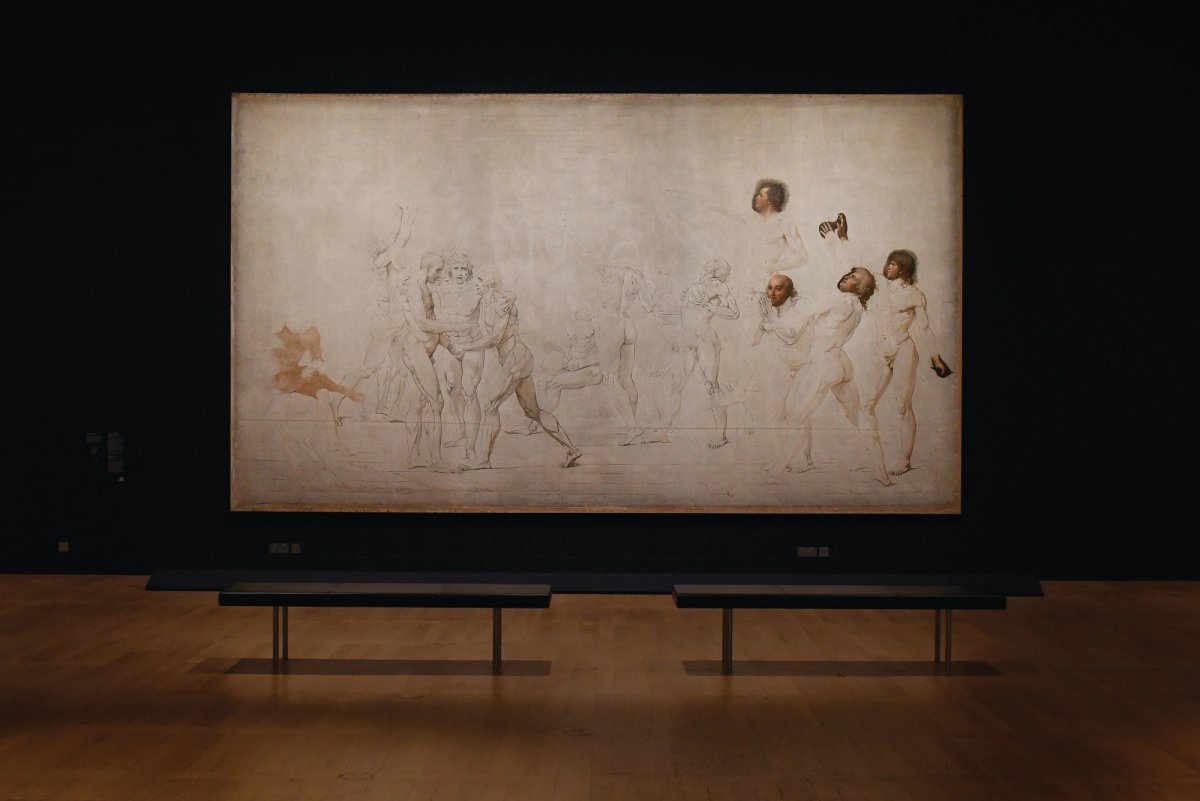
The path forward, to revolution, culminates in the Oath of the Horatii’s mirror work: the gigantic, unfinished canvas fragment of David’s planned 10m-long The Tennis Court Oath (1791-92), on loan from the Château de Versailles. Meant to commemorate a pivotal event in the French Revolution, when representatives of France’s Third Estate vowed to support a constitution, the project—eventually abandoned by David—lives on as an immense, mysterious draft, with anonymous nude bodies in states of being finished off with real people’s faces. The curators frame it in a view incorporating two of David’s greatest works of portraiture, both from 1790: the Louvre’s portrait of the Marquise d’Orvilliers and, on loan from the Neue Pinakothek, that of her sister, the Comtesse de Sorcy. Depicted in the early and ebullient phase of the revolution, they represent the French class who at first wanted the rupture, notes the Louvre’s Sébastien Allard, who co-curated the show with museum colleague Côme Fabre. Both paintings position their figures in David’s signature “neutral” backgrounds, as Allard says. And here, the curators allow that discreet and deliberate blankness to play off the vast, blank expanse of the nearby Tennis Court work.
The dark years of the Terror are commemorated in suitably dark galleries, bookended with David’s two self-portraits, ending with the Louvre’s own from 1794, completed while David was in prison. It is in these gloomy spaces that we encounter The Death of Marat in triplicate—the autograph version, on loan from Brussels, and the two adjacent copies that we glimpsed on our way in. Having all three is a reminder of the image’s impact. The murdered revolutionary’s equivocal pose—which seems to suggest both sleep and death, Allard says—has been much-imitated, but never demystified.
In what is less of a surprise than an urgent reminder, the show documents the width and depth of David’s talents. He mastered every genre, save landscape, and everything he did, from the smallest preparatory study to the large history paintings, looks exceptional here.
Critics have tended to cast aspersions on David’s later work, finding an element of satire creeping into the history paintings and post-Napoleonic portraits. But one final grouping is revelatory: The Anger of Achilles (1819), on loan from the Kimbell Art Museum in Texas; Portrait of the Comte de Turenne (1816), from the Ny Carlsberg Glyptotek in Copenhagen; andthe Louvre’s Portrait of Juliette de Villeneuve (1824). Here, we see how David’s nominally Neoclassical scenes are also group portraits, and how real-life figures can also be players in the costume dramas of their time.
Though none of these is regarded as major, together they testify to the freshness and uniqueness of the artist. Is he a Neoclassicist? Yes, unreservedly. But is he much more than that? Yes. Indeed.
• Jacques-Louis David, Musée du Louvre, Paris, until 26 January
Curators: Sébastien Allard and Côme Fabre
Tickets: €22-€32 (included with general admission)
What the other critics said
Jackie Wullschläger, writing in the Financial Times, calls it “a colossal, riveting retrospective” that can only be staged by the Louvre “since it owns most of his paintings, including some too big to move. To this cornucopia are added essential loans, making the exhibition a once-in-a-generation chance to understand this difficult, wily painter.” In Le Monde, Harry Bellet notes how the show differs from the Louvre’s huge 1989 survey by being “more cautious, more nuanced” and breaking with the idea that David was just a Neoclassicist.