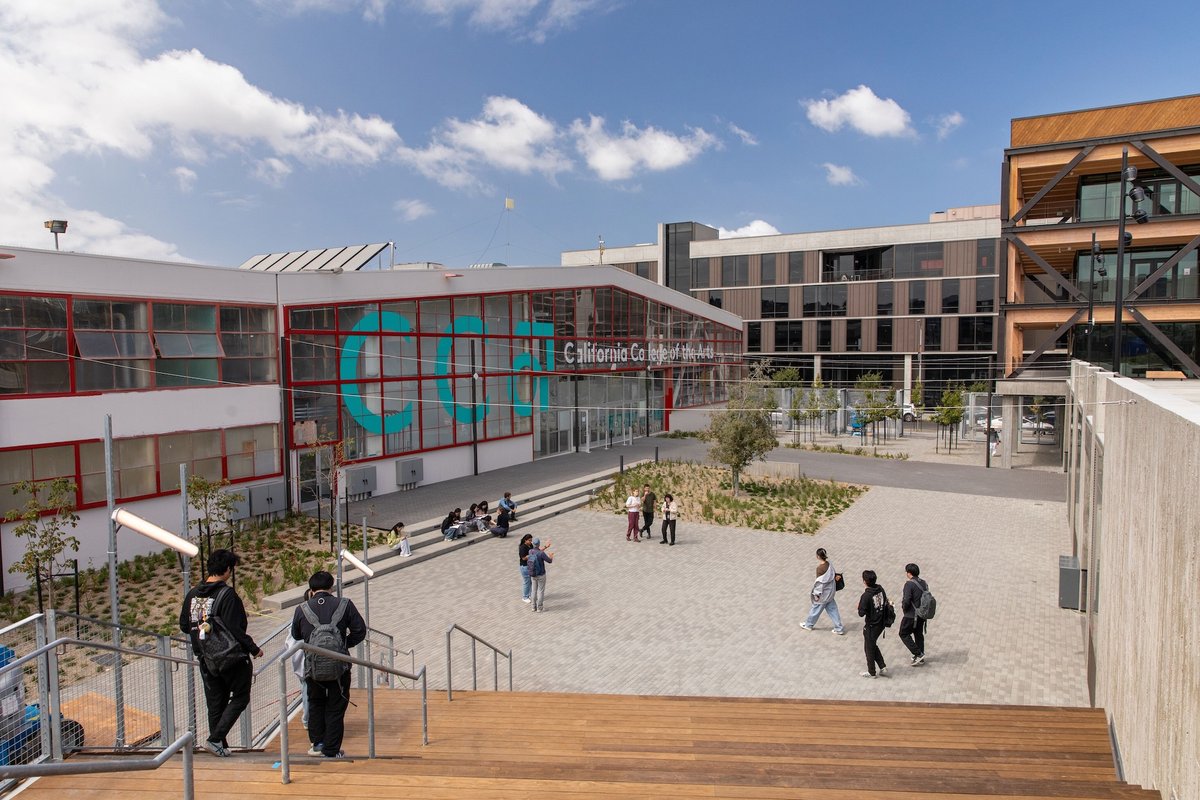
The California College of the Arts (CCA), which has struggled with declining enrolment and a $20m deficit, will close permanently in 2027. The college’s recently expanded campus in San Francisco, as well as its former properties in Oakland, will be purchased by Nashville’s Vanderbilt University.
“This was not a decision we reached lightly, and we expect there may be feelings of shock, frustration and disappointment,” David Howse, CCA’s president, wrote in a message posted today (13 January) on the college’s website. “After nearly two years of working to resolve the college’s underlying financial challenges, we know this is the necessary step to take.”
Vanderbilt will operate the former CCA complex in San Francisco as a West Coast satellite campus for around 1,000 undergraduate and graduate students, including art and design programmes. Vanderbilt will also take ownership of CCA’s former campus in Oakland, which the college occupied from 1922 to 2022, though its plans for that property have not been finalised.
Beyond its programmes in ceramics, fashion design, sculpture, textiles, painting and drawing, curatorial practice and more, one of CCA’s main public-facing attractions is its contemporary-art centre—the CCA Wattis Institute for Contemporary Arts. A spokesperson for the college tells The Art Newspaper that the Wattis will continue to operate after CCA winds down, as part of a “CCA Institute at Vanderbilt”. That will also include maintaining CCA’s archival materials and engaging with the college’s alumni—who include prominent contemporary artists such as Jules de Balincourt, Toyin Ojih Odutola and Hank Willis Thomas.
Howse’s message announcing the closure at the end of the 2026-27 academic year notes that the students on track to graduate by then (numbering 484, according to KQED) will be able to, while CCA “will be working closely with accredited institutions to establish transfer and completion pathways” for students whose coursework extends beyond spring 2027. That may require students to relocate relatively far afield since, as Howse notes: “CCA is the only remaining private art-and-design school in the Bay Area”.
According to KQED, a total of 207 undergraduate students and 117 graduate students started their studies at CCA last autumn. (Several of the region's largest private universities, including the University of California Berkeley, Stanford University and San Francisco State University, offer undergraduate and graduate programmes in fine art, art history and related fields.)
Before the start of the 2024-25 school year, Howse held a meeting with 300 CCA staff and faculty to share the severity of the college’s financial problems, including a $20m budget deficit and enrolment down a third from its 2019 high of around 1,800 full-time students. At the time, the college had wrapped up a $97.5m overhaul of its San Francisco campus as it integrated activities previously conducted on its Oakland campus. The college was able to stave off the worst impacts of that crisis, but only temporarily.

“Yes, it is true that with the generous help of trustees, a group of important private donors and a grant of $20m from the state of California, we were able to avoid a financial crisis and earn time to plan more effectively for the future,” Howse wrote. “And yes, it is true that a series of budget cuts have provided some relief on the expense side. But these measures have proven to be temporary and not sustainable if we are to serve our community effectively.”
News of CCA’s closure comes after another storied Bay Area art school, the San Francisco Art Institute, closed amid similar deficit and enrolment problems. That school, already struggling before the pandemic, was left in an even more precarious position, shuttering in 2022 and filing for bankruptcy the following year. It was acquired by Laurene Powell Jobs's nonprofit in 2024 and is said to be reopening as an unaccredited art school at a future date.