As unrest continues across Iran, its impact is felt well beyond the streets. Protests that began on 28 December among bazaar traders who were angered by the crashing currency in an already ailing economy soon spread, reaching artists and gallerists. Many galleries changed their opening hours, closing ahead of the nightly 8pm protests, while others shut their doors or cancelled exhibitions, some seemingly under public pressure.
Since the government shutdown of the internet and other communications on 8 January, information from the ground has been scarce.
Some Iranians were able to have limited internet access through unofficial channels, and The Art Newspaper was able to reach one established gallery via an intermediary.
Speaking anonymously for fear of retribution, the gallerist says, “I wasn’t planning on closing. I believe that galleries and cultural spaces, especially in a country like Iran and in times of chaos, function as more than just physical spaces that showcase artworks. They can serve as spaces for free dialogue.”
However, as the protests turned violent and reports of arrests and killings emerged by 8 January, the gallery closed. Other galleries also shut, though the gallerist stresses that it is impossible to know how others are responding because communication is now largely limited to phone calls.
“This time feels different—it isn’t simply about whether galleries stay open,” the gallerist says, recalling the previous unrest in 2022. “This time it is about a unified act among many sectors of society: businesses, the bazaar, privately owned restaurants and cafés and others. We decided to stand with what was happening as part of a broader collective action. This is an act of unity.”
Describing the state of the economy as “in its worst condition”, the gallerist says many people can no longer afford basic necessities such as meat, bread, eggs or oil. Instability makes even simple purchases impossible. For example, the price of bubble-wrap from a longtime supplier could not be fixed because the supplier expected the price to increase by 70% the next day. “Can you imagine?” the gallerist says.
The gallerist says that during times of war and protest there is little appetite for cultural activity, and their own staff are losing the motivation to work. They are unsure how long the gallery will remain closed, but believe that artists need to be in “better spirits” before reopening.
“It's all up in the air, not knowing what to expect, not knowing what will happen,” they say. “It’s a feeling I’ve never experienced in my whole life. Just not knowing. I don’t think it’s possible for anyone in the Western world to know how it feels.”
A gallery founder who spoke to The Art Newspaper before the communication blackout echoed the fears of an uncertain future. “This is unprecedented and unpredictable. The only thing we know is that our projects are on hold. We don’t know if future exhibitions will happen or not.” The founder added that staging an exhibition would risk public backlash for both artists and galleries. “They don’t want to be in that position, nor does the gallery.”
Amin Bagheri at Ab-Anbar Gallery Photo: © George Baggaley. Courtesy of Ab-Anbar Gallery
The popular Instagram account Galleryinfo.ir, which promotes visual art exhibitions in Tehran, was targeted online for posts on 5 and 6 January highlighting exhibitions. Responses ranged from insults to questions about the relevance of art at this time. Some accused the platform of lacking honour or humanity, while others asked if it expected people to go “gallery hopping” amid the crisis. The account’s last post appeared to respond to the criticism, noting, “as always, we stand by you step by step—by the side of the art and the artists of this land. This journey and companionship have no end. Long live and prosper our Iran.”
Similarly, Bavan Gallery changed course within 24 hours. After initially posting “resilience is an art form”, it later announced that it would not hold any exhibitions, adding that “the gallery is a white cube space, open for presence and dialogue”. An art scholar also faced backlash after suggesting that galleries and artists should remain open to fulfil their societal role.
By 13 January, limited one-way calls from Iran to the outside world were possible, and some video images began to emerge of morgues filled with bodies. Reuters cited an unnamed official confirming that around 2,000 people had been killed, including security personnel, though at time of publication no official figures were released. Meanwhile, US President Donald Trump’s repeated threats of action, including military intervention, in support of the protestors have further heightened tensions.
The violence and uncertainty over a potential war have affected even those outside of Iran. One artist, who requested anonymity, was due to return from Europe on 12 January but postponed her trip at her family’s urging until the situation became clearer. She had been in Europe for a group exhibition and a residency when the unrest began. Being far from the events and cut off from her loved ones, she says, has been difficult.
“Out of 24 hours, I spend perhaps 17 of them on social media, searching for news, images and videos of what is happening,” she tells The Art Newspaper. “This being in-between and not knowing is very difficult. I want to return home.”
The artist was abroad when the currency dropped to record lows and says she was consumed with worry for ordinary people. Even before this crash, she says, life had become unaffordable. Her long-term frame maker, for example, was forced to lay off staff.
She stresses that her own professional life is secondary—her main concern is for those in Iran, living in limbo. “It was always strange to me when I travelled to Europe and saw other artists planning meetings a year ahead. This is impossible for an Iranian, we can’t plan anything,” she says, recalling her last trip, which was cancelled after the surprise military attack by Israel.
The artist has another art residency in Europe scheduled for this summer, but she says it is the last thing on her mind. “I’d rather see the situation change and life become better for Iranians.”
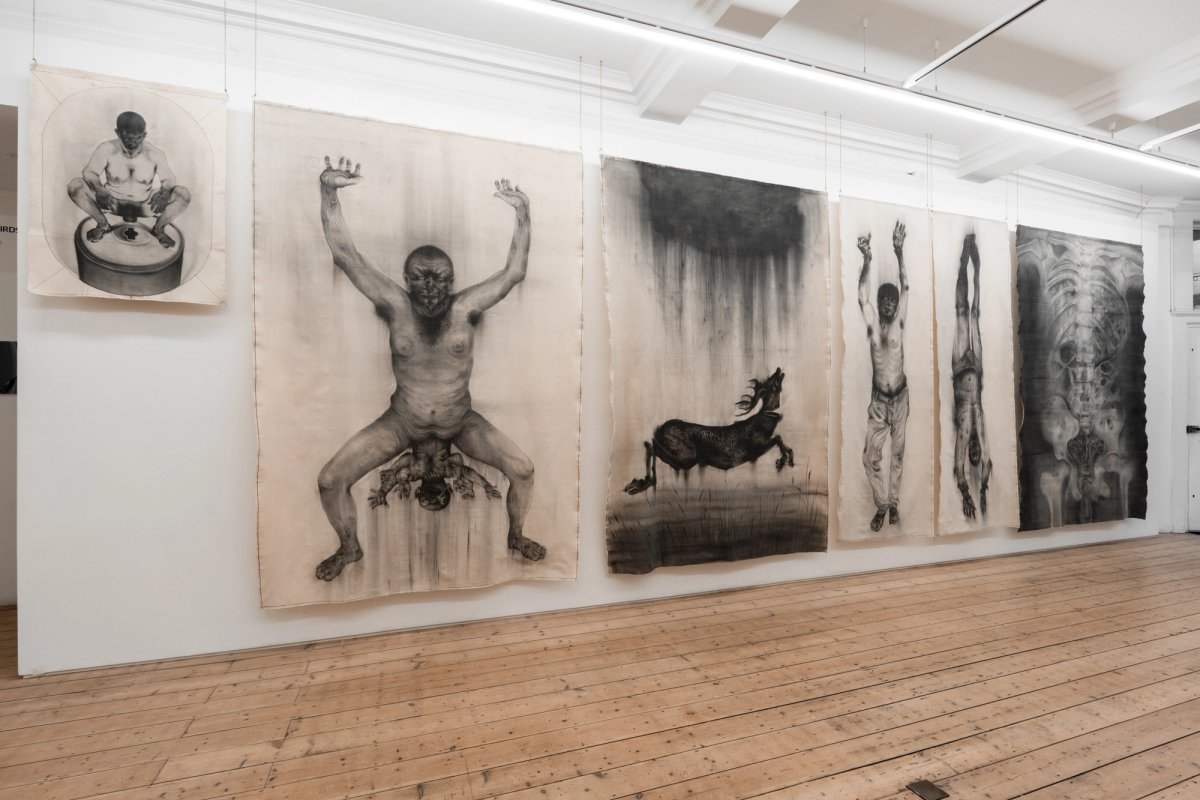
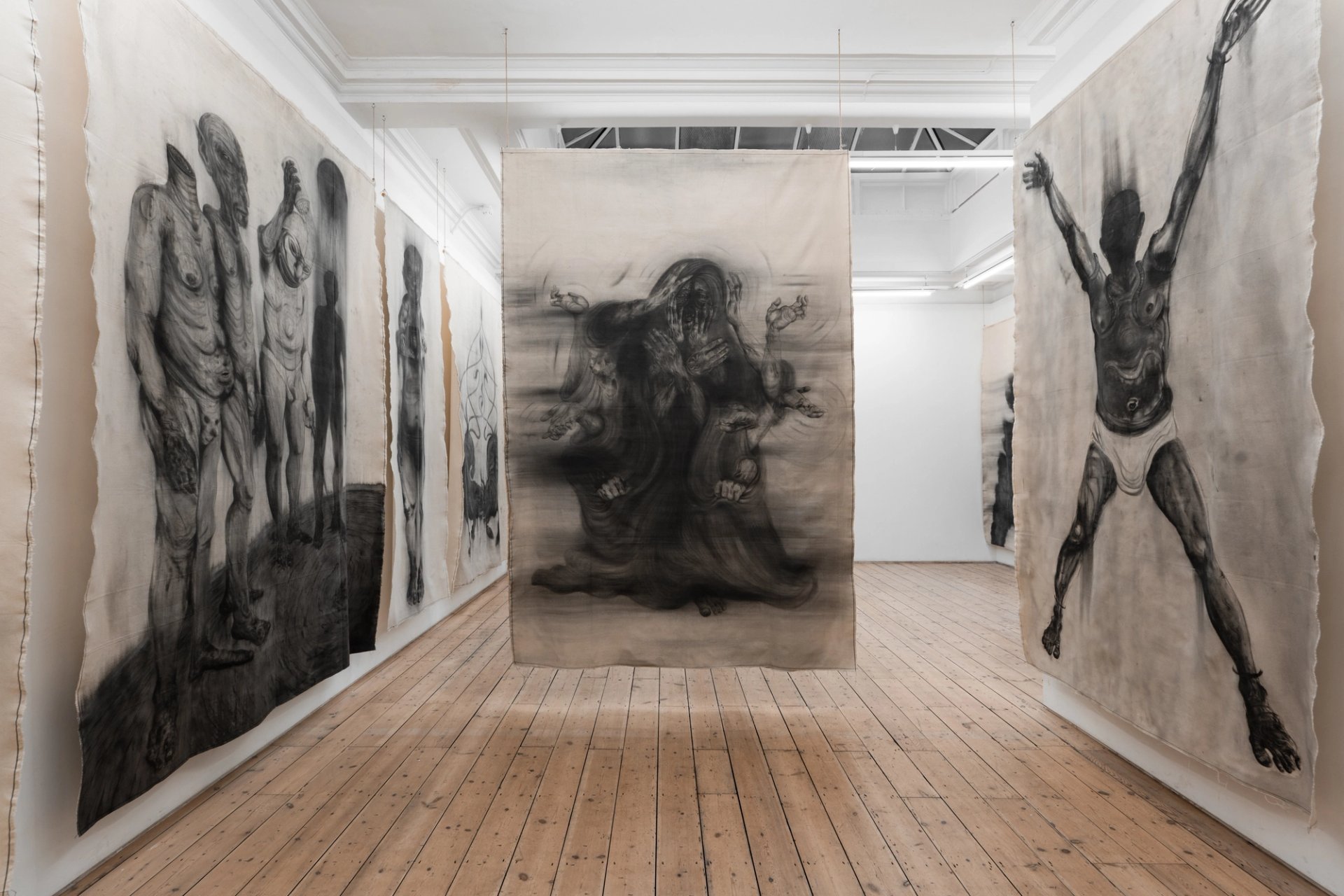
Her anxieties are shared by others struggling to navigate the unrest from abroad. Salman Matinfar, the founding director of Ab-Anbar Gallery in London, tells The Art Newspaper about his worries for friends and family in Iran, including Amin Bagheri, “a very talented artist” from Rasht, whose work is currently on show at the gallery in his first UK show. “His last message to me was on Thursday, he wrote ‘the internet is cut’ and that was it,” Matinfar says.
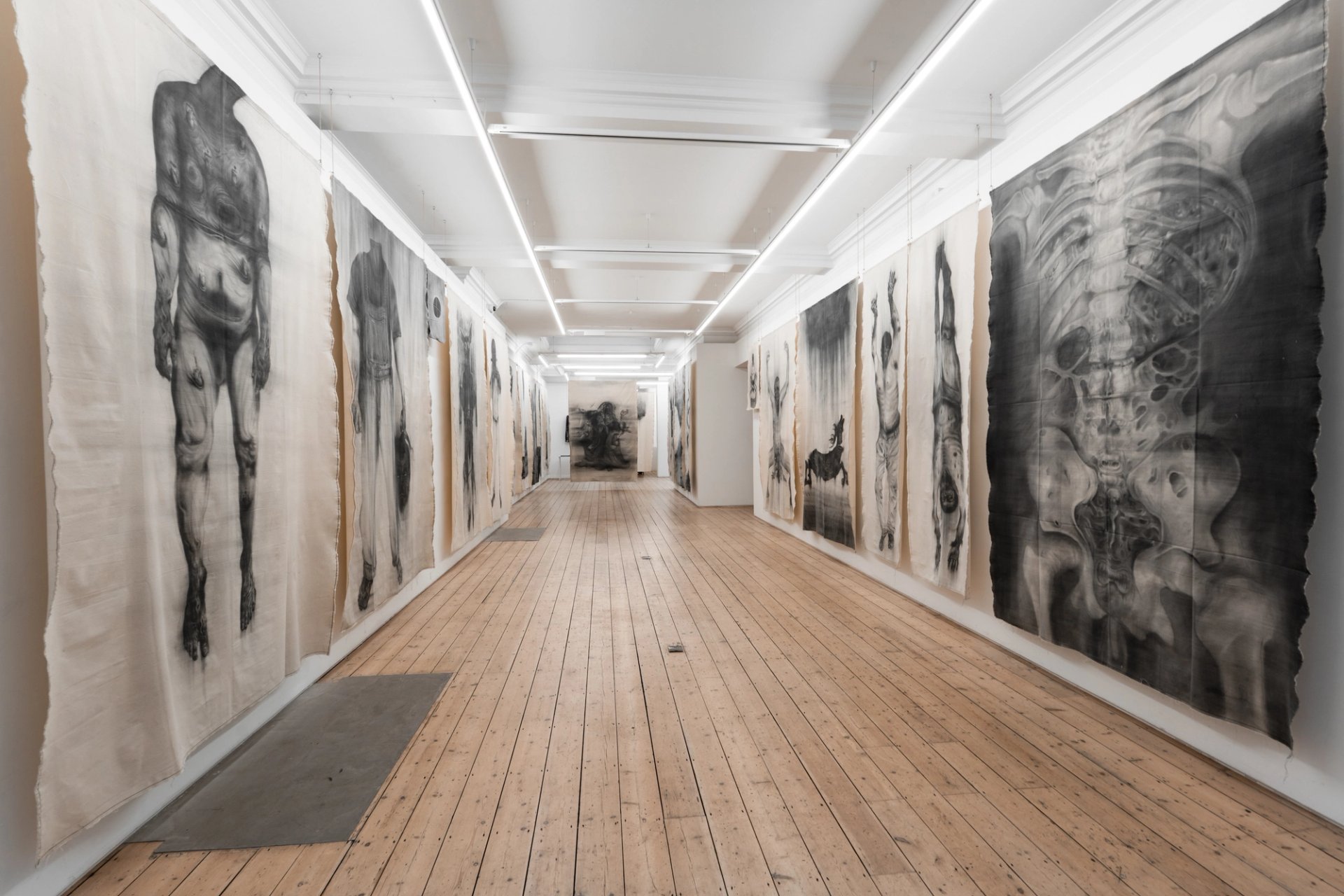
Amin Bagheri at Ab-Anbar Gallery Photo: © George Baggaley. Courtesy of Ab-Anbar Gallery
Matinfar says the timing of Bagheri’s show—Hyle – Dark Light, planned over the past year—coinciding with the unrest, makes it feel especially resonant. The 25 large graphite drawings on suspended cotton fabric explore the coexistence of opposites, good versus bad, and the gaps in understanding, revealing the enigmatic, often monstrous, nature of existence. “This work was always relevant, but it’s more visible now. It’s as if it were covered with dust, and now the dust is gone,” he says.
While many of the works cannot be shown in Iran due to censorship around nudity, the exhibition includes one piece depicting an X-ray image of gunshot wounds, which, Matinfar says, seems inspired by the X-ray images of shot protest victims that circulated online during the previous unrest. Other pieces from that series were shown in Iran, which he describes as a form of resistance. Bagheri’s exhibition has been extended until the end of February.
During the first weekend of the communication blackout, the gallery opened on Sunday to anyone affected by the events, providing “a safe space to speak”, which Matinfar calls a form of therapy. As for galleries staying open inside Iran, he says, “I think this can be a first practice of democracy: let people decide for themselves. If a gallerist wants to keep their space open and work, they should be able to do so without being taunted or pressured. And anyone who wants to remain closed should be free to do so too.”