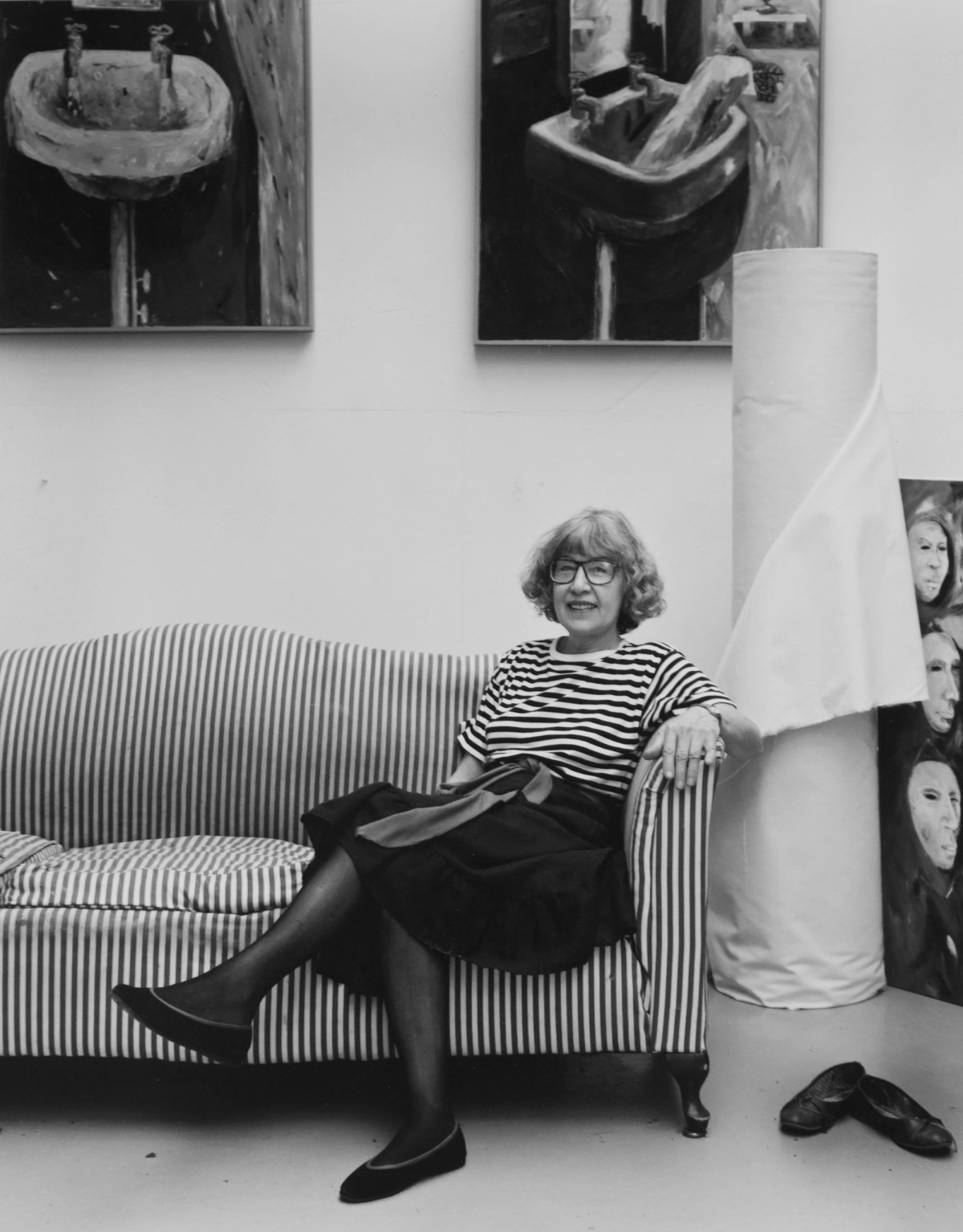
Gathie Falk, the acclaimed Canadian artist whose practice ranged widely across six decades from paintings with a Surrealist edge and hand-fashioned ceramics to sculptural installations and performance, died at her home in Vancouver on 22 December. She was 97.
In Falk’s hands, the quotidian was straw spun into gold. Her alchemical approach turned glazed ceramic apples and cabbages into jewels, a wedding veil into a gravity-defying ghost of marriages past and a painting of the starry night sky into a celestial portrait of the urban firmament. Her sculptures and installations included works consisting of rows and grids of ceramic shoes, the Picnics (1976-77) series of sculptures of Surrealist food still-lifes, and a 1977 exhibition for which she commandeered her estranged husband’s vintage Ford coupe and filled it with ceramic watermelons.
One of her best-known painting series, Cement With Poppies (1982), depicts the poppies that spilled out over the sidewalks that encircled her former 1920s Craftsman house in Vancouver. She once said of the canvases: “I feel that unless you know your own sidewalk really intimately, you’re never going to be able to look at the pyramids and find out what they’re about.”
That outlook captured Falk’s self-described “veneration of the ordinary” and, appropriately, she made her own pyramids from arrangements of exquisitely rendered ceramic fruits, inspired by her local greengrocer. “My idea was to do the things in my head,” she explained. “They were all experiments, but it was just to make the things in my mind that were visually and emotionally strong.”
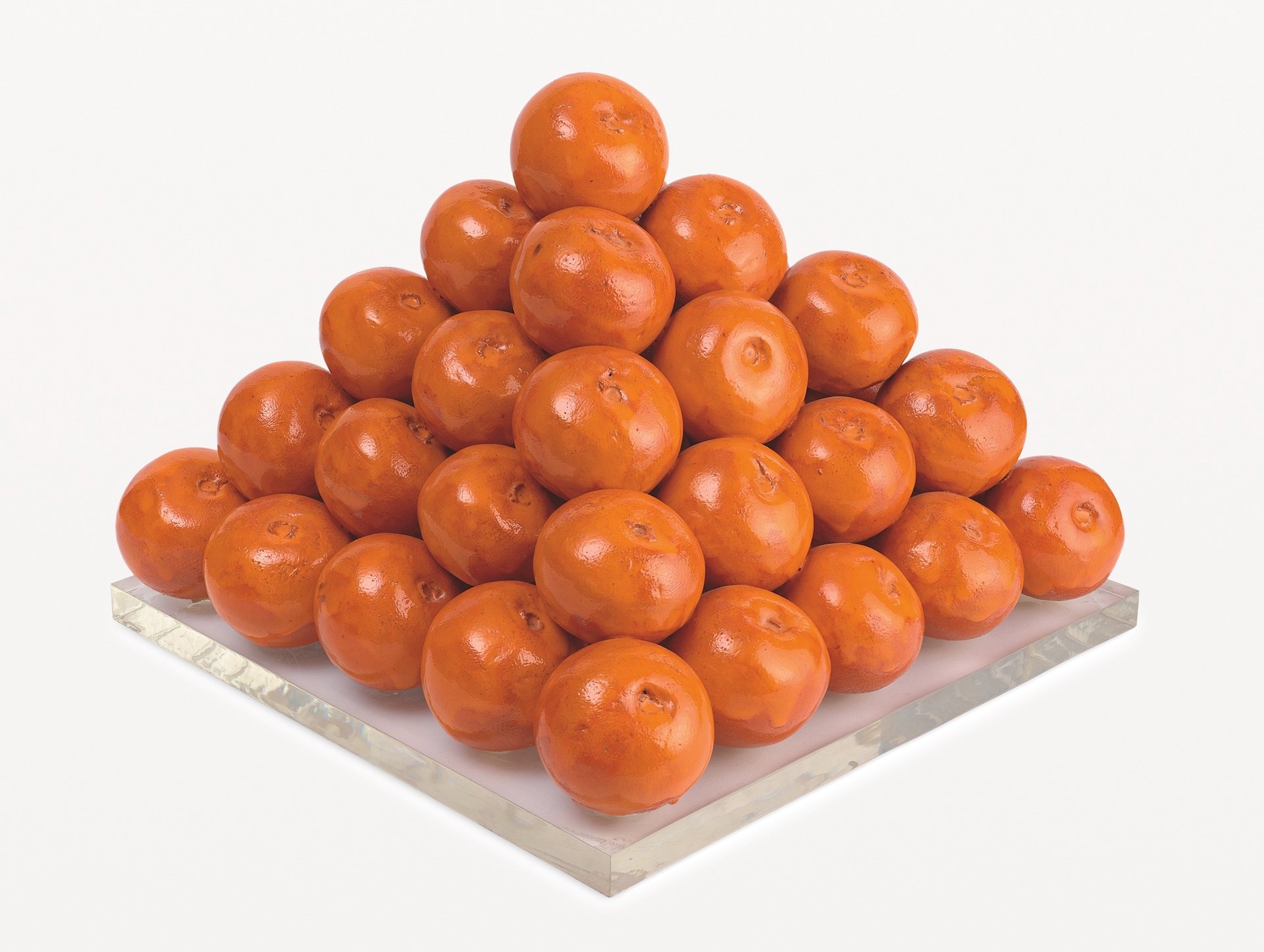
Gathie Falk, 55 Oranges, 1969-70 Courtesy of the TD Corporate Art Collection. © Estate of Gathie Falk. Photo: Craig Boyko
Born in rural Manitoba in 1928 to Mennonites who fled Communist Russian persecution, she grew up in poverty. “Growing up poor meant being resourceful and learning how to make new things out of the old,” Michelle Jacques, the head of exhibitions and collections and chief curator at Remai Modern in Saskatoon, wrote in a 2022 book on Falk published by the Art Canada Institute. “While the household Falk grew up in wasn’t necessarily artistic, it was certainly crafty and creative.”
While she initially pursued after-school art classes in Winnipeg, a teenage Falk decided her destiny lay in music and she enthusiastically sang in local Mennonite choirs, a practice that would help her through the difficult times that lay ahead. When her family was informed it had to pay back the Canadian Pacific Railway for its passage from Russia, she quit school and found full-time employment in a food packing plant.
In her memoir Apples, etc. (2018), published by Figure 1 and co-authored by Robin Laurence, Falk recalled singing hopeful songs with her co-workers while “filling cellophane bags with raisins, dates, brown sugar, peas, beans and chocolate rosebuds”. When she was 18, the family moved to Vancouver, where Falk found work in a luggage factory, sewing pockets on the inside of suitcases. As Laurence noted, curators and critics later saw this job “as formative to her capacity for detailed handiwork and repetition within the context of artmaking”.
Falk eventually became a teacher and, when she upgraded her teaching degree in 1957 at the University of British Columbia, she also enrolled in art courses, where she became enamoured of the German Expressionists. In 1965, at age 37, she cashed in some of her pension fund and began studying art in earnest. She studied ceramics with Glenn Lewis in the 1960s, shortly after he had returned from Devon where he and fellow Canadian ceramicist John Reeve had built a pottery studio.
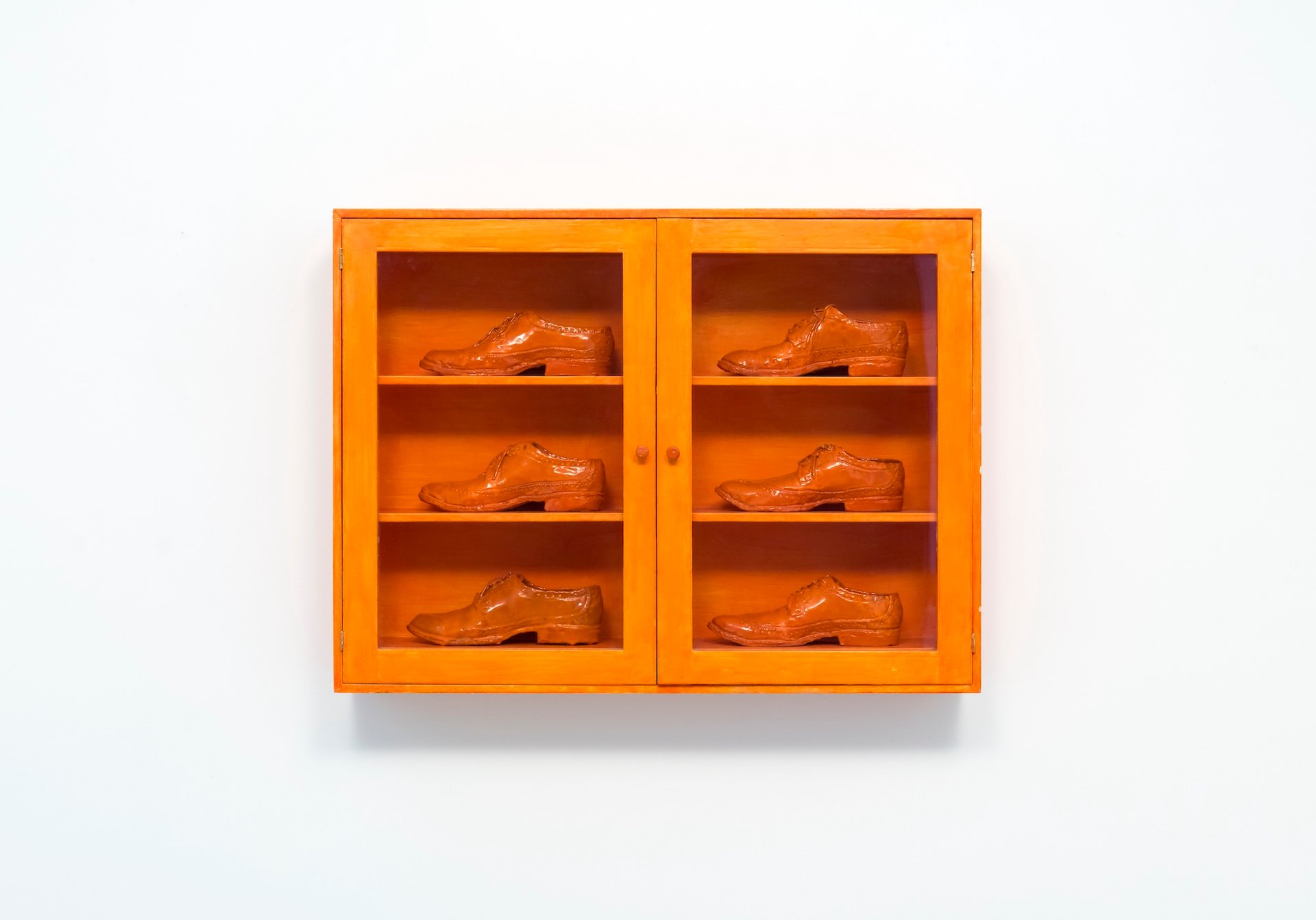
Gathie Falk, Single Right Men’s Shoes: Bootcase with 6 Orange Brogues, 1973 © Estate of Gathie Falk. Photo: Equinox Gallery
“I taught Gathie and the other students, what I knew—production pottery in a traditional workshop method where they could hone their skill in an intuitive way,” Lewis tells The Art Newspaper. “With these skills I encouraged them to experiment making sculptural work with an everyday world feeling. Gathie had an amazing capacity to express the visual world she lived in with an authentic, simple, charmed vision that had a subtle feminist story. We both worked subsequently on our art at Intermedia [an experimental artists’ society in Vancouver he co-founded] and in particular, produced performance art works in 1968.”
Falk’s breakout moment came at age 40 with her second solo exhibition, Living Room, Environmental Sculpture and Prints, at Vancouver’s Douglas Gallery in 1968. The show’s centrepiece was the titular installation (which she later re-titled Home Environment), a pastel-hued domestic space combining her custom silkscreened wallpaper, ceramic renderings of everyday items like a phone and a men’s jacket with modified thrift store items. It is now in the permanent collection of the Vancouver Art Gallery (VAG), which has the largest holdings of her work and has organised many solo exhibitions, including her first retrospective, in 1985, and another in 2000.
Stacks of accolades
Falk had more than 50 solo exhibitions over her six-decade career, and her works are in the collections of many of Canada’s most important public collections including the National Gallery of Canada in Ottawa and the Art Gallery of Ontario in Toronto. She also received the Order of Canada (in 1997), the Order of British Columbia (2002), the Governor General’s Award in Visual and Media Arts (2003) and the Audain Prize for Lifetime Achievement in the Visual Arts (2013), among other accolades.
Falk’s most recent retrospective, Gathie Falk: Revelations (2022-24), was curated by Sarah Milroy, the executive director and chief curator at the McMichael Canadian Art Collection in Kleinburg, Ontario. After its run at the McMichael, it travelled to Glenbow in Calgary, Alberta, and the Audain Art Museum in Whistler, British Columbia.
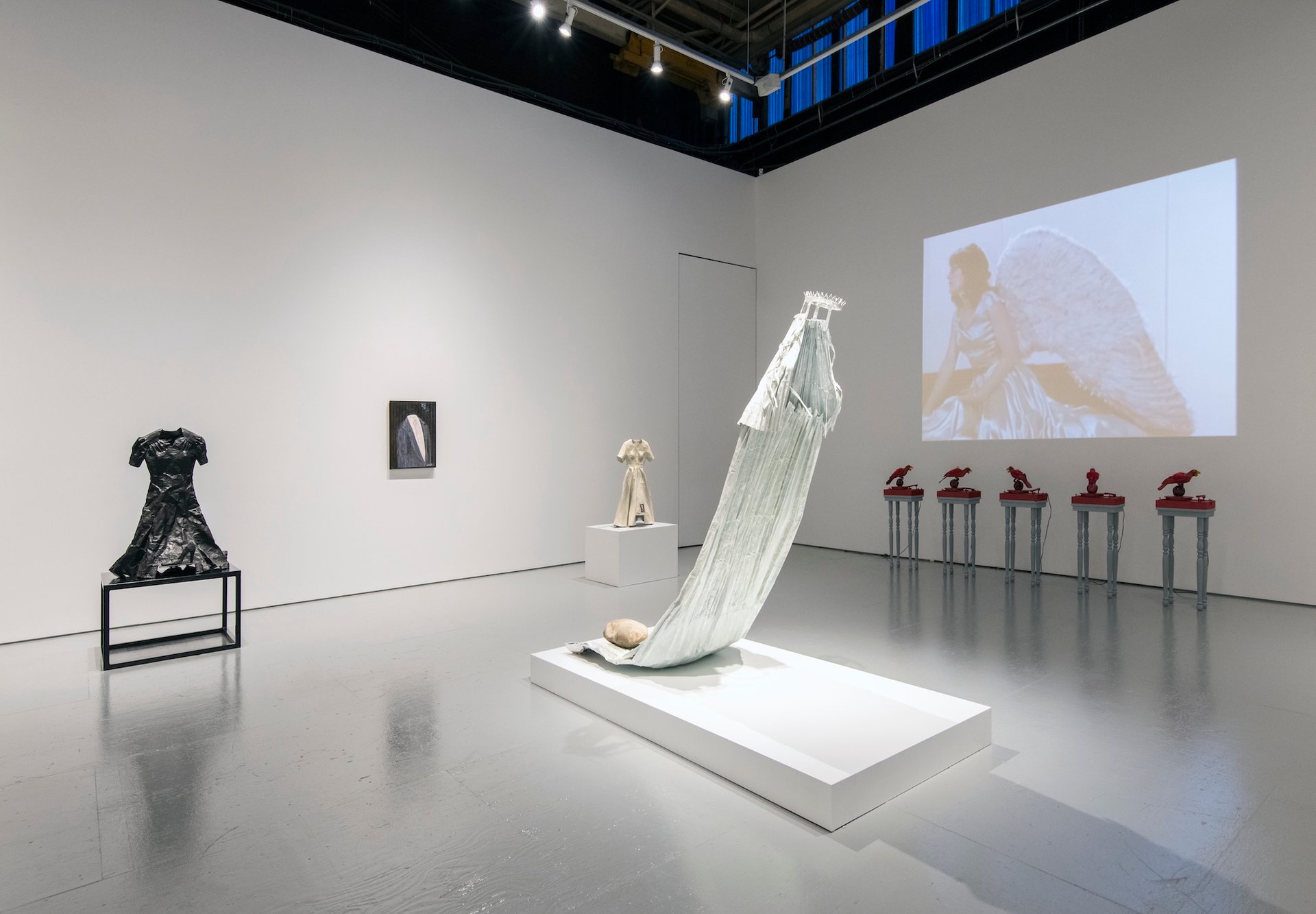
Installation view of Gathie Falk: The Things in My Head (2015) at Equinox Gallery in Vancouver Photo: Equinox Gallery
Milroy says that at the time Falk was making a name for herself in the Canadian art scene, Toronto and Montreal’s artistic communities were “comparatively insular”, while Vancouver in the late 1960s and 70s was a “hotbed of new ideas, flowing into the city via the Vancouver Art Gallery—which was very advanced for its time—and Alvin Balkind and Abe Rogatnick’s New Design Gallery, and the Fine Arts Gallery at the University of British Columbia”.
Artists like Yvonne Rainer and Robert Smithson were visiting Vancouver at the time and making work, as well as many leading artists from Los Angeles, Milroy says, and a group of Fluxus artists from the US and Europe congregated around the Western Front artist-run centre.
“It was in this milieu that Gathie’s sensibility quickened,” Milroy says. “She was most likely as influenced by Yvonne Rainer’s choreography of everyday movements, which she experienced in a workshop Rainer lead at the VAG, as she was by any of the painters or sculptors working around her. Gathie created her own unique amalgam of everything that moment had to offer.”
But Milroy contends that Falk has been “mis-filed in the story of art in Canada”. While many have seen her work and her interests as related to Pop art, “she was in fact more influenced by her own Mennonite upbringing, with its emphasis on hard work and dedication to the handmade, and a kind of love of simple everyday things—like a pile of apples at the corner store, or a pair of worn-out men’s shoes.”
She adds: “Gathie clearly revelled in bright colour, and she had a light comic touch, but she was miles away from Pop art’s infatuation with the machine-made, with plastics and with the allure and shallow promise of consumer goods. Hers was an art of everyday, humble things.”
- Gathie Falk, born Alexander, Manitoba, 31 January 1928. Married Dwight Swanson, 1974, divorced, 1979. Died Vancouver, British Columbia, 22 December 2025