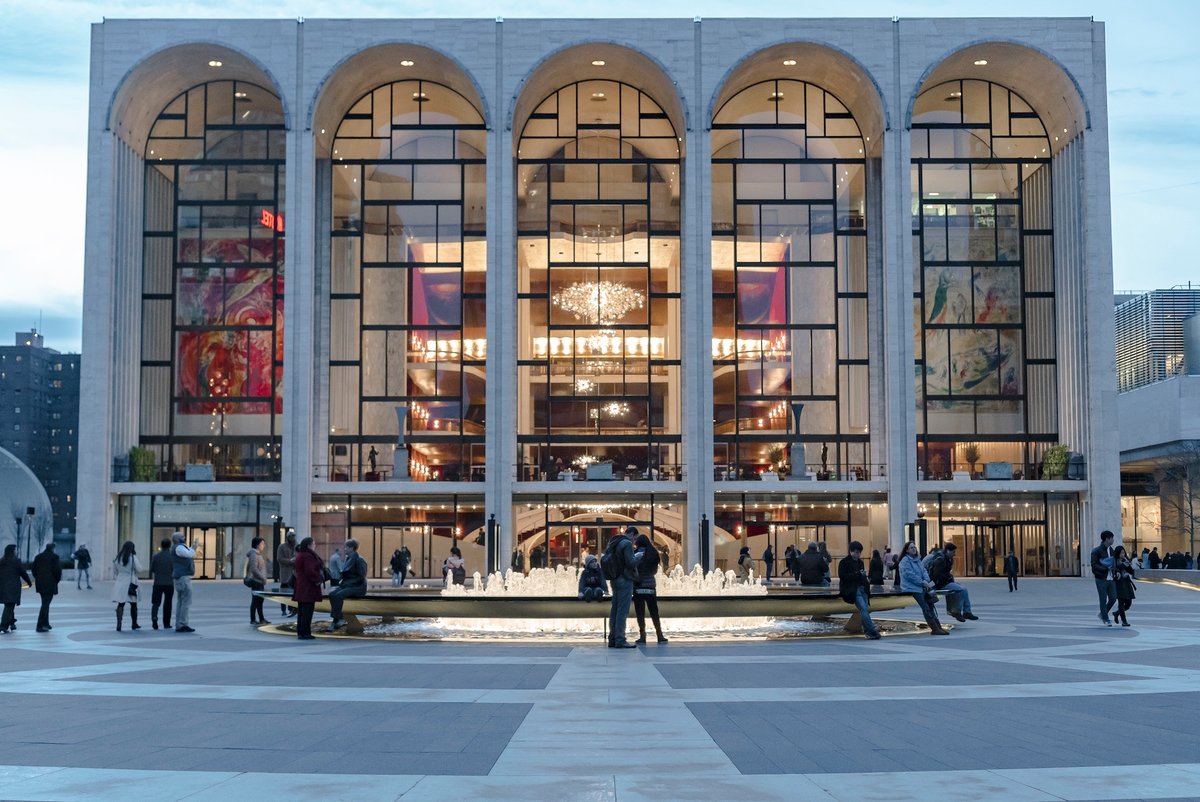
Amid mounting financial issues, the Metropolitan Opera, the largest performing arts organisation in the United States, announced on 19 January that it would lay off 22 workers, temporarily cut the salaries of its executives and explore a plan to sell its towering, site-specific Marc Chagall murals.
The two multi-storey, site-specific murals that Chagall created for the Met, The Triumph of Music and The Sources of Music (both 1966), have been collectively appraised at $55m by Sotheby’s. If they are offered for sale, it will be under the condition that the buyer leaves them in place. The new owner, in the event of a sale, would be identified by an adjacent donation plaque.
During a previous era of financial hardship, in 2009, the Met Opera put the murals—then appraised at around $20m in total—up as collateral for a loan.
According to The New York Times, the Met Opera’s general manager, Peter Gelb, also stated that the venue was postponing a new production from the forthcoming season, Modest Mussorgsky’s Khovanshchina. Gelb maintains that these steps were taken to address revenue issues downwind of a previously announced $200m deal with Saudi Arabia that made headlines last September. As part of that agreement the Saudis committed to subsidise the Met in exchange for the company coming to Riyadh to perform at the Royal Riyadh Opera House three weeks out of the year in winter. News of the alliance sparked criticism, given the Saudi crown’s history of human rights abuses, but Gelb defended the merger, emphasising the need to stablise the opera company in an arts ecosystem marked by declining donations and ticket sales. Now, the payout from that agreement has seemingly been delayed requiring further belt-tightening from the Met.
“I understand the Saudis have had to recalibrate their budgets because of their own economic concerns,” Gelb told the Times. “I’ve been assured that it’s going to go forward. But we have been waiting for some time.”
The Met, which has an annual operating budget of $330m, drew $120m from its endowment last year to keep up with costs, and Gelb has made it clear that further steps may be taken to recoup funds. The Met is considering following in the footsteps of its Lincoln Center neighbours—the New York Philaharmonic’s David Geffen Hall and the New York City Ballet’s David H. Koch Center—by selling the naming rights to its theatre.
As part of its efforts to find new sources of revenue, the Met Opera has already started leasing out its 3,800-seat theatre between seasons. This June, a musical written, composed by and starring Sting, The Last Ship, will have a nine-performance run there.
“We are being as entrepreneurial as possible,” Gelb told the Times. “What is clear is that we have to come up with new business models. It’s true for all performing institutions, but the costs are so great for running an institution like the Met, that it is necessary to find new ways to fund it.”
The 35 executives at the Met who make more than $150,000 will have their pay cut on a graduated basis of 4% to 15%, depending on their salaries. Gelb, who made $1.4m last year, told the Times that the cuts were expected to reverse by 2027, or even sooner if the Saudis make good on their deal. He estimates that the cuts announced this month will help save the Met $15m in the current fiscal year and another $25m next year.
“I have to show we can finance the Met going forward and at the same time demonstrate that we can cut the costs that we can cut without undermining our artistic results,” he said. “We have to do it.”