The complex weave of this book, Cubism and Reality, by one of the celebrated scholars of Cubism, has been evidently long in gestation. Christopher Green himself recognises it as having at times “the elements of something like a historiographic memoir”, as he tracks back to his studies under John Golding, the artist, art historian and author of the classic 1959 account Cubism: A History and an Analysis 1907-1914.
Green now adds Cubism and Reality to his own sequence of essential publications, including the monumental Cubism and its Enemies (1987), and Picasso: Architecture and Vertigo (2005), and such exhibition catalogues as Juan Gris (1992) and Cubism and War (2016). These (and many other texts) share the results of a lifetime of detailed research, which, through acute investigation, coalesce into persuasive and perceptive arguments.
Return to early Cubism
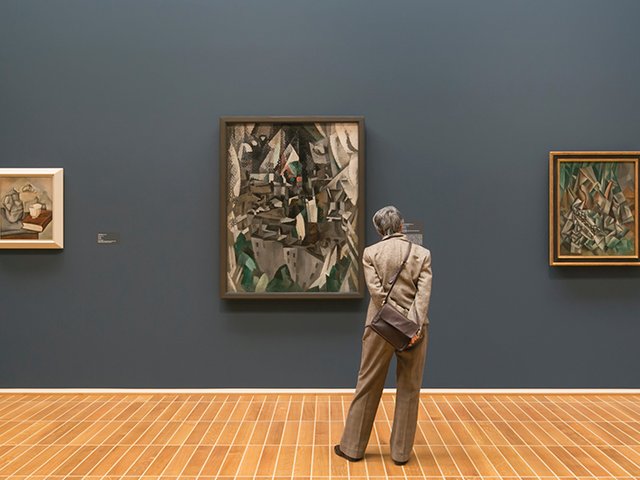
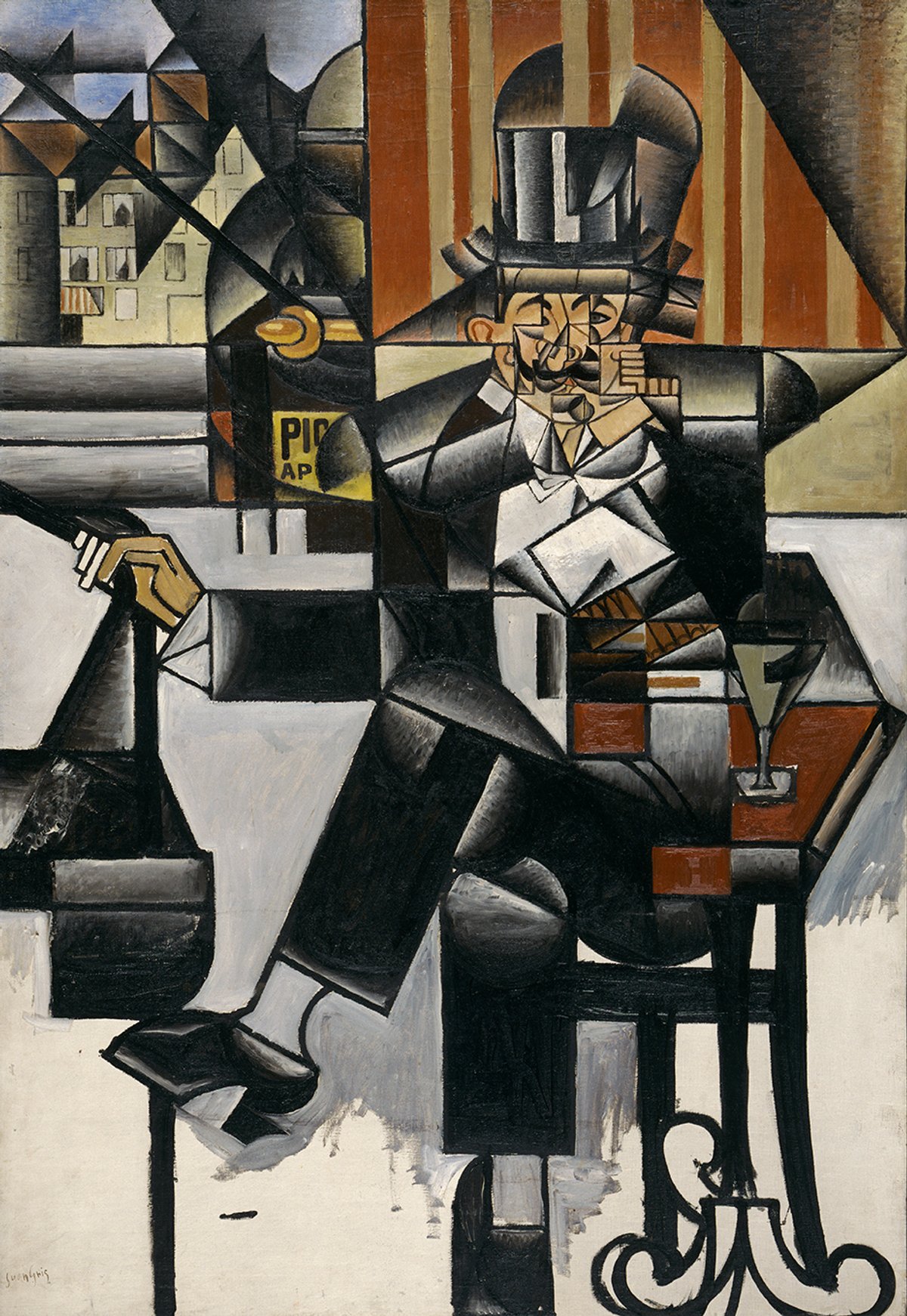
Cubism and Reality is his return to the works by Georges Braque, Pablo Picasso and Juan Gris that define early Cubism. The book has many strands but turns around a highly informed reconstruction of the processes by which their interactions with reality resulted in physical works of art, what Green terms “material things to be looked at”. The revolutionary works discussed remain visually difficult; as he acknowledges, they are “most often only slowly penetrated by looking, imagining, reflecting and looking again”.
Elsewhere, Green has cast his art historical net across generations, but here the focus is concentrated on the three chosen artists’ work in the years immediately preceding the First World War. It was the period in which Braque and Picasso jokingly compared themselves to the pioneer aviators Orville and Wilbur Wright. Braque later described their partnership as being “roped together like mountaineers”. This fond memory rather heroised the tentativeness and uncertainty that Green discerns in their paintings and drawings. In contrast to the view of Cubism as a prelude to abstraction, his contention is that Cubism remained, deliberately and fundamentally, a response to, and reinvention of, reality—of the individuals’ “lived experience of seeing things in the world”.
Mass-produced imagery
The book’s narrow historical period is framed by opening and closing chapters that contrast the uses of mechanically reproduced imagery in the work of Roy Lichtenstein (1923-97) and Francis Picabia (1879-1953) respectively. This establishes the groundwork for the ubiquity of mass-produced visual imagery as the reality with, within and against which Cubism was constructed. Just as photography and film displaced the role of painting in recording reality, so Cubism evolved to expose the illusion behind that very tradition of naturalism. In addressing this, Green summons a wide frame of reference, including those close to the moment—from the artists’ dealer Daniel-Henry Kahnweiler, to the writers Carl Einstein and Maurice Merleau-Ponty—as well as those, like him, who have investigated and theorised Cubism since Golding’s study. Green draws upon, and questions, alternative views with characteristic generosity and courtesy.
The conjunction of careful looking with a highly nuanced response to the works and their loaded history does not always make for easy reading, and nor should it, given the works’ complexity. It is striking that Braque and Picasso’s hermetic Cubism of 1910-12, which stands at the core of the book, is approached with an exploratory, step-by-step precision; the “walls of paint” are scrutinised as the mountaineer of Braque’s reminiscence might plot handholds for an ascent. Many questions—teasing out refinements and pinpointing deliberate obscurities—are posed, to draw the reader into the persuasive analysis of the artists’ engagement with reality. Occasionally the discussion flirts with a hermeticism of its own, but attentive (re)reading is repaid. In this relation, Green makes use of Braque’s recourse to the l’infinition in the latter’s observation “My direction is towards the undefinable”, qualifying the translation as the “infinite process of defining which can never reach any definition”.
Playing with reality
It is telling that in the chapter addressing the introduction of what Kahnweiler called “drawing with paper” (collage), the descriptions relax into a lucidity appropriate to the (apparent) legibility of the resulting works. The contingent language required for the earlier work gives way to revealing analysis of the material and conceptual purpose of introducing reality through printed paper elements redolent of (then) contemporary culture. This highlights the games that are played with reality like conjuring tricks presented to the viewer. Citing recent research into trompe l’oeil practices (led by Emily Braun and Elizabeth Cowling), Green shows how skilfully achieved pictorial illusions, such as the faux-bois woodgraining and wallpapers, were introduced as an assault on the tradition of naturalism.
Emphasising Braque’s training as a peintre décorateur, Green identifies the artist’s “determination finally to discredit the boast that painting can convincingly reproduce things as they appear, above all trompe l’oeil trickery”. Here the concern with fact and lies takes on a particular resonance for readers in our so-called “post-truth” era, encouraging—with this stimulating study as a guide—a renewed admiration for the prescience of the Cubist project undertaken by Braque, Picasso and Gris more than a century ago.
• Cubism and Reality: Braque, Picasso, Gris, by Christopher Green, published 18 September 2025 by Bloomsbury Visual Arts, 288pp,
104 colour illustrations, £90/£28.99 (hb/pb),