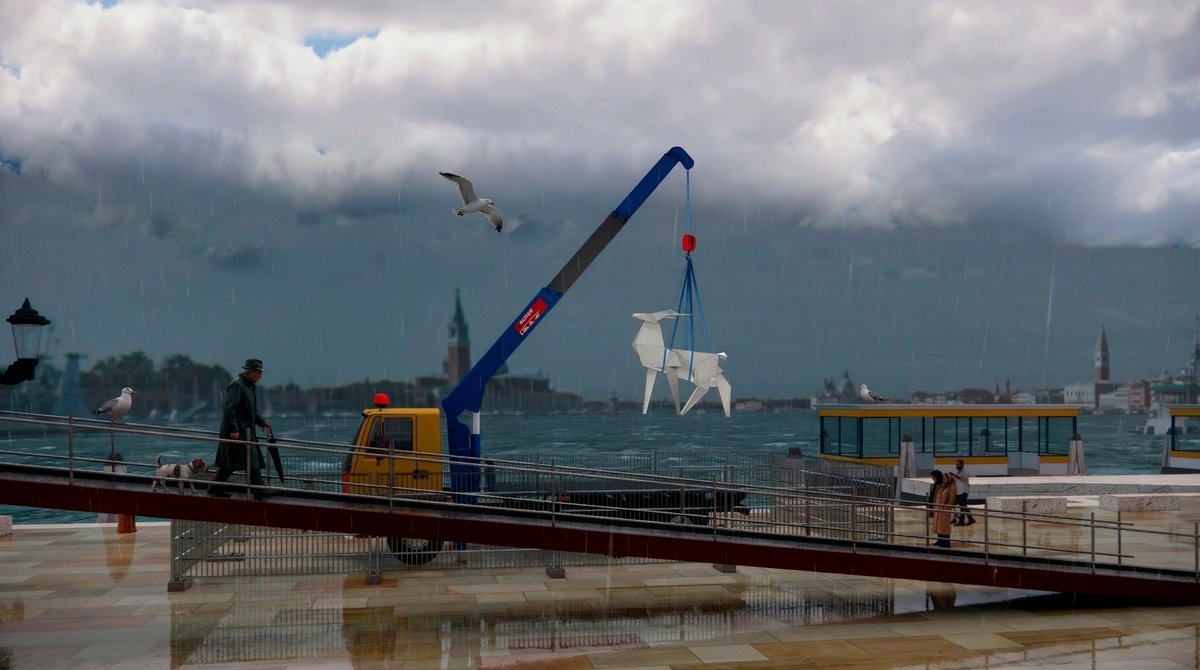
The Ukrainian Pavilion at this year’s Venice Biennale will directly address the lack of security guarantees afforded to Ukraine by the international community, according to the announcement of the pavilion in Kyiv on 5 February.
Its title Security Guarantees refers to the 1994 Budapest Memorandum, signed by Ukraine, the UK, the US and Russia. “Thirty years ago Ukraine gave up its nuclear arsenal and signed documents that promised security,” says Zhanna Kadyrova, the artist representing the country at the Biennale. “These guarantees were supposed to protect us. But they existed only on paper.”
At the centre of the pavilion will be Kadyrova’s concrete sculpture Origami Deer. Originally installed in 2019 in a park in Pokrovsk, a city in eastern Ukraine’s Donetsk region, the work was deinstalled and moved across the country as the Russian frontline approached in 2024.
In Venice, Origami Deer is set to be suspended from a crane on a truck parked along the lagoon embankment, negotiations around which are ongoing. "The suspended state of the sculpture symbolises the uncertainty familiar to Ukrainians today and is a kind of metaphor for forced displacement," a project statement says. "Origami Deer was forced to leave its pedestal and is now wandering the world."
In the pavilion, located in the Arsenale, the exhibition will include archival materials related to the Budapest Memorandum and a multi-channel video installation that documents the journey of Origami Deer through Ukrainian cities and across Europe. Before Venice, the sculpture will be shown in Warsaw, Vienna, Prague, Berlin, Brussels and Paris.
Origami Deer’s original pedestal was made from a dismantled Soviet-era aircraft used to carry nuclear weapons. As the frontline approached Donetsk, it was moved by Kadyrova, a group of specialists and municipal workers from Pokrovsk, and the non-governmental organisation Museum Open for Renovation.
“[The aircraft] represented military power and a militarised state. We changed the shape and added concrete elements, and it became a contemporary art sculpture,” Kadyrova says. “When the evacuation of people started, the sculpture was evacuated as well. We cut it from the pedestal, lifted it with a crane, and moved it to a safer city. The object followed the same routes as people. The sculpture carries this history with it. It is no longer only an art object. It contains the experience of evacuation and movement.”
Kadyrova describes the war as "a black hole" adding that support from the international community is not enough. "It’s a horrible situation, not just at the front, but in the cities," she says. "Russia has more instruments to make propaganda and fake news. Some of their cultural projects function as political propaganda. Because of that Ukraine has fewer possibilities to communicate the reality to people”.
Tetyana Berezhna, the commissioner of the Ukrainian Pavilion, said at the Ukrainian pavilion announcement that it was important to raise the issue of security guarantees at this year's Venice Biennale. "Here Ukraine takes on the role of saying: look, security guarantees don't work, the world must review them,” she says.