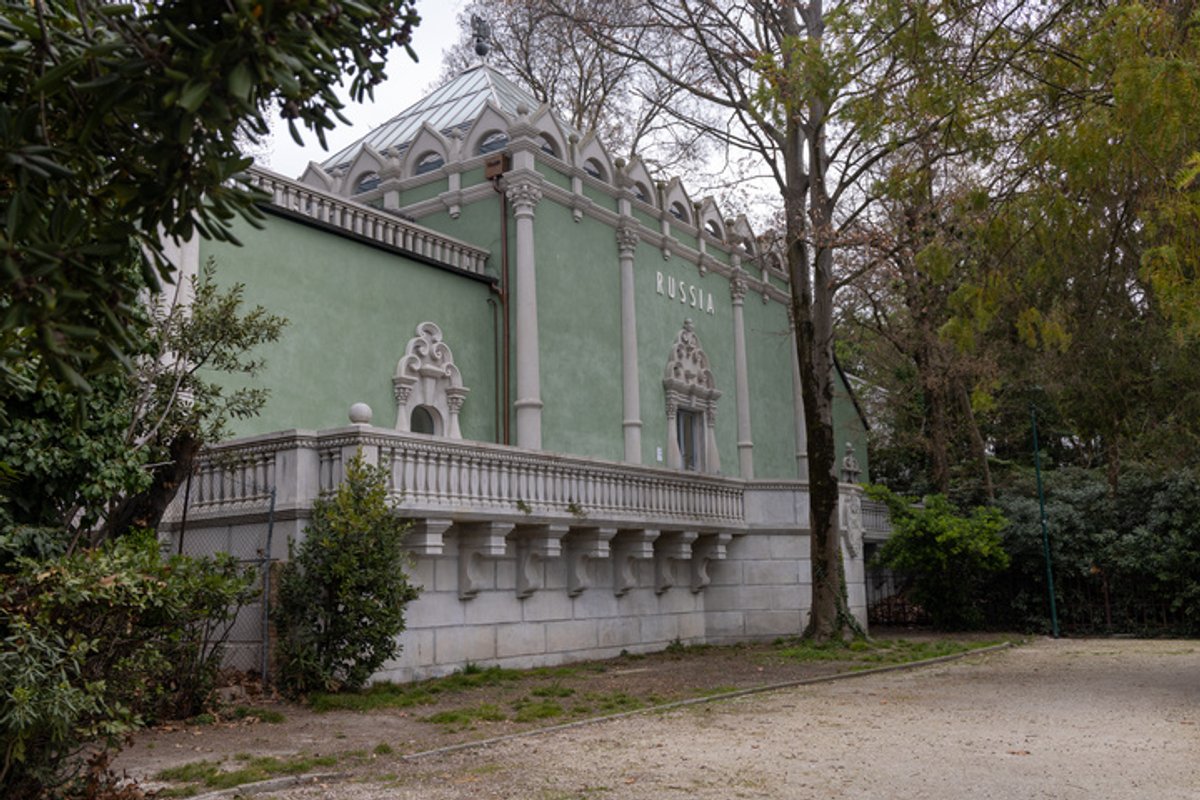
Russia’s first appearance at the Venice Biennale since Vladimir Putin launched a full-scale invasion of Ukraine in February 2022 will feature Russian folklore and world music, according to a list of participants from 99 countries published on the Biennale website.
Mikhail Shvydkoy, Putin’s international cultural envoy, told Artnews that Russia “decided to create a project in which a multilingual polyphony of cultures will be heard—cultures that do not consider themselves peripheral in relation to the West,” and would not be deprived of "the right to artistic self-expression.”
According to the Russian outlet Artguide, which is published by the pavilion's commissioner Anastasia Karneeva, the project will involve a three-day festival held from 5 to 8 May, before the official opening of the Biennale, which will be filmed and then shown in the pavilion. The programme’s title “The tree is rooted in the sky” comes from the work of the French philosopher and mystic Simone Weil. Shvydkoi said philosophers are also involved in the pavilion.
The pavilion has provoked backlash from the dissident community, including the punk protest collective Pussy Riot, who called it a “serious blow to Europe’s security”. In a Facebook post, they wrote: “Since the start of the full-scale invasion of Ukraine, cultural ‘soft power’ has become part of Russia’s military doctrine and an instrument of hybrid warfare. The Kremlin has long used culture as a continuation of foreign policy — and as a way to legitimise the regime abroad.”
They also stated: “We should not step on the same rake twice. We remember that in 1934, for example, Hitler and Mussolini enjoyed art together at the Biennale. In 1942 the Biennale was dedicated to military art, while the exhibition catalogue contained not a single mention of World War II. It is nothing new that totalitarian regimes use art to normalise their power.” The group said it intends to protest Russia’s participation.
Karneeva was approached for comment.
The Biennale defended Russia’s inclusion, saying in the press release that announced the list of participants that “any country recognised by the Italian Republic” can “simply send a notification [of intent to participate] if it owns a pavilion in the Giardini”.
“La Biennale di Venezia rejects any form of exclusion or censorship of culture and art,” says the statement, and “like the city of Venice, continues to be a place of dialogue, openness, and artistic freedom, encouraging connections between peoples and cultures, with enduring hope for the cessation of conflicts and suffering.”
The organisers’ decision comes in the wake of other Italian organisations cancelling performances by Russian musicians seen as supportive of Putin. Last July, for example, a concert by the leading Russian conductor Valery Gergiev was called off following an outcry. In a press conference in January, the Russian foreign minister Sergey Lavrov accused Italy of “actively shunning Russian art” and barring Russia from its Venice pavilion.
Kostiantyn Doroshenko, a Ukrainian art critic and curator tells The Art Newspaper that Russia’s impending participation in the Biennale has “caused outrage” in Ukraine, and “not only in the art world, but also in society as a whole”.
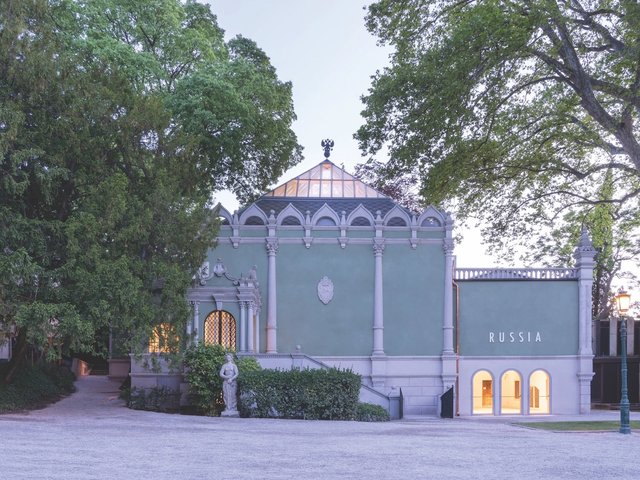
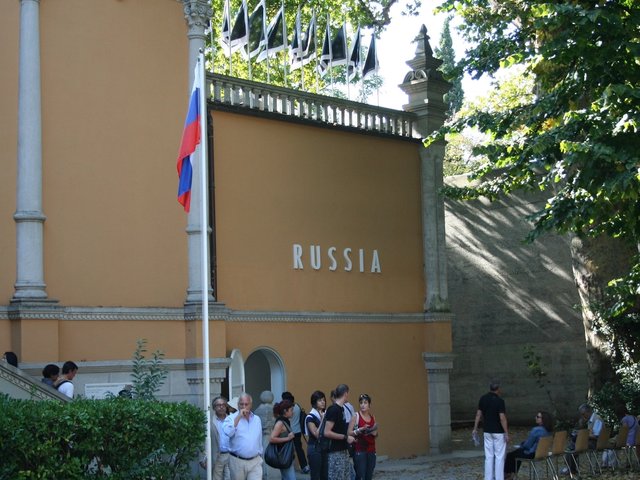
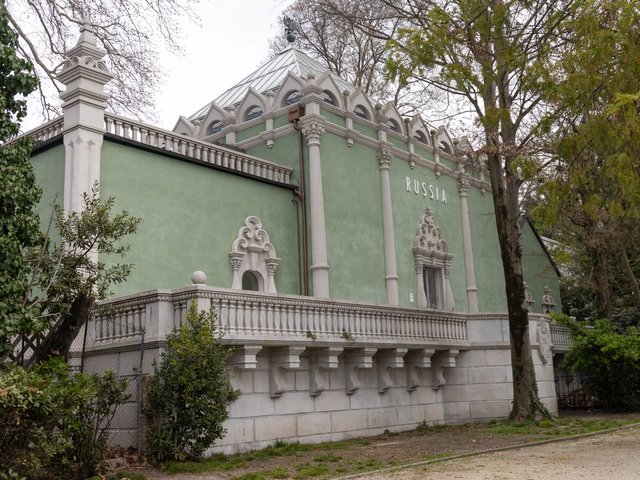
Doroshenko notes that Russia’s pavilion structure in the Giardini, designed by the architect Alexey Shchusev and completed in 1914, “was originally built with money from the [Ukrainian] patron Bogdan Khanenko”. He also points out that some international art figures boycotted the tenth edition of the biennial Manifesta, held at the State Hermitage Museum in 2014, following the annexation of Crimea. “Since then, the situation has become even more egregious,” he says.
In 2022, the Hermitage director Mikhail Piotrovsky called Russian exhibitions abroad “a powerful cultural offensive,” comparing them to a “special operation.” “The management of the Venice Biennale would do well to take this into account,” says Doroshenko. “The format that the Russian Federation intends to present at the forum demonstrates a classic colonial approach to representing countries and peoples through their exoticization and marginalization in relation to modernity.”
Participants in Russia’s programme will include the Malian sound artist Diaki Kone, known as DJ Diaki. He tells The Art Newspaper in an email that his participation in Russia’s Pavilion will be “a rare opportunity to bring the sounds of West Africa (Mali) to life in such a prestigious international artistic context, by combining street music, underground club culture, and contemporary art.” He intends to “fuse West African rhythms (Mandingue, Malian percussion, etc.) with Russian elements (revisited folklore + electronic music) for a true cultural dialogue” in a live DJ set and sound performance.
“For me, art and music are spaces for encounters that transcend political tensions. I make music to connect people, not politics. These cultural exchanges remain precious even in a complex context.”
Russia’s programme will also include members of folk music ensembles that are featured on state television. One of them, Toloka, whose work emphasises Russian nationalism, geared to a young audience, showed one of its members in an Instagram post having his head shaved as he headed off for military service, accompanied by a song that described it as the patriotic duty of every healthy male. 'Toloka' is a term originally used to describe mutual assistance among villagers. It is broadly used in Ukraine too, now as motivation and support in the war effort.
Karneeva is the daughter of Nikolay Volobuyev, a former Federal Security Service (FSB) general—and the current deputy chief executive of Russian state-owned defence contractor Rostec. Smart Art, a company specialising in producing art exhibitions that Karneeva co-founded with Ekaterina Vinokurova, Lavrov’s daughter, was contracted in 2019 to run the pavilion for ten years.