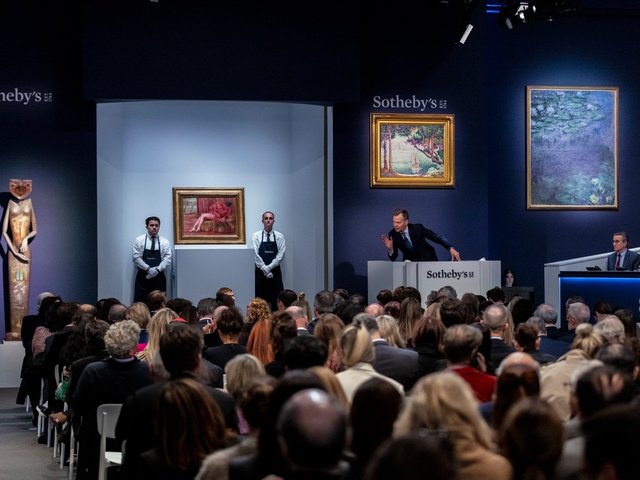
Sotheby's has changed its buyer’s premium fees in locations worldwide, starting from Friday 13 February. These non-negotiable fees, paid by the winning bidder on top of a lot’s hammer price at auction, are a major source of revenue for auction houses, which have been among the businesses hardest hit by the art market downturn of the past three years.
Under the terms of Sotheby’s new fee structure, the buyer’s premium for sales in New York are increasing from 27% on lots priced at or above $1m to 28% for all works sold for hammer prices up to and including $2m (£1.5m in London). The medium-tier buyer’s premium will remain 22% of the hammer price but will be applied to lots sold for $2m-$8m (£1.5m-£6m in London). Previously, the medium-tier rate applied to lots with hammer prices between $1m and $8m (or £800,000 and £6m). The buyer’s fee for the most valuable works, which hammer at more than $8m (£6m), will remain 15%.
A spokesperson for Sotheby's declined to comment on the changes to the house's fee structure.
In September 2025, Christie’s raised its buyer’s premium to 27% on each lot priced up to $1.5m or £1m, 22% for lots that hammer at $1.5m-$8m (£1m-£6m), and 15% for $8m+ works. Previously, Christie’s had charged 26% on the first $1m or £800,000, 21% on lots up to $6m or £4.5m, and 15% on anything sold for more.
Fee uplift
Across the board, more buyers will be paying higher fees at the lower end of the auction houses’ sales. This comes after lower-priced works remained relatively in demand even amid a wider market downturn, and with auction houses trending toward more conservative estimates after several years of slowing sales. At the end of last year, both Sotheby’s and Christie’s reported higher projected revenue, thanks in large part to private sales and luxury auctions.
Phillips instated a new buyer’s fee structure in September 2025 that prioritises early bidding. If a bidder places a binding written bid that is at least equal to the lot’s low estimate at least 48 hours before the auction begins, they pay a “significantly lower” fee should their bid be successful.
In early 2024, Sotheby’s implemented a new fee structure that reduced buyer’s premiums to a flat 20% on almost all lots, while pinning a 10% fee on works that hammered over $6m. To compensate for the revenue lost by slashing buyer premiums in this way, higher fees were transferred onto consignors of valuable works. That shift understandably “proved less attractive to potential sellers”, chief executive Charles Stewart said in a statement when Sotheby’s reversed course less than a year later.
Securitisation
Sotheby’s latest update to its buyer’s premium fee structure comes weeks after it announced its financing arm, Sotheby’s Financial Services (SFS), would sell $900m in asset-backed notes backed by art-secured loans. For the first time, it included loans secured against collectible cars as well as blue-chip art.
Securitisation involves pooling together existing loans and selling that cash flow to investors, allowing Sotheby’s access to capital up front in exchange for those bonds. The auction house therefore gets early access to revenue that would otherwise have come in over time through its loans. SFS first announced a $700m offering in 2024.
“The transaction was significantly oversubscribed, reflecting strong investor demand and confidence in our disciplined business model and portfolio quality,” SFS chief executive Ron Elimelekh says in a statement. The securitisation transaction closed on 3 February. Morningstar DBRS, a leading global credit rating agency, assigned generally strong ratings to the offering—officially titled Sotheby's ArtFi Master Trust, Series 2026-1—indicating low default risk.