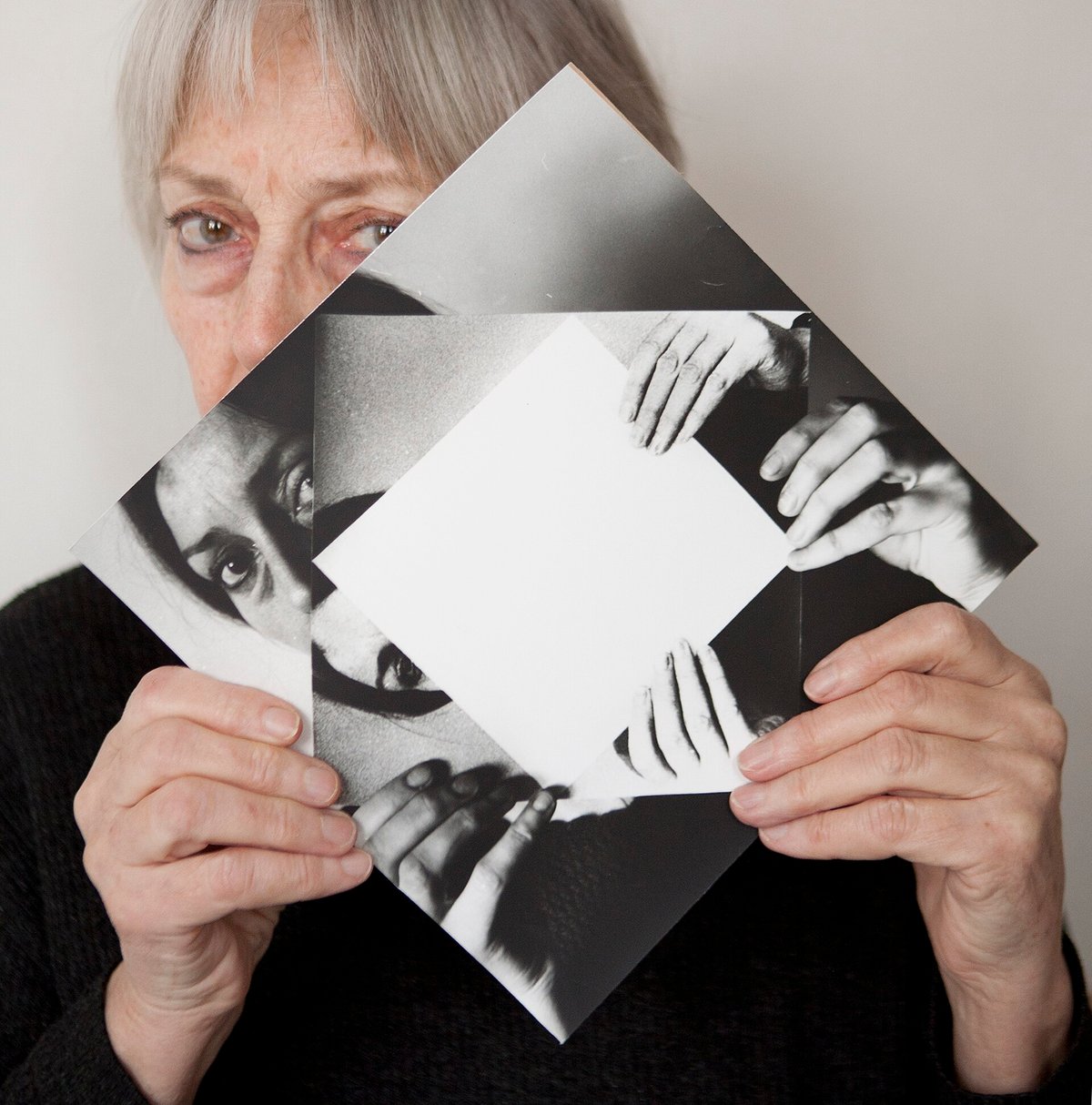
Dóra Maurer, the Hungarian painter, printmaker and filmmaker, has died at the age of 88. Her death was confirmed by the Széchenyi Academy of Literature and Arts, of which she had served as president since 2017.
Born in Budapest on 11 June 1937, Maurer graduated in 1961 from the Hungarian Academy of Fine Arts, where she studied under the painters Gyula Hincz and Sándor Ék. She began her career as a printmaker before expanding into photography, film, performance and painting.
In the late 1960s and early 1970s she produced conceptual photographic works before turning increasingly towards painting and teaching from the mid-1970s onwards. Her practice was marked by an intense exploration of form, time and movement, often employing systematic or mathematical processes to generate visual effects.
Among her best-known works are Quasi-images (1970-73), the series Reversible and Changeable Phases of Movement (1970s), Seven Twists (1979) and the Overlappings series (1970s-80s), in which layered geometric structures generate optical movement and chromatic tension. Although critics have at times read her work through a political lens, Maurer maintained that her practice was not conceived as political, suggesting such interpretations reflected the historical conditions in which it was produced.
Her innovative approaches influenced a generation of Hungarian artists and contributed to a wider appreciation of Central European conceptual art internationally. She collaborated with Miklós Erdély on the Creativity Exercises course (1975-77) and later worked within the InDiGó Group (1981-83). From 1990 she taught at the Hungarian Academy of Fine Arts, eventually becoming a full professor.
András Szántó, a New York-based cultural consultant, described Maurer in an Instagram post as a “towering figure of the Hungarian art scene”, whose “commitment to abstract art and emerging mediums never wavered, even though experimental art was sidelined back then [during the Communist era in Hungary]”.
“She was part of the artistic underground, organising exhibitions and contributing journals,” Szántó added. “And that scene and camaraderie offered its own rewards.”
Her international profile expanded in the 2010s as her work appeared in group exhibitions at the Museum of Modern Art, New York; the Centre Pompidou, Paris; and the Museum of Fine Arts, Houston. Solo exhibitions of her works were held at Museum Ritter in Waldenbuch, Germany, in 2014 and Tate Modern, London, in 2019. Her work appeared widely across Europe, including in Graz, Utrecht, Zagreb, Vienna, Stockholm, Bratislava, Nuremberg and Stuttgart. In 2022, she was ranked seventh in the culture category of Forbes’s list of Hungary’s most influential women.
Maurer received the Kossuth Prize in 2003 and in 2021 was designated a Nation’s Artist, one of Hungary’s highest state honours for cultural figures.