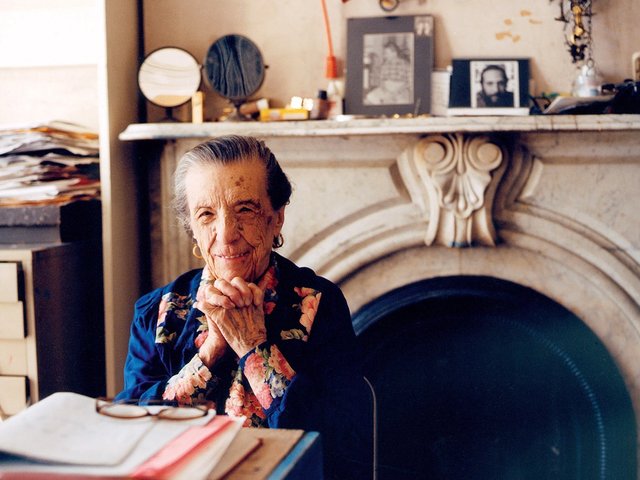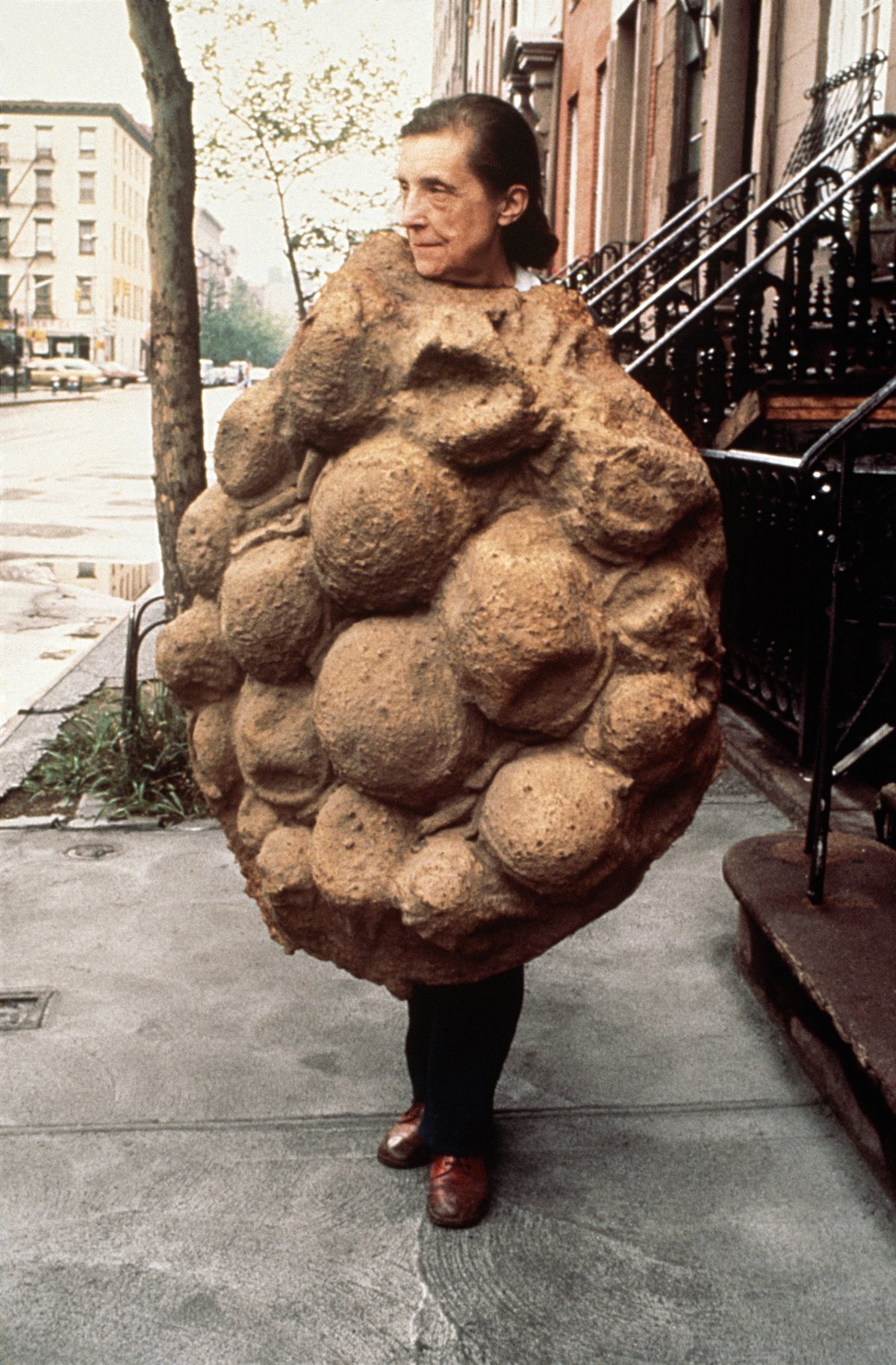
A famous portrait of the French-American artist Louise Bourgeois (1911-2010) shows her outside her home in New York City, wearing one of her latex sculptures, Avenza (1968-69), named after a village in Tuscany. Wrapped in a cocoon of breast-like half-cups, she looks like a rumpled mother goddess who has been accidentally teleported to Chelsea in New York: the Ephesian Artemis, for example, usually portrayed with similar appendages covering her upper torso. Strikingly, Bourgeois, her hair pulled back, looks away from the camera, as if hoping to distance herself from her own daring: a schoolmarm pushed to play the role of iconoclast. In her richly detailed Knife-Woman: The Life of Louise Bourgeois, wonderfully translated from the French by Lauren Elkin, the art historian and curator Marie-Laure Bernadac suggests that such ambivalence is in fact characteristic of her subject’s work as a whole.
Born in Paris on Christmas Day three years before the outbreak of the First World War, Bourgeois spent a lifetime revisiting the traumas of her childhood. Her father Louis, the owner of a gallery of fine tapestries, came back from war an enthusiastic philanderer and incorrigible bully. For years he carried on an affair with his children’s British nanny. Monsieur Bourgeois’s favourite after-dinner entertainment was to cut the peel of an orange into the shape of a girl, leaving the fruit’s pith in place to simulate a penis. “Louise has nothing there,” he exclaimed, according to Bernadac.
Avenging her father
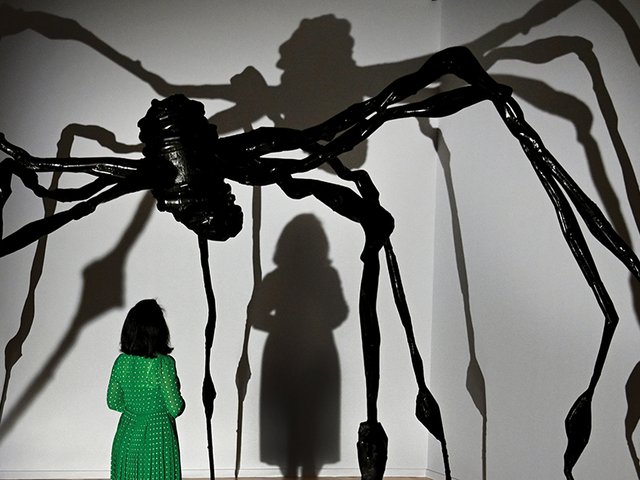
Little did Louis know that his daughter would go on to wield the knife herself, but in a far grander fashion, creating a complex gallery of sexually ambiguous figures and installations that were eventually shown all over the world. If Louise Bourgeois thus avenged herself on her father, she celebrated her beloved mother Joséphine, a weaver and seamstress who died when Louise was 20, in a series of gigantic spider sculptures such as Maman (1999, in the collection of the Tate).
As Bernadac reports, it was Fernand Léger (1881-1955) who encouraged his student to try her hand at sculpture. Dangling a piece of wood before her, he said: “Louise, you are not a painter, but a sculptor.” But was she? Over her remarkable, six-decade career, Bourgeois adamantly refused to be defined by neat categories, denying that she was a feminist, even though her work, with its focus on birth, pain, and motherhood, spoke so plainly to the experiences of women. Starting with totem-like wooden human figures, she shifted, as her designs grew more abstract, to pliable latex. She then experimented with marble, and finally, as the scale of her works expanded, used anything she could get: metal, rubber, fabric, glass and found objects. Bourgeois’s first major retrospective came in 1982, at New York’s Museum of Modern Art, when she was already 70 years old.
Concealment
Bourgeois had begun making her signature “lairs”, or nests, in the 1960s, works that both seemed to hide and hint at some deeply personal secret. In The Quartered One (1964-65), for example, she created a suspended bronze sculpture that looks like an animal’s skinned carcass with a hollowed-out interior, a deliberate blurring of inside and outside. For Bourgeois, such “cells”, as she would later call them, were places of both imprisonment and safety. In Precious Liquids (1992, Centre Pompidou), she recycled a decommissioned New York water tower, placed an old bed inside, covered with spilled liquid, and hung clusters of glass containers over it, alluding to the fluids that cascade through the human body. On the wall, framed at the bottom by two large wooden globes (a giant’s testicles?), she placed a huge man’s coat, with a girl’s smaller white nightshirt tucked into it carrying the inscription “Merci/Mercy”. Was this the aftermath of a rape? A strange posthumous message to her dead father? In her 1974 tableau The Destruction of the Father (Glenstone Museum, Potomac, Maryland), Bourgeois was less circumspect: here the father appears as dinner food, a garishly lit assemblage of organs spread out on a table, surrounded by a multitude of latex-covered bumps descending from the ceiling and planted around it.
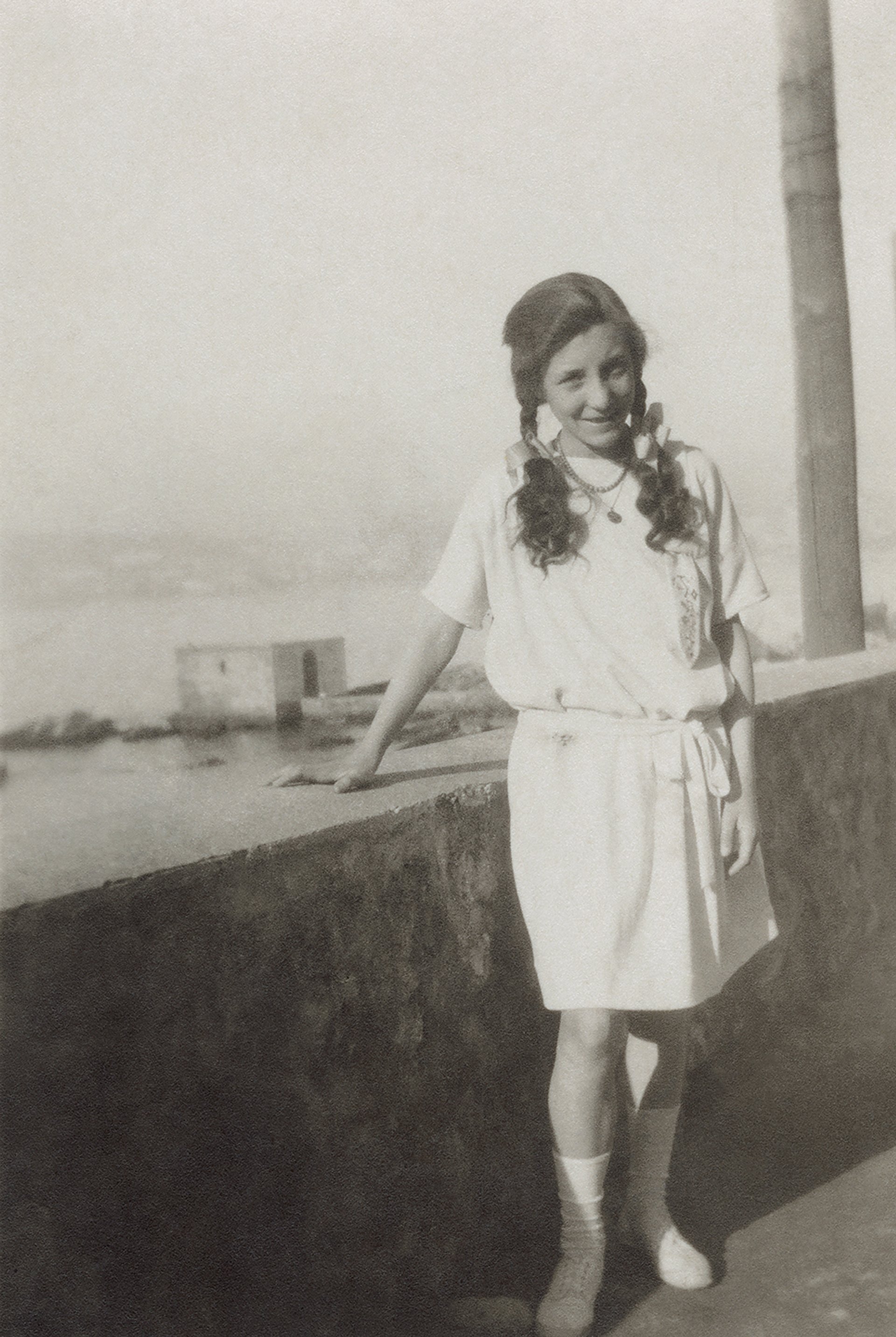
A portrait of the artist in Cannes as a teenager, wearing a Coco Chanel dress
© 2026 The Easton Foundation/VAGA at ARS, NY, and DACS, London
Family life was a “cell” to Bourgeois, a space both enchanted and accursed, but one impossible to avoid. Emerging from the burdens of her upbringing, she married the art historian and museum director Robert Goldwater and, in 1938, followed him to New York. She adopted a son and had two sons of her own. Struggling in her marriage, she sought fulfilment in affairs but stayed with Goldwater, sending him regular love letters until his death in 1973. A graphomaniac and chronic insomniac, Bourgeois left copious journal notes, the idiosyncratic transcripts of a life lived with blazing intensity.
Bernadac, whose resumé includes leadership positions at the Louvre and the Centre Pompidou, is an internationally well-regarded specialist on Bourgeois. But her expertise, reflected in the numerous quotations from Bourgeois’s unpublished journals, never gets in the way of a richly textured story she tells with warmth and tenderness. Quite appropriately, following in the footsteps of Bourgeois’s mother, she calls herself a weaver.
Hell and back
But Bernadac also warns us not to read Bourgeois’s compositions as simple transcripts of the artist’s inner turmoil. Bourgeois’s art is less a product of the psychoanalytic treatment she sought than an extended comment on psychoanalysis itself, on the stories—simultaneously disturbing and ridiculous—it encourages us to tell about ourselves: “I have been to hell and back,” reads the tongue-in-cheek message on a series of handkerchiefs Bourgeois embroidered in 1996. “And let me tell you, it was wonderful.”
Knife-Woman is the fullest account to date of the life of one of the most influential artists of the last century. But it also delivers, as the best biographies do, a coherent and consistently stimulating interpretation of the wellsprings of Bourgeois’s art. In an inspired aside, Bernadac offers one of the most useful keys I have seen to understanding Louise Bourgeois: she likens her to Baubo, the servant of Demeter. Revered as the Ancient Greek goddess of agriculture and the seasons, Demeter was inconsolable when her daughter Persephone was abducted. Hoping to cheer her up, Baubo did something crude but immediately effective: she lifted her skirt. Nakedness, as Louise Bourgeois also knew, is funny. Demeter laughed. And with that, the world was saved from perennial winter.
• Knife-Woman: The Life of Louise Bourgeois, by Marie-Laure Bernadac, translated by Lauren Elkin. Published 13 January by Yale University Press, 472pp, 36 colour and 35 b/w illustrations, £30/$38 (hb)