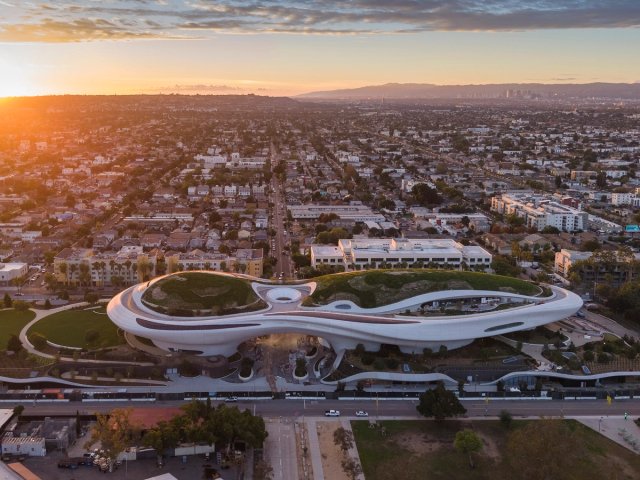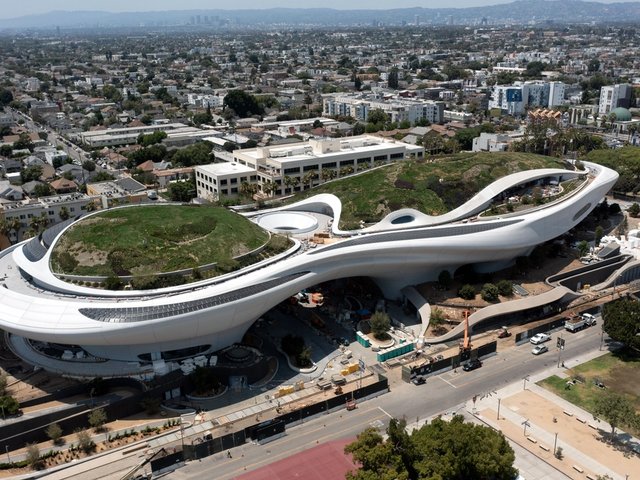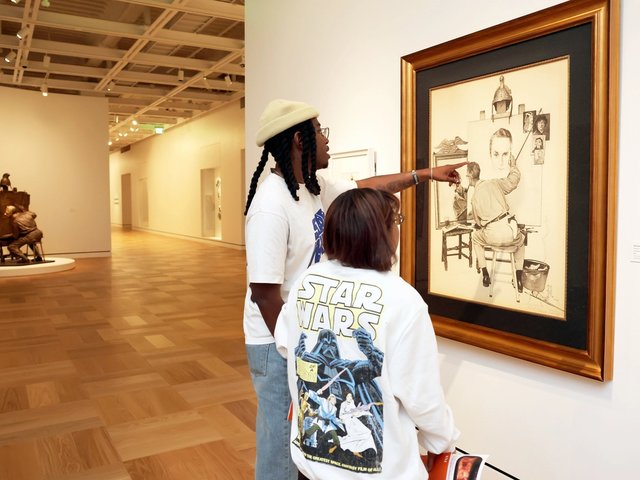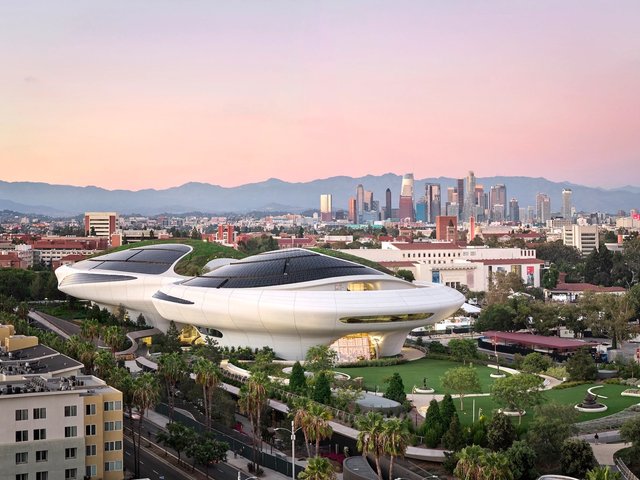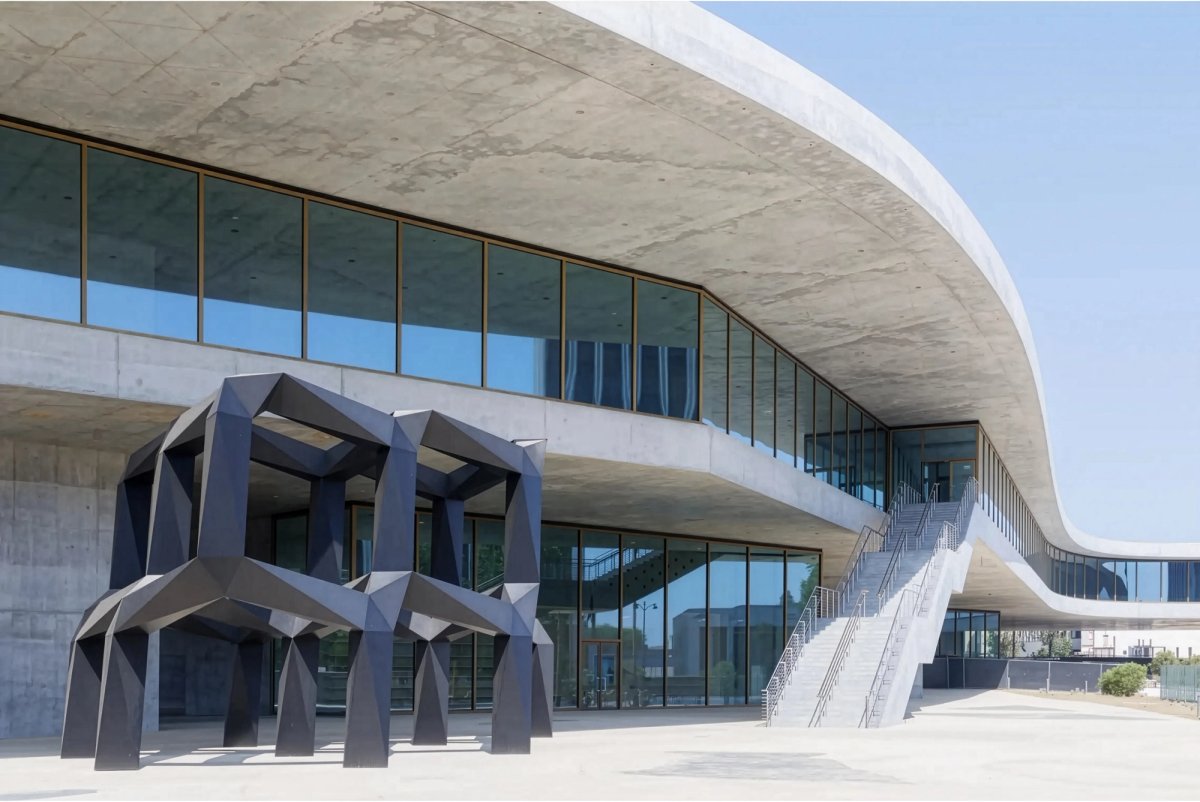
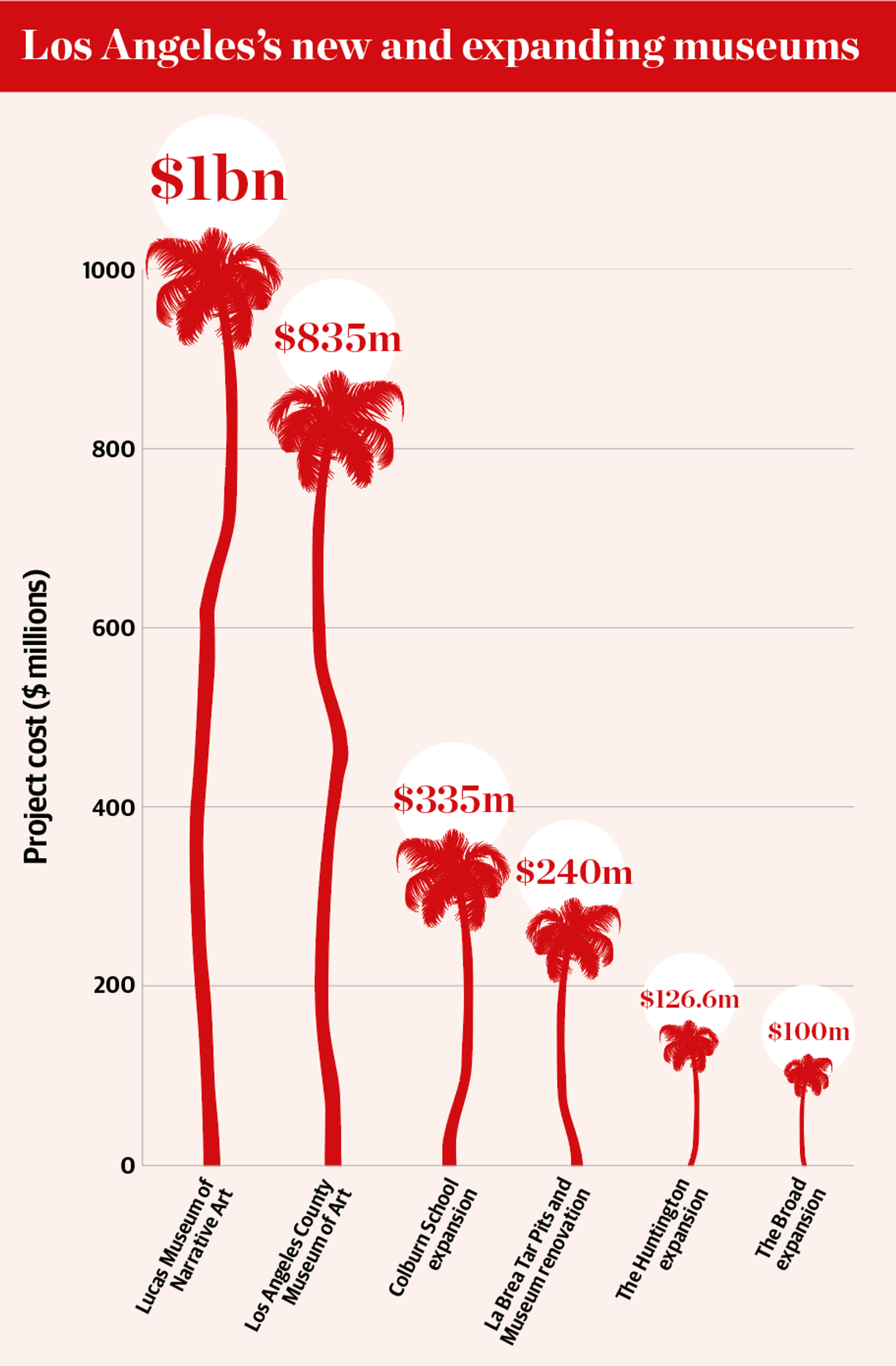
If museum construction is any measure to go by, the next few years are shaping up to be a boom time for the Los Angeles arts and culture scene. It all kicks off this spring, when the Los Angeles County Museum of Art (Lacma) opens its $835m, Peter Zumthor-designed expansion to the public. Refik Anadol’s Dataland—a temple to art created with artificial intelligence—is also due to open in the spring, inside Frank Gehry’s $1bn Grand LA mixed-use development downtown. Star Wars creator George Lucas will finally unveil his $1bn Lucas Museum of Narrative Art in an alien whale-like building by the architect Ma Yansong in Exposition Park in September. And The Broad is busy building a $100m (so far) extension by Diller Scofidio + Renfro, scheduled to open by 2028—in time for the Summer Olympics in Los Angeles.
Meanwhile, The Huntington in San Marino has announced plans to expand its library and conservation spaces, breaking ground on its $126.6m project this spring, and is also building a $40m village to house visiting scholars on its campus. Add to that another Gehry-designed $335m performing arts centre for the Colburn School, to be completed by 2027, and the city’s cultural infrastructure is swiftly evolving. But what does all this expansion and activity mean for Los Angeles’s art community—including its artists, collectors, gallerists and curators?
“Los Angeles has gone from being provincial to international in a very short time,” says the multidisciplinary artist Diana Thater, who has lived and worked in the city for decades and is the chair of the art department at Pasadena’s ArtCenter College of Design. “It was still a small and very close community up until about 2010. After that, it really exploded in terms of the number of artists moving here, and I think it’s because life in New York has become untenable for real artists.”
Thater adds that this shift to the West Coast has long been driven by the region’s many art schools, including the ArtCenter, California Institute of the Arts, Otis College of Art and Design and the art department at the University of California, Los Angeles. (The city’s art schools have so far weathered the economic storms facing higher education better than those in the Bay Area, such as the San Francisco Art Institute, which has closed, and the California College of Arts, which will close in 2027.) Like the generations before them who came to Los Angeles for school and stayed there for the community, this new crop of artists “backed the right horse”, Thater says, because the city’s cultural reputation is poised to gain wider recognition now with major projects like the Lacma expansion—for which Thater has been commissioned to create a new public video work—and the Olympics. “There are a lot of eyes on LA,” she says.
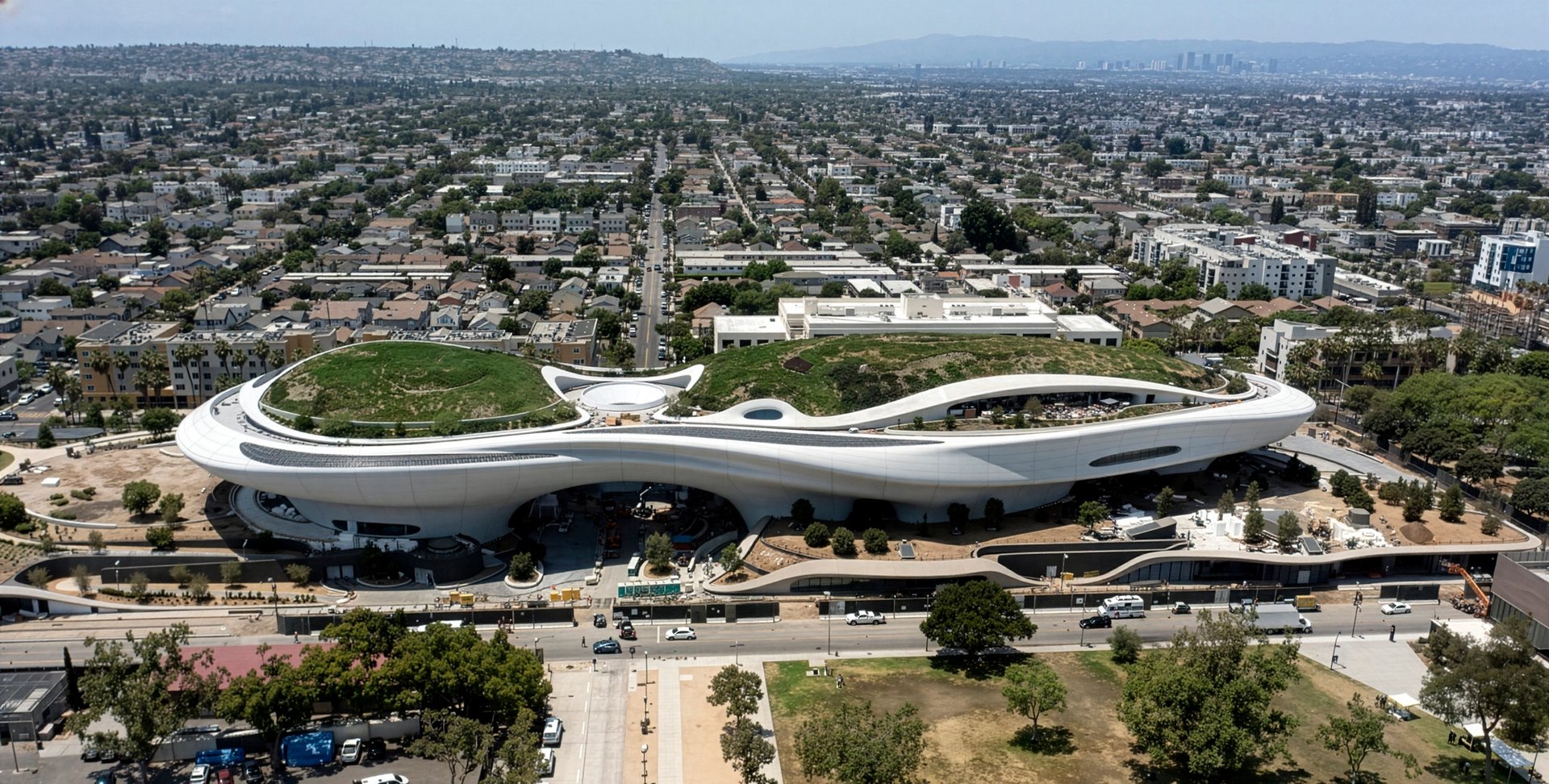
The alien whale-like Lucas Museum of Narrative Art is due to open in September, 13 years after the project was first announced
© 2025 JAKS Productions. Photo by Sand Hill Media/Eric Furie. All rights reserved.
Lacma grows—or shrinks
The new Lacma building, in particular, has drawn international attention for more than a decade—not all of it positive. Soon after the Swiss architect Peter Zumthor unveiled his design for a long-discussed expansion to house Lacma’s permanent collection, critics pointed out that the new amorphic structure, raised above street level and straddling Wilshire Boulevard, would provide less gallery space than the original 1965 museum buildings designed by William Pereira. (The former Los Angeles Times art critic Christopher Knight christened Lacma the “incredible shrinking museum”.) Lacma has said that the addition of the Broad Contemporary Art Museum and the Lynda and Stewart Resnick Exhibition Pavilion (elements of an earlier, ultimately scrapped three-phase expansion plan by the architect Renzo Piano) brings up the total gallery space.
A preview of what are now officially called the David Geffen Galleries—before the art was installed—was held for museum members and the press in June 2025, and early reactions have been mixed. The veteran Los Angeles architecture critic Christopher Hawthorne described the expansion as “bold and compromised in nearly equal measure: a sort of hamstrung Gesamtkunstwerk”.
One area where the building seems to have succeeded is in connecting more directly to its neighbours. These include the Academy Museum of Motion Pictures (housed in a former department store that Lacma bought in the 1990s and once considered for its own expansion plans), Lacma’s quirky Pavilion for Japanese Art and the La Brea Tar Pits and Museum—which are undergoing their own $240m renovation ahead of the Olympics.
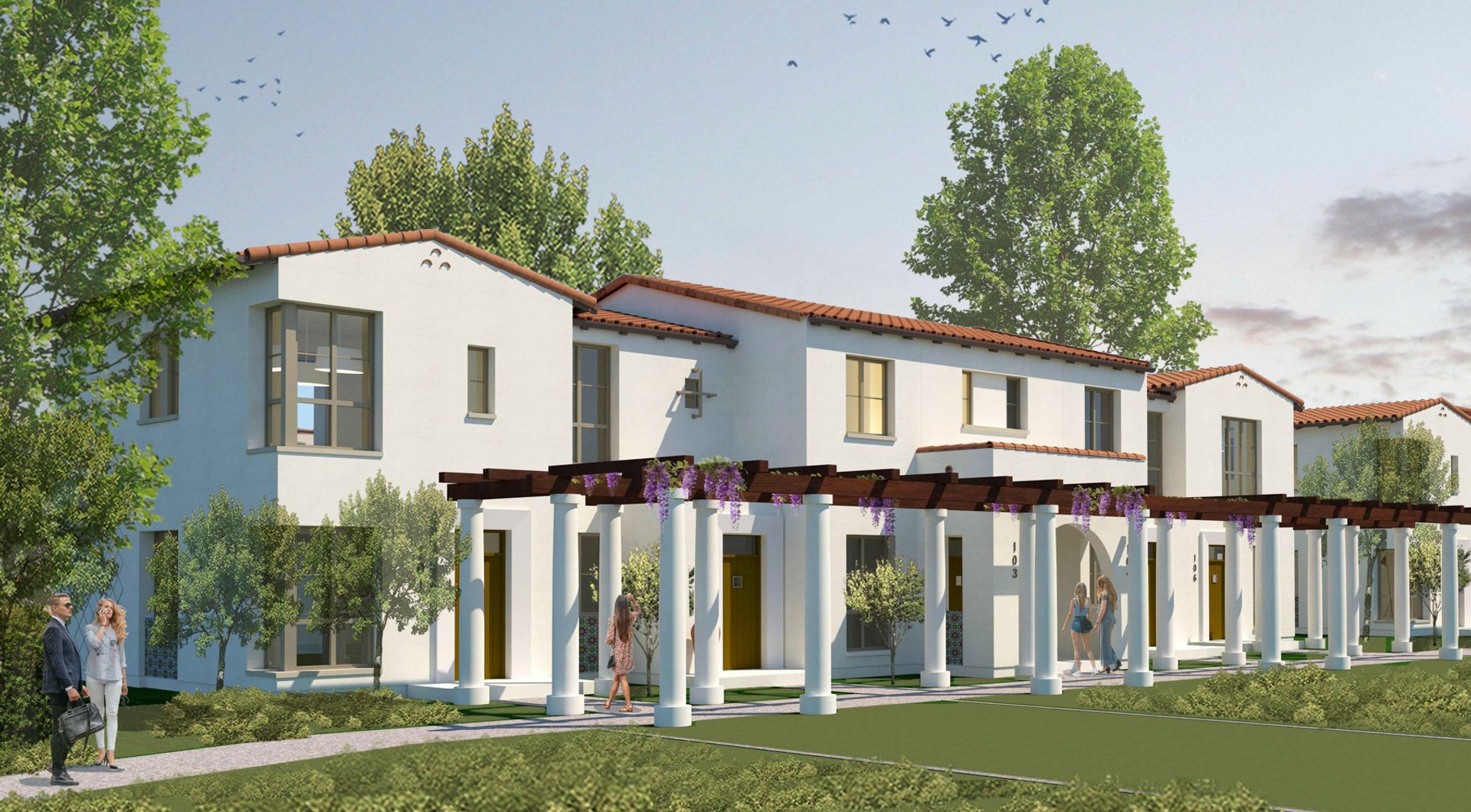
A rendering of the village that The Huntington is building for its visiting scholars
VTBS Architects
But the true test will be how well the new Lacma building functions as a space to display the museum’s encyclopaedic collection—to be installed thematically—and how Angelenos will be served by the new museum, which has educational spaces and a theatre on its plaza-level. Major works of public art will be installed across the campus to join Chris Burden’s ultra-popular Urban Light (2008), Michael Heizer’s Levitated Mass (2012) and other long-time favourites like Tony Smith’s Smoke (1967/2005), Alexander Calder’s Three Quintains (Hello Girls) (1964) and a garden of sculptures by Auguste Rodin. Among the new additions will be Jeff Koons’s living floral sculpture Split-Rocker (2000)—which the artist started planting in September—a 12-ft-tall interactive UFO by Shio Kusaka and Mariana Castillo Deball’s carved-and-scraped floor designs for the concrete plaza.
The art dealer Peter Goulds, who recently decided to rethink the model for his gallery LA Louver after 50 years and donate its archives to The Huntington, sees the new Lacma building as the “first step” in a long journey the relatively young museum must take in serving its community. He hopes the long-term plan that Lacma’s director, Michael Govan, originally promoted of developing satellite outposts of the collection across the city will eventually be realised. “In the end, either Michael or his successor will hopefully pick up the mantle of the broader reach of Lacma being a city-wide museum,” Goulds says.
Goulds adds that the key to success is to think on the scale of decades rather than just the immediate future, pointing to projects like the Watts Towers, preserved from demolition through a concerted 70-year effort, and the Colburn School, whose long-term future was secured through a generous endowment (estimated at around $500m today) given in 1985 by its main benefactor, the late Richard D. Colburn. “A lot of these initiatives transcend the lifetimes of their founders,” Goulds says.
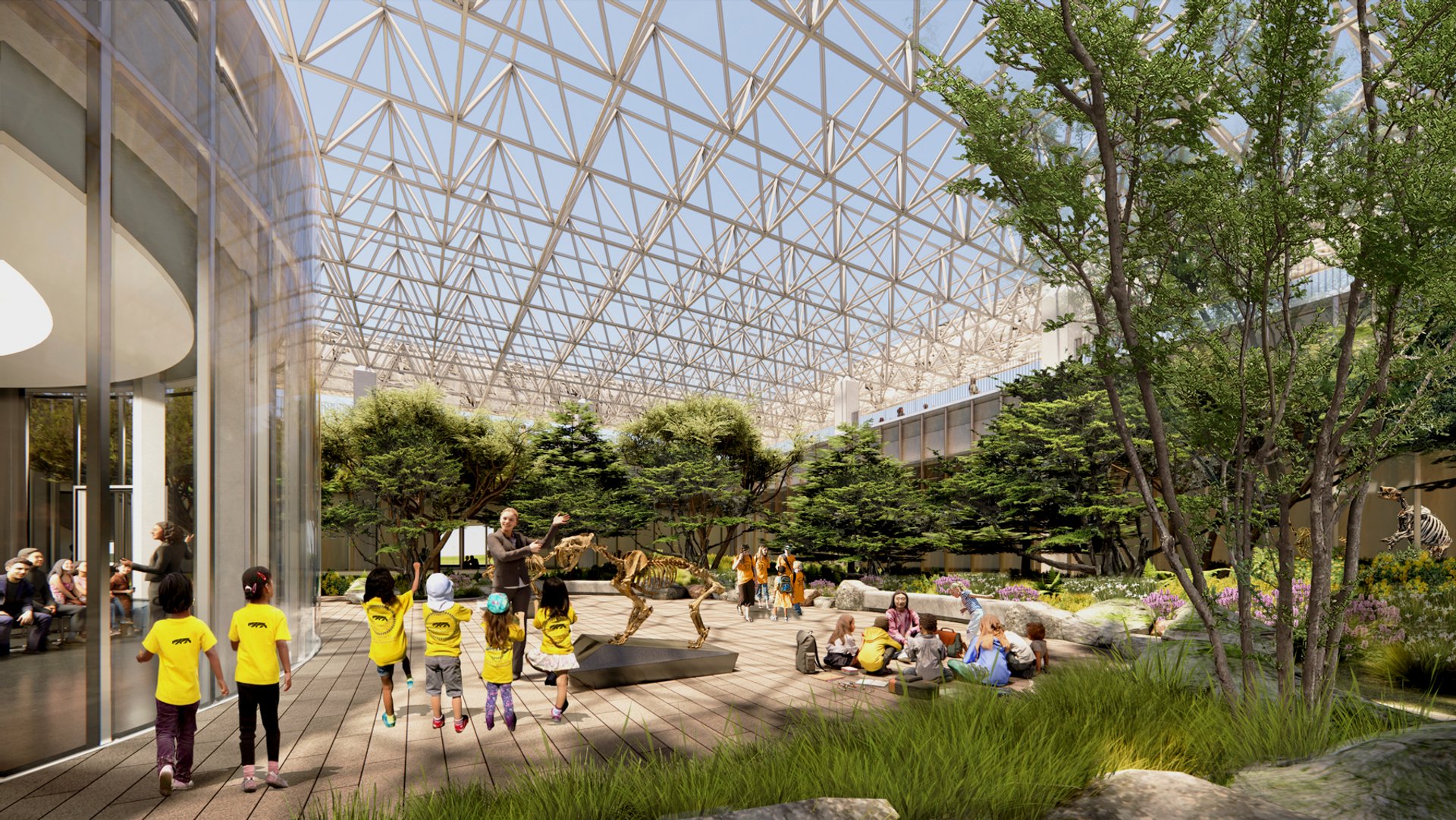
An illustration of the La Brea Tar Pits and Museum, currently undergoing renovation
Render: WEISS/MANFREDI; Courtesy of Natural History Museums of Los Angeles County
More than mere vanity projects?
Some of the city’s other museum projects, such as the Lucas Museum, Dataland and The Broad expansion are being eyed more dubiously. “Two of them are vanity projects, and I don’t care,” Thater says bluntly.
“We have no clear idea what the Lucas Museum really is about, except self-aggrandisement,” says Goulds, echoing concerns many people have about what the term “narrative art” entails and whether there will be a unifying curatorial approach to the museum’s displays. Questions have only increased since the museum either laid off or lost a large chunk of its curatorial and educational staff—including its former director and chief executive, Sandra Jackson-Dumont, and chief curator Pilar Tompkins Rivas—leaving Lucas himself to oversee content direction for his museum.
Others, like the philanthropist Nicolas Berggruen, who is building a new headquarters for his Berggruen Institute in the Santa Monica Mountains—designed by the architects Herzog & de Meuron and funded by a $500m endowment—see all the additions to the city’s cultural scene as clear signs of its dynamism. “Los Angeles is lucky to have an enormous pool of artists and talent,” Berggruen says. “With the new Lacma and the Lucas Museum, it will continue to grow as a cultural centre, allowing not only the creation of objects but their display and broad interaction with the public. This increases Los Angeles’s appeal as a cultural magnet.”
Any way you look at it, the city’s cultural calendar will be busy for the foreseeable future, and this could position Los Angeles as an even more important arts hub. “There’s so much going on here,” Goulds says. “This is the equivalent of how New York was a bridge to Europe at the turn of the 19th century. Los Angeles is the bridge to the Southern Hemisphere and to Asia.”