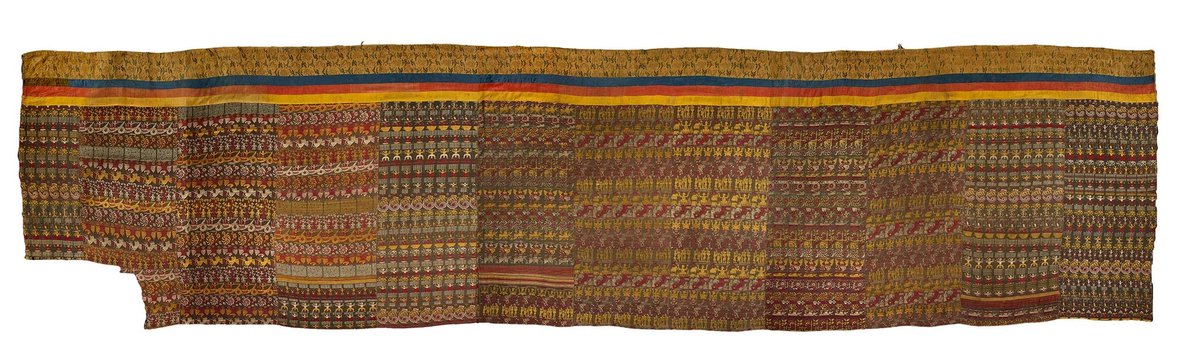
The Vrindavani Vastra, a tapestry featuring scenes from the life of the god Krishna woven 350 years ago in the foothills of the Himalayas, is set to return to its place of origin for six months under the terms of a loan agreement between the British Museum in London and the state government of Assam in northeastern India.
The loan, due to begin in 2027, was agreed after Assam’s chief minister pledged to construct a new extension to the Assam State Museum in Guwahati, the state capital, to house the textile, which is so extraordinarily fragile that it can only be displayed for six months every ten years.
The largest and earliest known work of art to feature inscriptions in the Assamese language, the Vrindavani Vastra sits “at the very heart of the cultural life of Assam”, according to Richard Blurton, who curated the 2016 British Museum exhibition Krishna in the Garden of Assam—the last time the tapestry was shown in public.
The agreement is in keeping with the British Museum director Nicholas Cullinan’s policy of emphasising “partnership rather than … ownership”. The British Museum is prevented by law from permanently deaccessioning artefacts: instead, Cullinan has made clear he prefers to negotiate loans. Under his watch, the Satala Aphrodite was last year loaned to Armenia, where it is commemorated as a national symbol on bank notes and public buildings. In December, Cullinan announced a significant new collaboration with India; 80 artefacts from diverse ancient civilisations will travel on long-term loan to Mumbai in what he called an act of “cultural diplomacy”.
Woven on 12 vertical strips of lampas silk, the Vastra—a Sanskrit word meaning textile—illustrates a devotional play about Krishna by Srimanta Sankardev, a writer and guru who lived in Assam at the turn of the 16th century. Sankardev’s philosophy was kept alive in esoteric teaching institutions known as Satras, where his plays are still performed to this day.
“People here are emotionally connected with Sankardev,” says Kuladhar Saikia, Assam’s former chief of police and the president of a cultural non-profit. “So the Vastra is widely claimed as a living piece of history in Assam.”
It was most likely woven in or for a Satra, but travelled far from its original context; some time in the 18th century, Buddhist pilgrims brought the Vastra over the snowy mountain passes to far-off Tibet, where they sewed the strips of silk together under a Chinese dragon brocade almost nine metres long. For hundreds of years, the tapestry hung on the walls of a Tibetan monastery, soaking in the smoke of butter lamps and incense, until the winter of 1903, when Francis Younghusband led a punitive expedition against the 13th Dalai Lama.
Tibetan pilgrimages
“We don’t know much about how it moved from Assam to Tibet,” says Jessica Harrison-Hall, the head of the China section of the British Museum, but some have suggested that the Satras may have played an important role. Until the 19th century, Tibetan pilgrims would travel to Hajo, in northwest Assam, which they believed to be the site of the Buddha’s death.
Sanjib Baruah, a professor specialising in Assam at Bard College in New York, speculates that Tibetan pilgrims might have stayed in Sankardev’s Satras, which were designed in the style of Buddhist monasteries. “The borderlines were not always clear between Hinduism and Buddhism in this period,” he tells The Art Newspaper.
At the turn of the 20th century, the Younghusband expedition breached a pristine Himalayan kingdom that few Europeans had ever seen. The medieval bows and match-lock rifles of the Tibetan monks were little match for Younghusband’s British and Indian troops, who, in addition to opening the Dalai Lama’s domains to British trade, helped themselves to hundreds of manuscripts, statues and thangka paintings.
A journalist embedded with the expedition, Perceval Landon, wrote one of the first accounts of Tibetan culture. He described a “land of thin air and blinding light” filled with art “not dissimilar from that of the Italian tapestries of the best period”. He was also able to bring back a few mementos—by his own account, some were purchased while others were not—including the Vrindavani Vastra, which he then gave to the British Museum.
In May 2016, India’s ruling Hindu-nationalist Bharatiya Janata Party came to power in Assam, and “the Vastra started to come into the public consciousness”, Baruah says, adding that “a loan like this requires quite a bit of mobilisation of resources”. The new government reached out to the British Museum.
In November 2025, Assam’s chief minister Himanta Biswa Sarma travelled to London to sign a memorandum of intent to receive the Vrindavani Vastra after securing funding from the Jindal Group, a major Indian steel conglomerate. He declared the loan would last 18 months, while the British Museum said it would only last six. He stopped short of making a restitution claim for the tapestry—which spent longer in Tibet than it did in Assam—but declared that “by bringing it home” he was “restoring not just fabric, but our identity, our soul, and our timeless heritage”.
The funding will cover the Vastra’s transport, the construction of an extension to the new museum large enough to accommodate it, and a research programme at the British Museum’s textile conservation facility in Reading.
“Our specialist conservators will look over every inch of the textile before we send it to India,” says Harrison-Hall, who adds that researchers would comb the museum’s collections to identify objects brought back with Younghusband’s expedition as part of a wider new documentation and digitisation project.
The government of Assam says the new museum space will remain in use after the end of the loan. “We plan to collaborate with other museums around the world and around India to display artefacts which have some linkage with the history and religion and culture of Assam,” says Krishna Kumar Dwivedi, the principal secretary to the government of Assam.