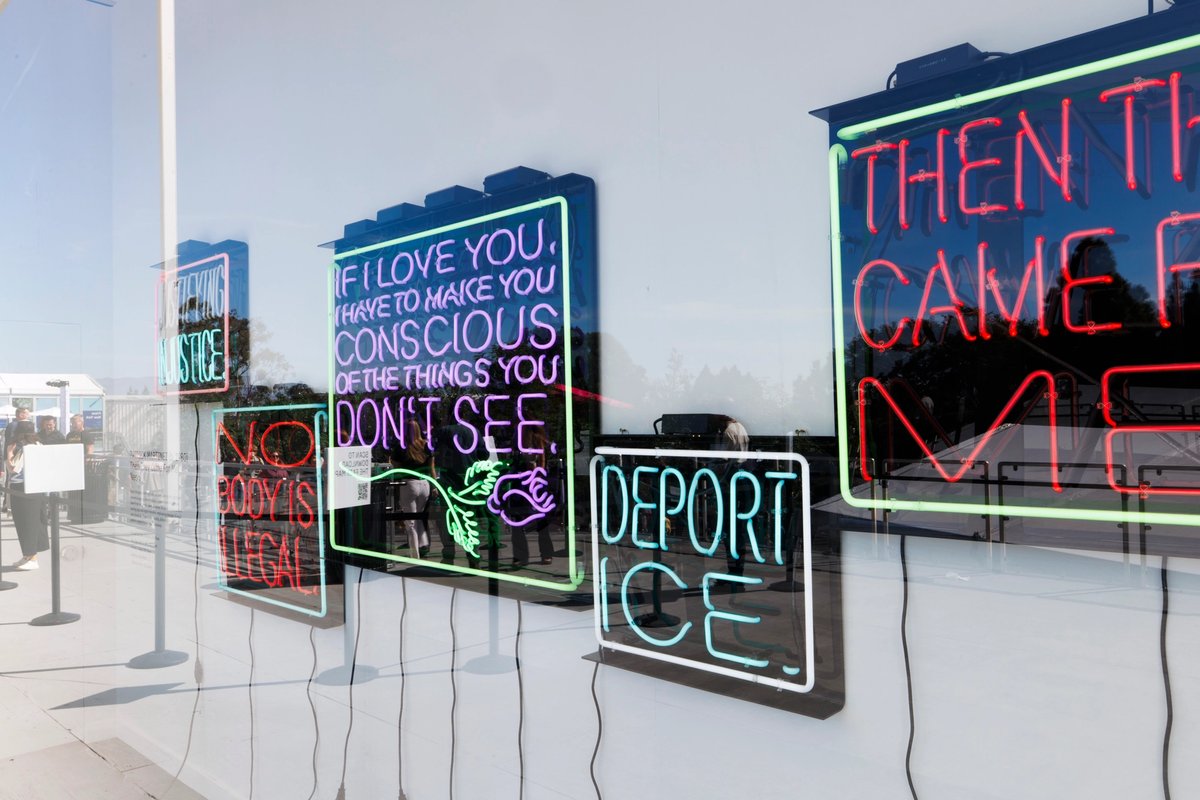
At the height of protests against US Immigration and Customs Enforcement (Ice) raids in Los Angeles last year, the local artist Patrick Martinez turned some of his neon sculptures—works riffing on the iconography of the city’s storefront signage, but with pointed political messaging—into protest placards and lawn signs. Now, six of his neon pieces are stationed at the entrance to Frieze Los Angeles, brightly and boldly proclaiming phrases including “Deport Ice” and “Nobody is illegal”.
“These neons come from the aesthetics of mom-and-pop storefront signage here in Los Angeles—income-tax accountants, check-cashing places, pawn shops, things like that,” Martinez says. “I’m remixing the messaging to speak to passersby directly, and a lot of that language is the language of protests.”
These neon works riffing on protest phrases have been a recurring focus of Martinez’s practice for a decade, including a solo stand at Art Basel Miami Beach in 2022 responding to the supreme court overturning the federal right to abortion and a 2016 piece commenting on the electoral-college system.
“These messages need to exist in the art world. They need to be seen and normalised. It’s urgent,” Martinez says. “These neons are being shown in the context of art, but for me, my work does not only exist in one place. It’s a bridge to the people that inspire the work. It’s a way of injecting the work back into the places where it needs to be seen or the places it’s inspired by.”
Appropriately, Martinez’s art can be seen throughout the city this week. Images of his neon works are on display on billboards around Los Angeles through the fair’s partnership with the media agency Orange Barrel Media. His work is also featured in the Hammer Museum’s Made in L.A. biennial (until 1 March) and he just opened a solo exhibition, Left in Ruins (until 11 April), at Charlie James Gallery in Chinatown. The solo show includes many of his large-scale pieces that re-create the cinderblock façades of stores—complete with signs, graffiti, floral murals and hints of pre-colonial imagery—as well as poignant new neons.
“I think Americans have more in common than they don’t, and this messaging is trying to bring people together,” Martinez says. “Especially in these times, because there’s so much turmoil and people are looking to connect, organise and push back collectively.”