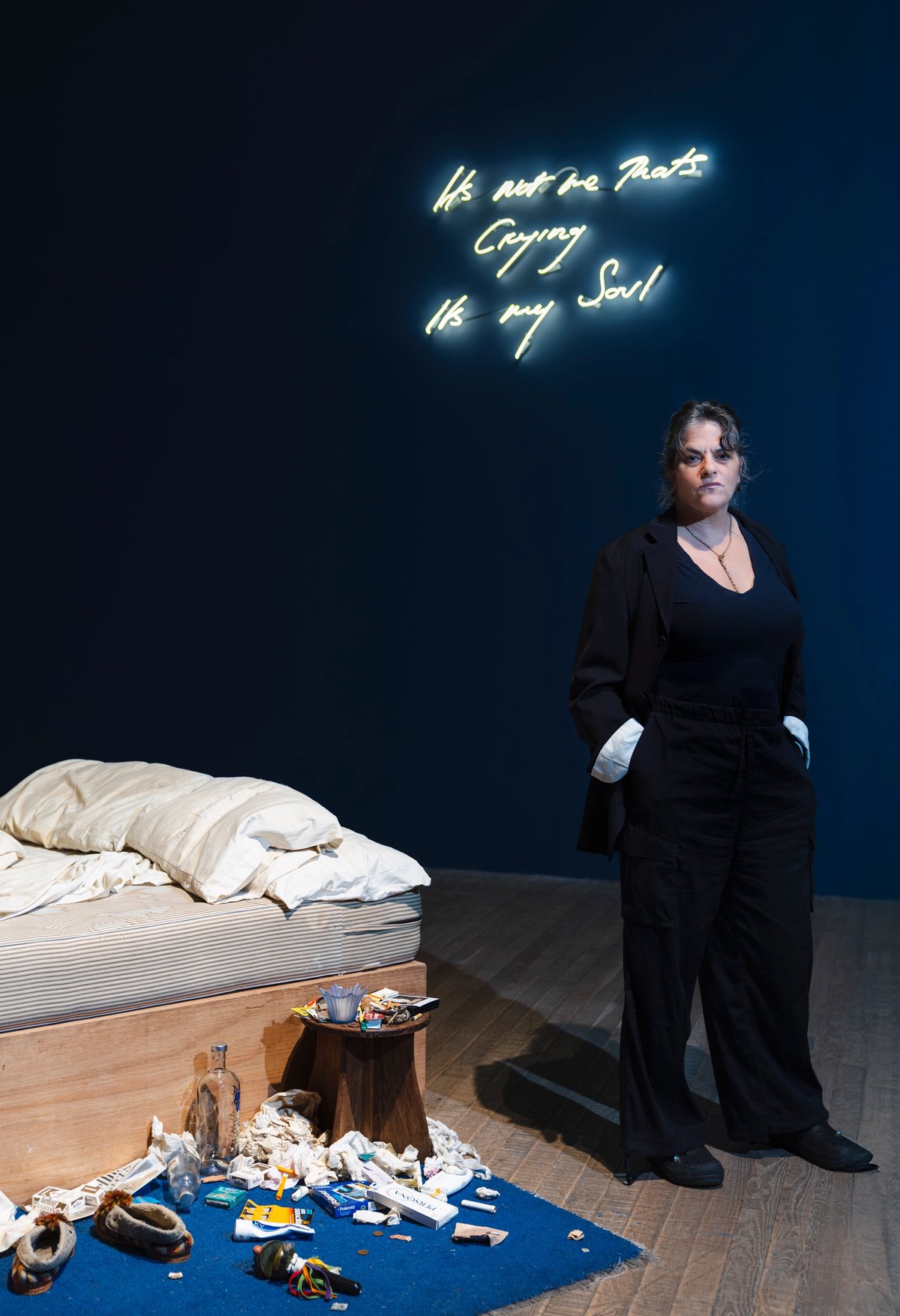
Living British artists are typically shown at Tate Britain, rather than Tate Modern. But Tracey Emin is not like most British artists.
Speaking yesterday (25 February) at the press preview of her major exhibition Second Life, which opens this week, the artist says she turned down the venue of Tate Britain as it wasn’t enough of a “challenge”, having shown there several times already, including at the 1999 Turner Prize.
Emin recalls how when she got the offer to show at Tate Modern, it came out of the blue. “At first I was hesitant,” she says. “If I was 70 or 75, I’d have thought, ‘Yeah!’ But I had to really think about what I was doing. Is this the right time in my career to do it? How would it affect me? Sometimes, when you do things too young or when you’re not ready, it’s not good for you. But you also have to do things when you’re given the opportunity. I keep saying, ‘I’m so lucky I didn’t die’, because witnessing this is quite phenomenal for any artist.”
The exhibition is pointedly not a retrospective, taking instead a thematic, deeply personal approach. Harry Weller, Emin’s longstanding creative director, has overseen the curation, working with Tate's outgoing director Maria Balshaw, and the museum staffers Alvin Li and Jessica Baxter.
One gallery pays homage to Emin’s multicultural heritage and exposes the racism she and her family were subjected to. Emin’s father, Enver, was a Turkish Cypriot, whose own grandfather was Sudanese and enslaved during the Ottoman Empire, while her mother had Romanichal roots. “My whole background is so British, everything about me is what being British is—it’s a bit of this, a bit of that. And I’m very proud of it, I’m so proud to be British. I love lots of it. But what I don’t like is jingoistic, racist, bigoted behaviour that is dividing our country,” Emin says.
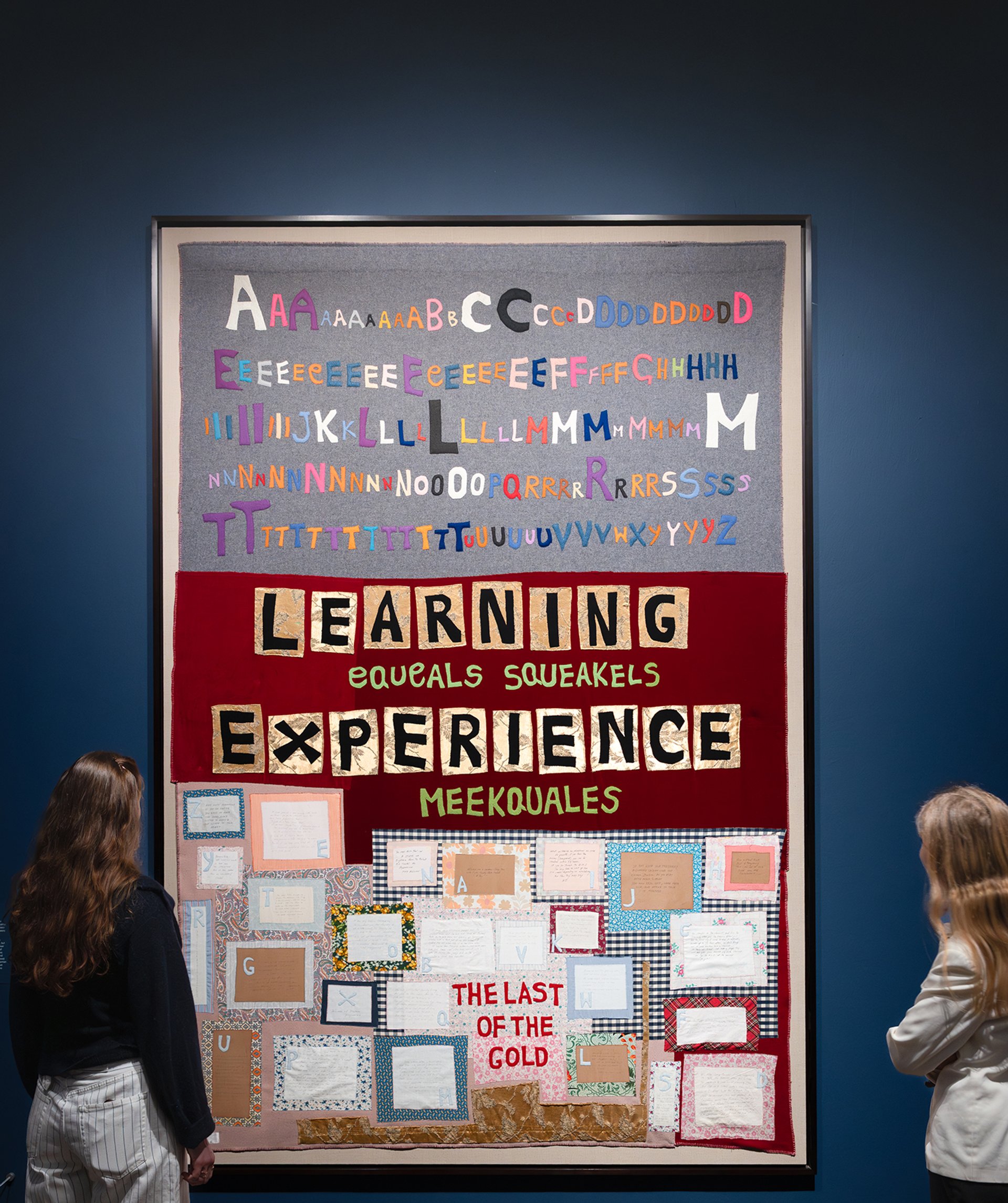
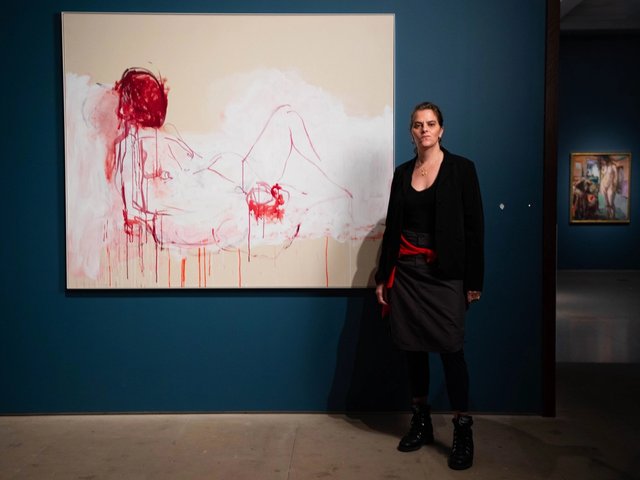
Tracey Emin, The Last of the Gold (2002)
© Tate / Sonal Bakrania
The artist notes how Reform party leader Nigel Farage has twice tried to win Margate, the Kent seaside town where Emin grew up and where she returned to live permanently in 2020. “He didn’t get in because there are a lot of people there who are a lot more intelligent and a lot more politically astute than people imagine,” she says.
The opening of Turner Contemporary in 2011 and the launch of Emin’s school and residency in 2023 has gone some way to boosting the local economy in Margate, but, as the artist points out, 18,000 people still live below the poverty line in the town. “Margate is a tough place, it’s really windy and it’s really cold,” she says. “But I’ll tell you what’s making it much better: art. Art is really changing the landscape. More businesses are opening—there are vintage shops, restaurants, little cafes, art galleries, boutiques, you name it. It sounds boujee and like gentrification, but it’s providing young people with jobs. If more people actually did something [about poverty], the country would be in a better place. And Reform wouldn’t have such a big, loud voice.”
Emin is a staunch supporter of keeping Britain’s art institutions free, suggesting that wealthier people should take museum memberships and make voluntary donations to increase access for the less well off. Coming from a working-class background and having left school at 13, the artist recalls how she needed to “find her own way” to museums. “I was 22 when I first went to Tate Britain, and I was really lucky because it was free.”
As a trustee of the British Museum, Emin is also keenly aware of the work the institution needs to do to modernise. “It’s a fantastic museum in many ways, but it has this terrible colonial past,” she says. “I hope it changes. Nick Cullinan, the new director, is really pushing it. There are a number of new trustees and our aim is to actually get it into gear and into the 21st century. But it’s hard. It’s a battle with certain things and certain issues which I’m not allowed to talk about.”
The British Museum has faced significant, growing pressure to repatriate colonial-era artefacts, notably the Benin Bronzes which were taken by British troops from Nigeria in 1897. The museum's chairman George Osbourne has failed to reach an agreement with Greece over the Parthenon Marbles. Emin says, however, that “you can’t just give things back, it doesn’t work like that”. She adds: “There is a level of responsibility for every museum to look after the works and if you just give something back you don’t know that it is going to be looked after. It is much more complex. I wish it was easier.”
The artist suggests a more supportive approach. “Rather than everybody slagging off [the BM] and trying to get it closed down, why don’t we just try and make it a better place—make it more ethical and make it stronger.”
For now, Emin has her sights on the next leg of her Tate Modern show, which tours to the Louisiana Museum in Denmark in October and later to the Hoam Museum in South Korea. Plans for the exhibition to be shown at the Guggenheim Museum in New York were shelved after Emin was offered half of the Rotunda—a space that would be impossible to fit the Tate show into. “In the end it wasn’t the right institution. We’re in no rush to show in the US and will wait for the right place,” Weller says.
There is also an argument that some of her work, particularly the pieces that address abortion and women’s rights, is at odds with the prevailing political climate in the US. But Emin doesn’t see herself as particularly radical anymore. “There’s still a side of me that that facilitates radical thinking with my residency programme and one of the most important things at the moment is for people to promote freedom of thought and expression,” she says. “But I’m 62. I don’t really want to throw myself around naked or scream at the top of my voice anymore. I just want to do my work and hang it on the wall.”