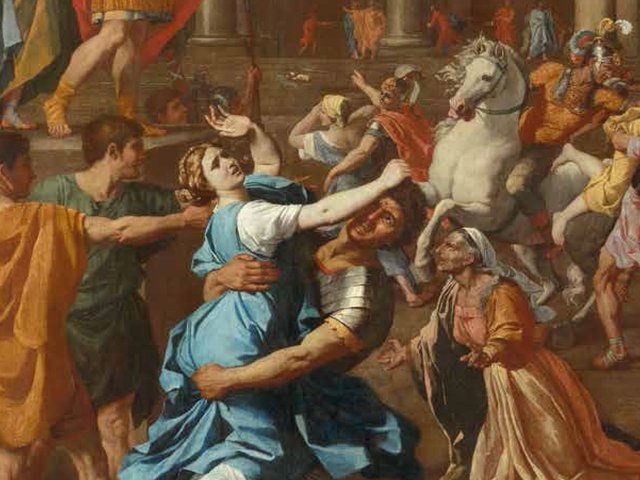
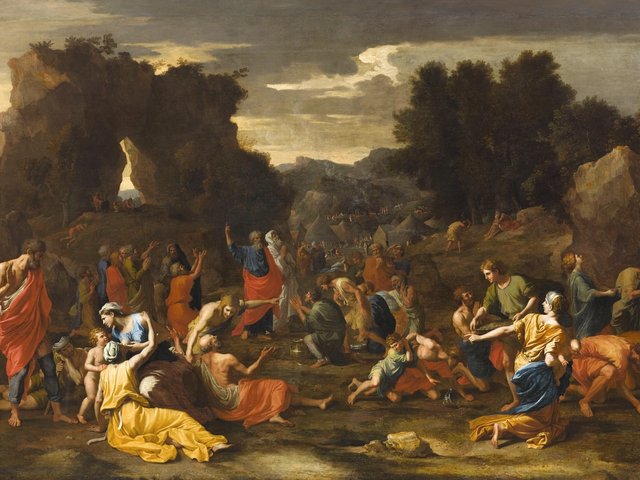
On any given day, around 25,000 visitors crowd into Paris’s Musée du Louvre, but the vast majority manage to stay clear of the sleepy north-east corner of the Richelieu Wing, home to key works by the French Classicist painter Nicolas Poussin (1594-1665). That may change this spring, when the museum’s former president-director, the art historian and curator Pierre Rosenberg, brings new attention to the artist with the publication of his long-awaited four-volume catalogue raisonné of Poussin’s paintings.
Nominally a specialist in French and Italian art of the 17th and 18th centuries, Rosenberg, now 89, is a kind of living embodiment of the whole museum.
Born in Paris in 1936 to German-Jewish parents who fled the Nazis, his family survived the war in hiding in south-western France. Rosenberg first arrived at the Louvre in 1962, at the invitation of Charles de Gaulle’s minister of culture, later heading up the department of paintings during the museum’s dramatic relaunch in the 1980s and early 90s, symbolised by the 1989 completion of I.M. Pei’s sculptural entrance, the Louvre Pyramid. He finally took over the top job, stewarding the expanded museum from 1994 to 2001. All the while, he has also been curating major shows on both sides of the Atlantic, from the Grand Palais in Paris to the Metropolitan Museum of Art in New York. To this day, he still holds the title of the Louvre’s honorary president-director.
Living legend
Open and affable, but marked by a measure of formality, he is spoken about by colleagues with a mixture of genuine affection and frank wonderment.
The French art historian Neville Rowley, a curator at Berlin’s Gemäldegalerie, says Rosenberg is “certainly a living legend”. The British art historian Colin B. Bailey, the director of New York’s Morgan Library & Museum, who has known the Frenchman for over four decades but concedes that “I’m still in awe of him”. And the US art historian Christopher Wood, whose 2019 book A History of Art History is an authoritative overview of the profession, refers to him simply as “the great Rosenberg”.
Rosenberg and his wife Béatrice de Rothschild usually divide their time between a house in Paris’s Sixth Arrondissement, and Venice, where the couple have an apartment in a Grand Canal palazzo. This winter, the two were staying put in Paris while Béatrice recuperated from an illness. Invariably wearing a necktie, Rosenberg receives his visitors in the glass-enclosed foyer, where an ornamental door handle recalls the building’s origins as a public bathhouse.
‘Eight kilos’ of thinking
Rosenberg worked on his first Poussin exhibition in the early 1960s, when he was a very young curator at the Musée des Beaux-Arts in Rouen. The new Poussin catalogue represents six-and-a-half decades of thinking about the artist, and he is pleased to measure the accomplishment not in years, or even pages, but weight—“eight kilos”.
Louvre-goers, even if they make it to the right place, tend to speed past the Poussin masterpieces. Does their lack of interest surprise him? Not really, he says: “Poussin is a very difficult painter.”
Born in Normandy, Poussin spent most of his career in Rome, where his intellectual interests and deeply allusive approach mean that true appreciation can require a near-encyclopaedic knowledge of classical and Biblical sources. In France, the artist is still associated with the rarified work of the poststructuralist philosopher Louis Marin (1931-92), while in the Anglo-American world he is wedded to the controversial career of the British art historian, and notorious Soviet spy, Anthony Blunt. Rosenberg’s new publication is nothing if not comprehensive and manages to absorb the often abstruse reflections of Marin, while engaging with, and sometimes correcting, Blunt’s own 1966 single-volume catalogue of Poussin’s paintings.
The challenge of doing this kind of catalogue raisonné, says the University of Chicago’s Richard Neer, an art historian specialising in 17th-century French painting, is addressing “important issues of attribution” connected to the artist, who had many followers and imitators. Among the works rejected by Blunt but now accepted by Rosenberg is the Kimbell Art Museum’s Venus and Adonis (around 1628-29). Among those accepted by Blunt but rejected by Rosenberg is the Toledo Museum of Art’s The Holy Family with Saint John (around 1627).

Poussin's Venus and Adonis (around 1628-29) in the Kimbell Art Museum
Fateful encounter
The new catalogue also reflects Rosenberg’s evolving ideas. The Louvre’s Mars and Venus (around 1625) is a picture that he had long considered a copy. Then, in 2012, he had a fateful encounter with the work. “I was walking through the galleries by chance, and I saw the picture in very strong sunlight. It was filthy, covered by varnishes, and I suddenly asked, ‘Is this not by Poussin?’ The picture was sent to the lab, cleaned, and studied by me more seriously. And now, I’m sure.”Blunt had attributed the work to an unnamed French Baroque painter called the Hovingham Master.
Rosenberg can still speak with some regard for Blunt, whose complicated career, including decades of service at Buckingham Palace as Surveyor of the Queen’s Pictures and public exposure as a spy, was covered in the Netflix series The Crown. He says Blunt’s review of his Poussin show in Rouen, which appeared in the Burlington Magazine, helped launch his own career—“it was the beginning for me,” he says. And he can vividly recall a private lunch at London’s Courtauld Institute, where Blunt, the longtime director, served him undercooked chicken. Blunt “spoke French better than I do”, he says. “But he was a terrible cook.”
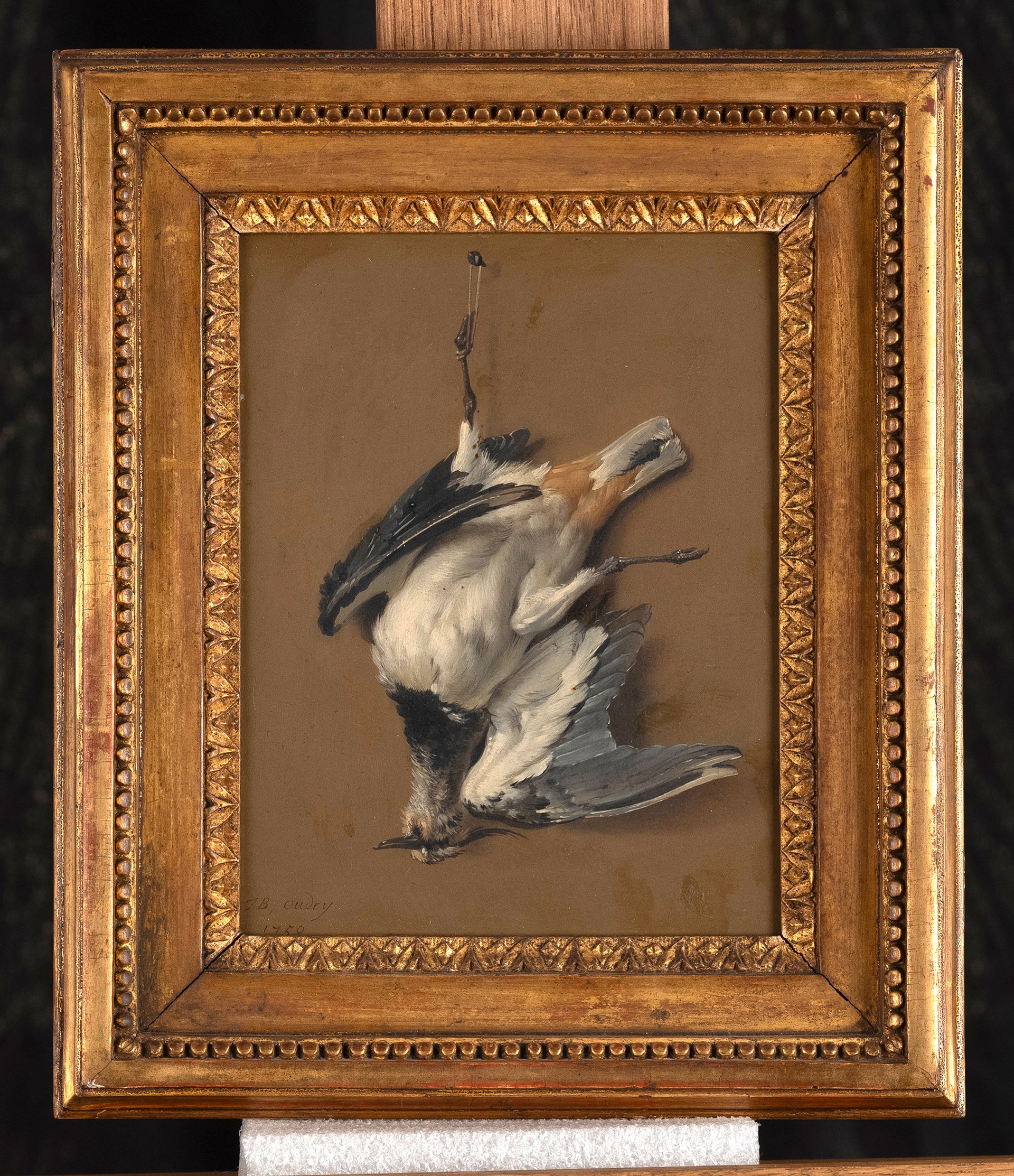
One of the works in Pierre Rosenberg’s collection, Jean-Baptiste Oudry's Northern Lapwing Hanging by One Leg (1750)
Grand Siècle Museum; Photo: Julien Garraud
As his Paris house amply demonstrates, Rosenberg is not just a curator and scholar, but an inveterate collector. He keeps his private library, comprising tens of thousands of volumes, in a low-ceilinged basement, with a documentation centre, open to enquiring scholars, on an upper floor. In between, on just about every available bit of wall space, he displays art amassed over the decades. Though concentrating on 17th-century works—among them several Poussin drawings—his holdings extend across centuries, including a 1750 still life by Jean-Baptiste Oudry; an obscene drawing by the Swedish Neoclassical artist Johan Tobias Sergel; a 19th-century Poussin-inspired study by Eugène Delacroix; and an Italian Futurist sketch from the 1920s.
A curious passion
One surprising passion: glass animals from Venice’s Murano workshops. These curious, comical objects crowd tabletops and cabinet shelves, and seem to come from another world than the refined works on the walls. Bailey, however, sees a connection—“virtuosity”. Rosenberg says the animals “make me smile”.
Rosenberg cannot recall exactly how many catalogues raisonnés he has worked on, but puts the number at six or more. In addition to Poussin’s drawings—co-edited with the French art historian Louis-Antoine Prat—he has worked on volumes about Antoine Watteau’s drawings and Jean Siméon Chardin’s paintings, among others. For Rowley, this kind of herculean effort is synonymous with a particular generation of art historians who fell between the less exacting connoisseurship of the pre-Second World War era and today’s ideologically minded younger art historians. Done right, a catalogue raisonné, he says, is not only “about seeing, but also checking, double-checking, and triple-checking”. Rosenberg’s ability to combine this level of scholarship with his curatorial career, assembling decades of landmark shows, “is just absolutely amazing”, Rowley says.
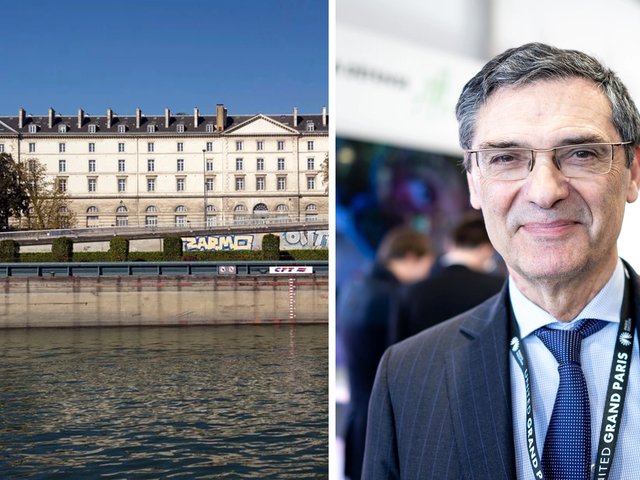
Now that the paintings catalogue is complete, Rosenberg is readying another legacy—a new and ambitious museum just outside Paris, in a derelict 19th-century building in the western suburb of Saint-Cloud. Working with its director, the French architectural historian Alexandre Gady, Rosenberg is the motor behind the Musée du Grand Siècle, covering France’s 17th-century heyday under Louis XIV. Taking shape in a one-time royal barracks overlooking the Seine, it will display Rosenberg’s holdings, down to the Murano animals. The €120m project is on track for a 2028 opening.
Thinking bigger
The museum project comes at a time of bad headlines and bad omens for the Louvre itself, which, in addition to the shocking robbery last autumn, is coping with strikes, building leaks and increasingly unmanageable crowds. Looking back on his tenure, which predates the current crises, would he do anything different?
Yes, he says, citing an inability to see how exploding visitor numbers might impact the institution. In planning for the Louvre’s expansion over the course of the 1980s and 90s—a long-term project called the Grand Louvre—“we made a great mistake”, he says. The goal was to create a museum for four or five million visitors annually, he says, not more than twice that, which is what the Louvre is often dealing with now. One new controversial solution is to relaunch the museum again, with, among other interventions, a third main entrance. Rosenberg is in favour but would not comment on a controversial suggestion to isolate the Mona Lisa in its own area as a form of crowd control.
In the meantime, while figuring out what will go where in the Saint-Cloud museum, Rosenberg is also working on another new project—Poussin’s letters, which are “quite beautiful”, he says.