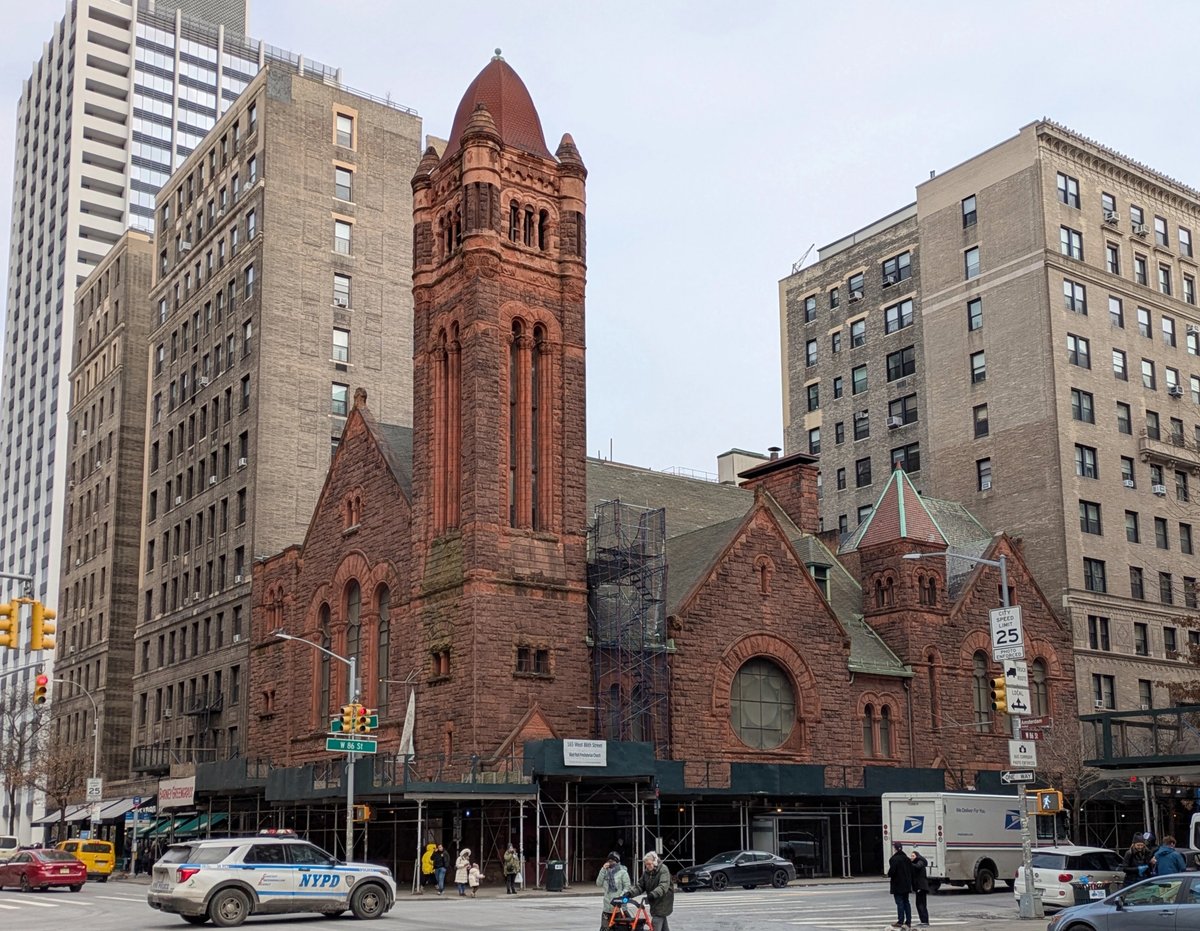
For 25 years, the sidewalk shed at the base of West Park Presbyterian Church on Manhattan’s Upper West Side has been shielding pedestrians’ heads from fragments of red sandstone crumbling off its façade. After decades of financial difficulties, the church has petitioned New York City’s Landmarks Preservation Commission (LPC) to allow its demolition, claiming that the building’s landmark status imposes an undue hardship. The move has caused uproar, most notably from the Center at West Park, an arts nonprofit founded by the church but evicted last July after years of court battles.
The Center, the building’s manager and sole tenant from 2017 to 2024, has hosted resident dance troupes and theatre companies as well as affordable spaces for arts, sports, religious and other community programmes. In the final two years, it held more than 400 public events and performances.
Since 2023, the Center has turned to celebrities to campaign for donations and raise awareness of the church’s potential demolition. The actor Mark Ruffalo has played a lead role in assembling famous friends such as Scarlett Johansson, Matt Damon, Jon Hamm and Laurence Fishburne to appear at rallies, staged readings and panel discussions.
The hardship provision of the Landmarks Law is rarely invoked; there have been only 23 applications in 60 years. To succeed in its appeal, the church must prove, among other things, that it cannot earn a “reasonable return” (6% of property value) and that the building is not suitable for performing its charitable purpose.
Celebrity endorsement
At a public hearing on 9 December, those in favour of the hardship application were outnumbered five to one. Opposing voices included residents, activists, lawyers, architects, public officials and real-estate experts who project that the leasing of space and the sale of air rights—whereby their transfer allows another site nearby to build higher—would generate revenue far exceeding the 6% reasonable return.
At a subsequent hearing on 10 March, the church said the total cost of repairs is at least $26.6m, rather than the Center’s estimate of $9.1m. When asked why it has not attempted to sell its unused air rights, the church claimed that the market is demand-driven and that there are no buyers.
Present at the December hearing were a number of actors who own homes in the neighbourhood, including Ruffalo. “Yes, I’m a celebrity,” he said. “But behind me are 1,000 young actors who were just like me, who came to New York looking for a dream, and these spaces fulfil that ability for them to find a way into the world.”
While the celebrities backing the Center largely have no connection to its programming, the one exception is Matt Dillon, who rented an art studio at the church for almost ten years. “Everywhere throughout the building there is a palpable sense of community,” he said at the hearing. “It’s hard to believe that anyone would even think about tearing down this beautiful landmark. It’s not in the best interest of the city to destroy its history.”
History of activism
Completed in 1890, the building was designed by the architect Henry Kilburn to expand an existing chapel. Its Romanesque Revival style, distinguished by its round arches and hefty masonry, is shared with dozens of churches across the city. Its tower is topped by a distinctive bell-shaped roof, and its stained-glass windows include a large 1920s backlit Tiffany panel depicting Jesus and the children.
In its 2010 decision to designate West Park a landmark, the LPC noted that “the extraordinarily deep colour of its red sandstone cladding and the church’s bold forms and soaring tower… produce a monumental and distinguished presence”, declaring it “one of the Upper West Side’s most important buildings”.
West Park has a long history of fostering culture and activism. In 1978, it became the first Presbyterian church in the US to allow LGBTQ+ ministers. In the 1980s, it housed the Shakespeare Center and the first kitchen operation of God’s Love We Deliver during the Aids crisis.
The church insists that demolition is the only way out of its financial woes, which deepened as its congregation dwindled. It sold its manse (minister’s apartment) in 2014 and laid off its pastor, the late Robert Brashear, in 2017.
Brashear, a musician himself, helped set up the Center as a secular arts nonprofit that would engage the community and raise funds for the church. Though the Center was conceived as an arm of the church, over time it became a separate entity and an adversary. An agreement to share profits yielded nothing, and the church had to bear the bulk of maintenance costs.
In 2022, the church signed an agreement to sell its building for $33m. The developer proposed building a mixed-use property with a luxury condominium tower, retail space and a 150-seat auditorium for use by the congregation and the community. In mid-2023, the Center hired a new executive director with extensive experience in fundraising, and approached the church offering millions of dollars for repairs and $600,000 in shared profit. After its eviction order, the Center offered to pay rent of $30,000 a month (roughly the previous annual rate) with an option to purchase the building for $34m after three years. All proposals were rejected.
Since leaving West Park, the Center has moved its office and some programming to the Church of St Paul and St Andrew, two blocks away. Remarkably, the new location is also a designated landmark that claimed hardship, in the 1980s. Now, in fighting to preserve a building of which it is neither owner nor tenant, the Center hopes that West Park’s landmark status stands and that it can someday move back into its original home.