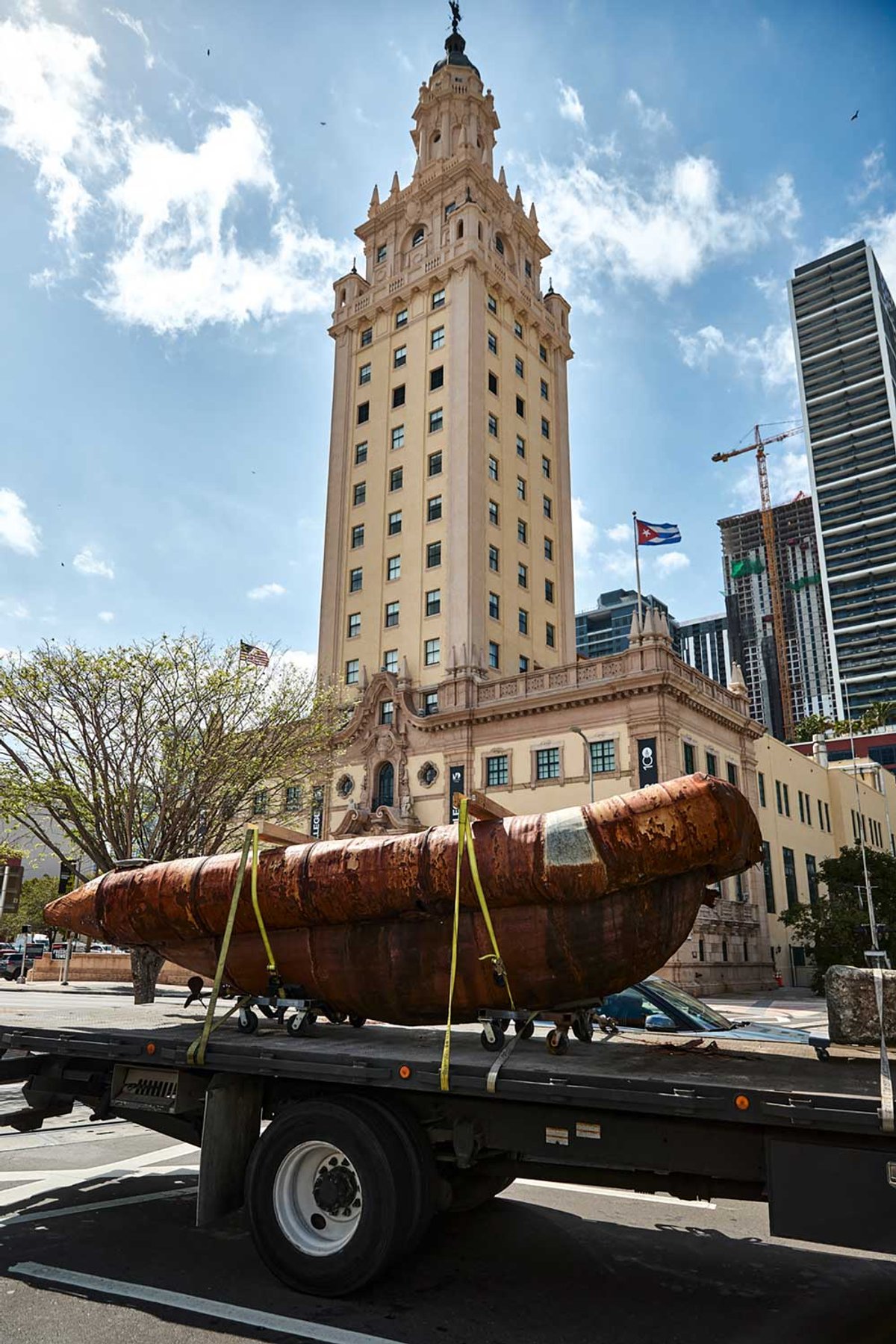
Until recently, a large, rusted vessel hung from a steel beam in the Miami studio of artists Antonia Wright and Ruben Millares. The craft is made of steel barrels welded together, with two cone-like drums topping either side. In the centre, an oxidised engine is connected with makeshift wires; four wooden planks span the raft’s barrels, providing structure and seating. Two bullet holes are visible in the wreckage, as are signs of human life: the word “Mami” is scrawled on the vessel, as is a small child-like sketch of a boat.
This vessel, salvaged from the shores of Key Biscayne in 2022 and towed back to Wright and Millares’s studio along the Miami River, is now the focal point of their exhibition at Piero Atchugarry Gallery, Exile (until 2 May). It speaks volumes about the dire circumstances facing Cuban migrants—for whom the situation in their home country is so desperate that many are willing to risk their lives on a 93-mile journey across the Straits of Florida in a makeshift boat.
“Empathy is what I used to think art was about,” says Wright. “But then I realised we would never know what this experience is. I can imagine it. I can interview people and hear their experience. I can watch films. But the actual terror they feel, I don’t think you can ever really get there. So then we realised, maybe it’s not empathy that’s the goal, but embodiment.”
Exuberance and despair
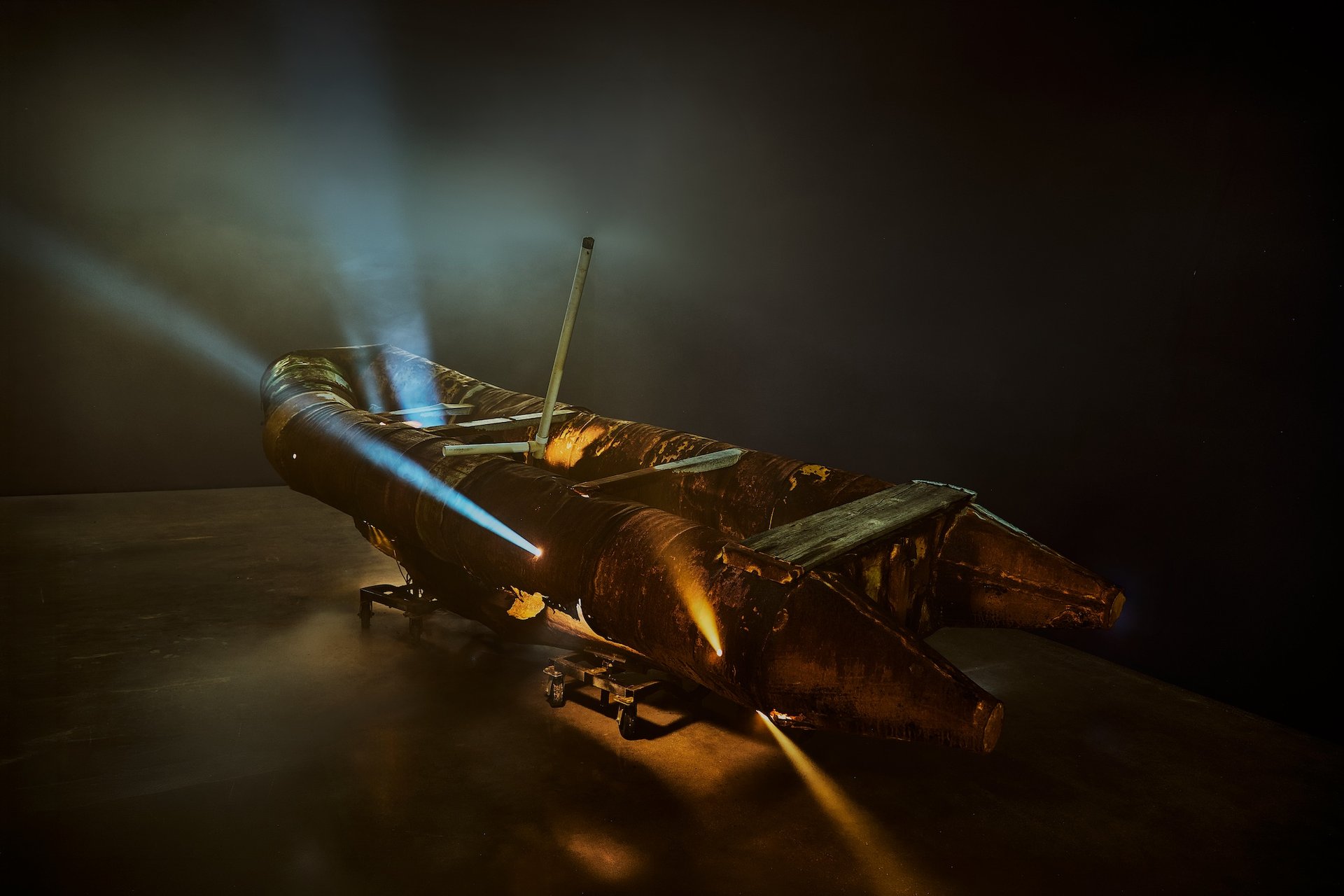
Antonia Wright and Ruben Millares, Exile, 2026 Photo: Rudy Duboué. Courtesy of the artists and Piero Atchugarry Gallery
Life in Cuba has devolved into a catastrophe in recent months. For Cubans who have lived away from the island for years, the possible fall of the revolutionary government is a prospect mired in contradiction: exuberance at the possibility of a Cuba freed from dictatorship; despair knowing that leaders in the US—especially president Donald Trump and secretary of state Marco Rubio—are mostly interested in the economic resources they can extract from the island; and fear for those who remain on the island facing hunger, disease and shortages of fuel and electricity.
“I cannot explain to you how dire things are,” says the Cuban American artist Coco Fusco, whose recent retrospective at El Museo del Barrio in New York and the Museu d’Art Contemporani de Barcelona dealt in part with the treacherous realities of the Cuban revolution. “Cuba looks like a country that has been bombed. Garbage is piled up like mountains and buildings collapse everywhere; the schools are a mess and the hospitals are completely overrun. My relative broke their hip and died because she couldn’t find gas to drive herself to the hospital. This happens every day.”
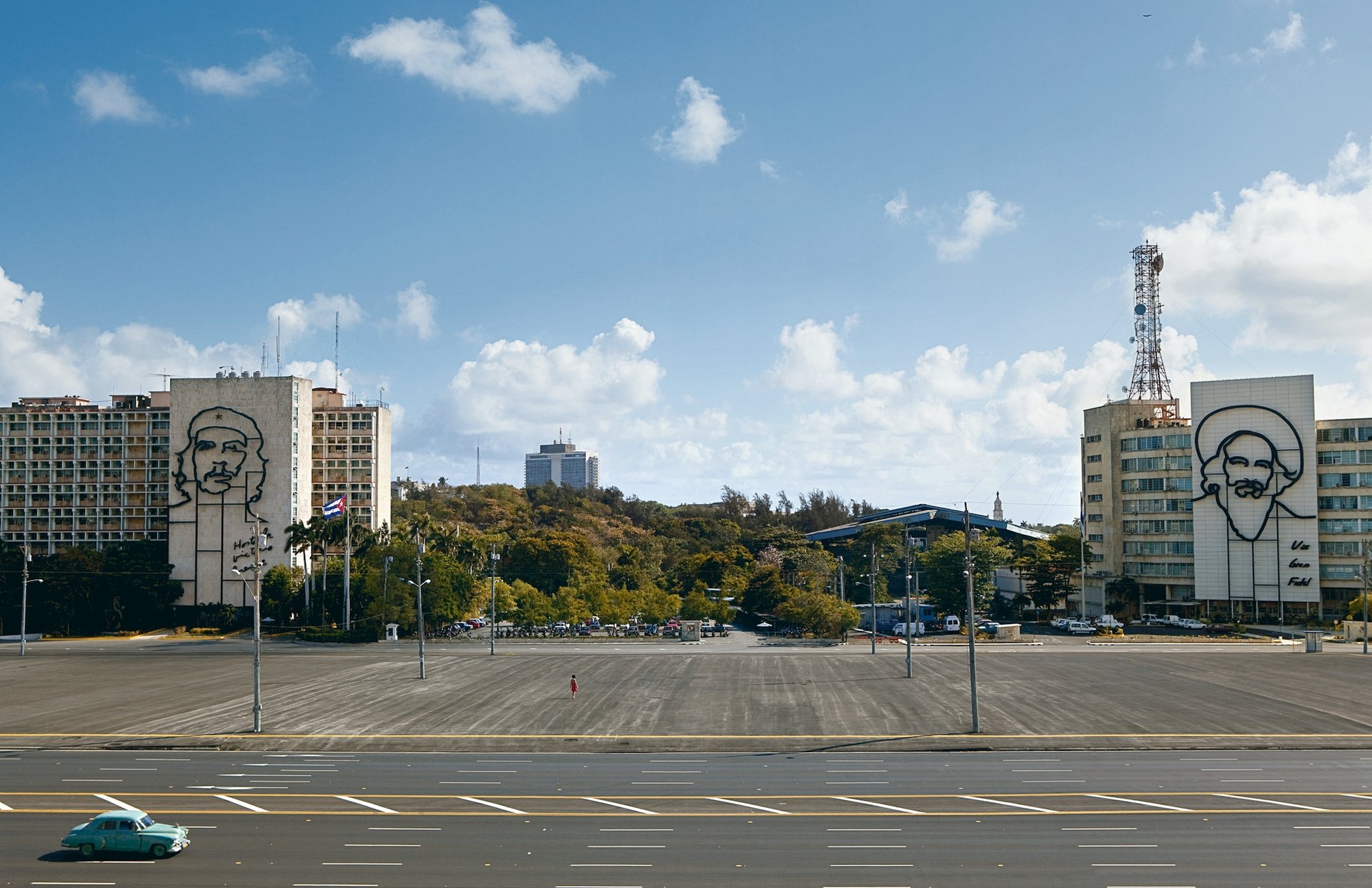
Coco Fusco, La plaza vacía (The Empty Plaza), 2012 (still) Collection of El Museo del Barrio, New York. Acquisition enabled by VEZA New Media Fund 2022 and headline supporters South SOUTH and Niio
Despite the mounting evidence that Cuba is a failed state, president Miguel Díaz-Canel’s government remains defiant and continues to strangle free expression on the island. The government blocked all internet access during protests in 2021 and arrested 19 artists including Luis Manuel Otero Alcántara. Most of them have been in jail ever since. Last month, the Cuban government arrested the duo behind the dissident TikTok account El4tico, Ernesto Ricardo Medina and Kamil Zayas Pérez, who had shunned Cuban artists’ typical practice of “creative resistance” in favour of more bluntly documenting what is really happening in Cuba.
Would-be migrants from the island now face an impossible choice: stay, suffer and risk imprisonment, or find a way to the US and risk arrest, detention and deportation. Historically, Cubans arriving in Miami by foot or by raft were afforded automatic residency thanks to a policy known as Wet Foot, Dry Foot. When president Barack Obama eased the trade restrictions between the US and Cuba in the final months of his presidency, he eliminated this policy. The move proved to be a lose-lose for him: hard-line Cubans in the US saw his attempt at rapprochement as a sign of sympathy for the Cuban Communist party, while Cubans newly arriving in the US lost their right to residency.
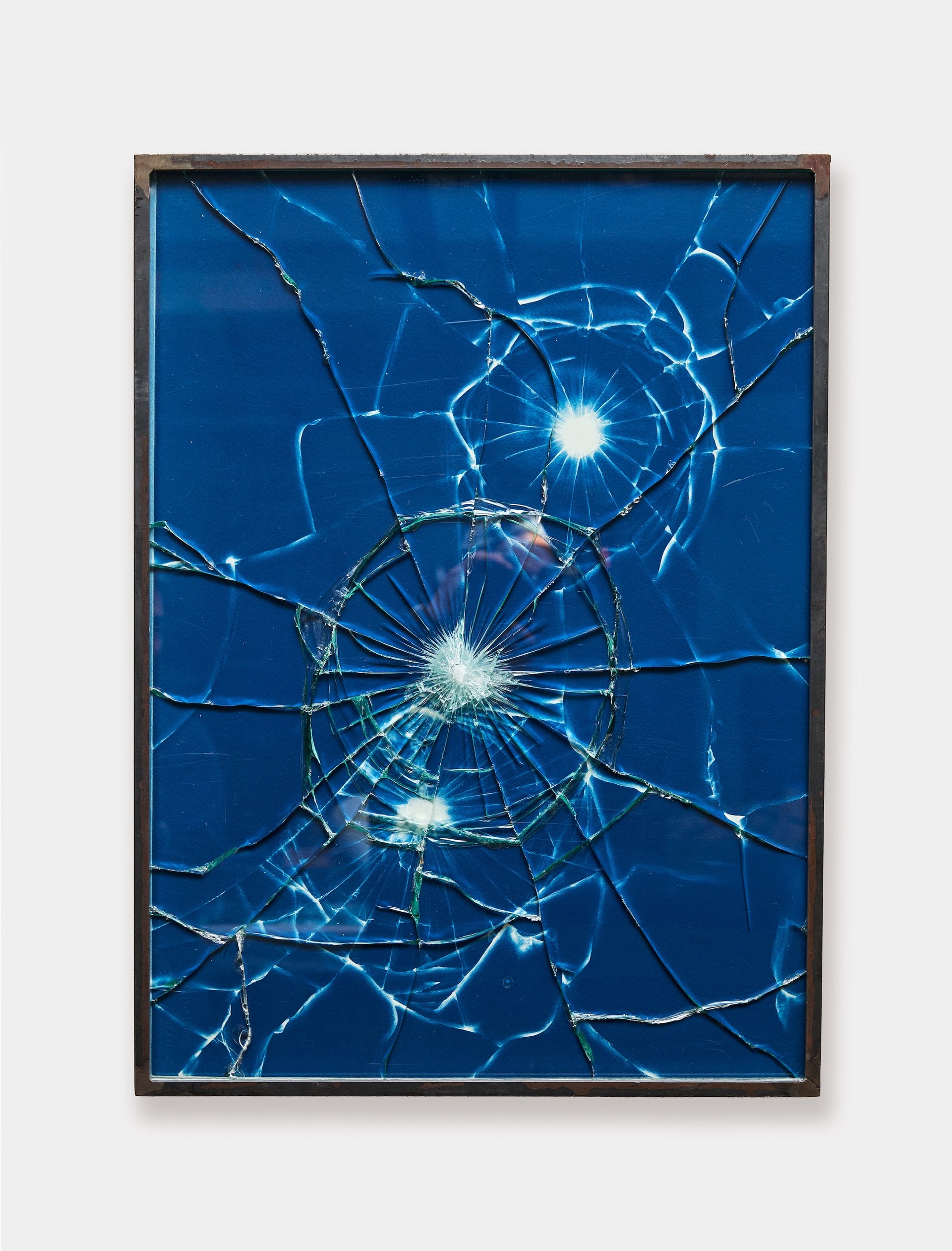
Antonia Wright, Home, 2026 Courtesy of the artist and Piero Atchugarry Gallery
The shifting US policies have done little to dissuade Cubans from fleeing north. Since 2021, more than one million Cubans have left the island, the majority to seek asylum or humanitarian parole in the US. Many of the country’s artistshave left, too. Some of the most prominent, like Tania Bruguera and Tomás Sánchez, have not returned to Cuba since the 2010s. Other artists who not that long ago spent the majority of their time on the island—like Reynier Leyva Novo, Amaury Pacheco and Nestor Siré—say that returning feels impossible under the present circumstances.
Similar to a country at war
“This is the longest I’ve ever been away from Cuba, since I never left the island for more than six months at a time, and now I’ve been gone for almost a year,” says Siré, a multimedia artist who was based in Havana and whose research probes how technological infrastructures shape, and are shaped by, everyday social life. “What’s happening now is laying the groundwork for a social and humanitarian crisis similar to a country that’s been bombed or is at war. It’s also incredibly difficult that nobody really talks about it much internationally, especially in Europe, where I am now.”
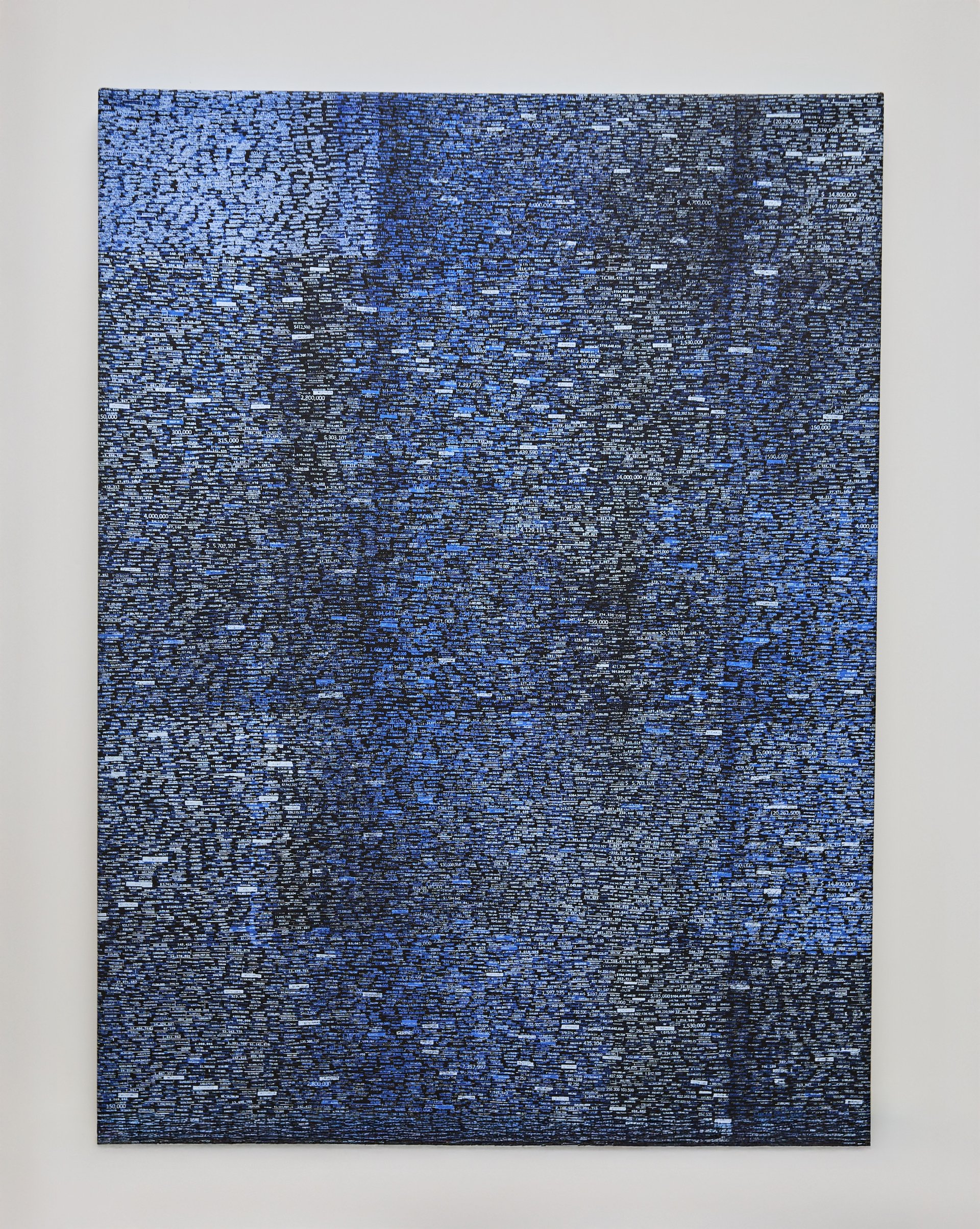
Ruben Millares, Paint by Number, 2017 Courtesy of the artist and Piero Atchugarry Gallery
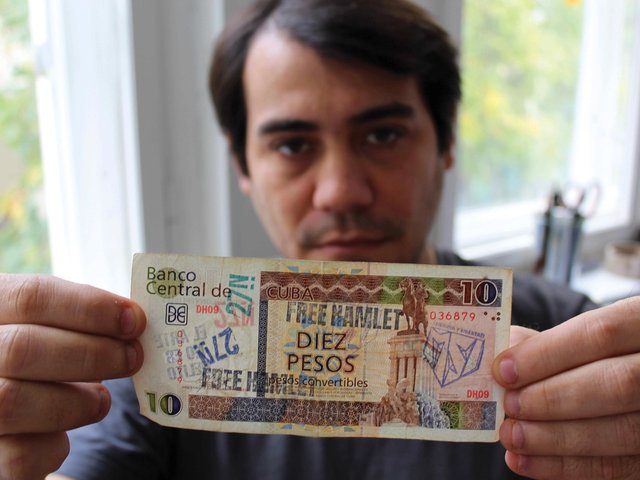
Cuban artists shine a light on state repression
In their exhibition, Wright and Millares reflect on this experience, shared by new migrants and the around one million Cubans exiled after the 1959 revolution. The exhibition is charged with both violence and a sense of the uncanny. It includes Wright’s cyanotypes under smashed glass, which evoke brutality and fragility in a single, visceral gesture. Works from Millares’s Paint by Number series are also on view, in which the artist takes numbers from financial documents and transforms them into silkscreen prints, akin to reducing people to a series of jumbled numbers on a canvas. The salvaged boat sculpture, Exile, is installed in a darkened room with a warm, hazy light shining out of the bullet holes and embedded speakers playing sounds that register as vibrations before they are heard.
Standing near the humming hull, the artists’ intention is clear. The glowing sculpture “makes me think of the boat as an immigrant body”, Millares says. “Having my body be close to it and feel the vibration, I can, for a moment, be inside the body of someone who had to ride in this to get to a better place.”