Even before planning began for the David Geffen Galleries, LACMA’s chief executive and director, Michael Govan, had been encouraging curators to think beyond traditional departmental lines. A series of collection-based exhibitions demonstrated the possibilities of hanging contemporary photography beside ancient textiles, or Latin American sculptures with South Asian design objects.
“What was apparent was the values and gains that came from breaking down silos,” says Britt Salvesen, the head of the museum’s departments of photography and prints and drawings. The new curvilinear building provides the opportunity to collapse rigid categories and implicit hierarchies. Rather than replicate the 19th-century Beaux-Arts model, in which rooms were confined to a single discipline, culture or era, LACMA’s 45 curators were invited to reconsider how the museum’s holdings might communicate across multiple sightlines and adjacencies, animating new connections and questioning fixed notions of history.
“I don’t see it as flattening so much as I see it as an enlivening,” says Leah Lehmbeck, the head of the departments of European painting and sculpture and American art. “It only makes it richer when you include the other media that were being made at the time, because artists weren’t working in a vacuum: they were looking around and trying different things.”
A structuring principle that was first proposed by the museum’s junior curators—using bodies of water as curatorial nodes—emerged as a powerful way to enliven the collection. In the galleries, the Mediterranean Sea and the Atlantic, Indian and Pacific oceans serve as conduits foregrounding how water has, for centuries, been the medium through which objects, ideas and people have circulated. Here are seven key works that serve as anchor points amid the drift.
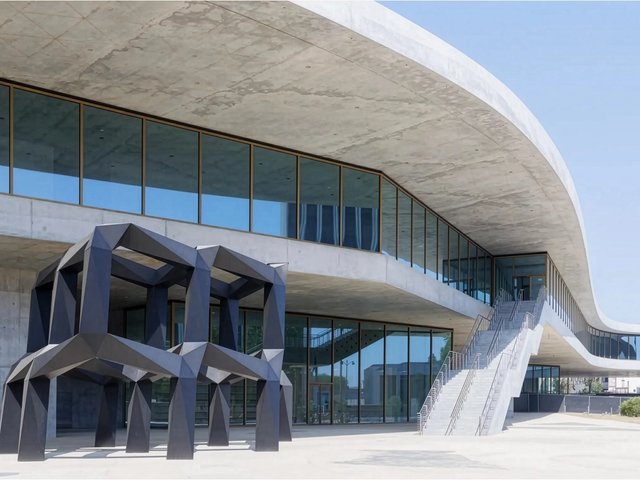
Todd Gray, Octavia’s Gaze (2025)
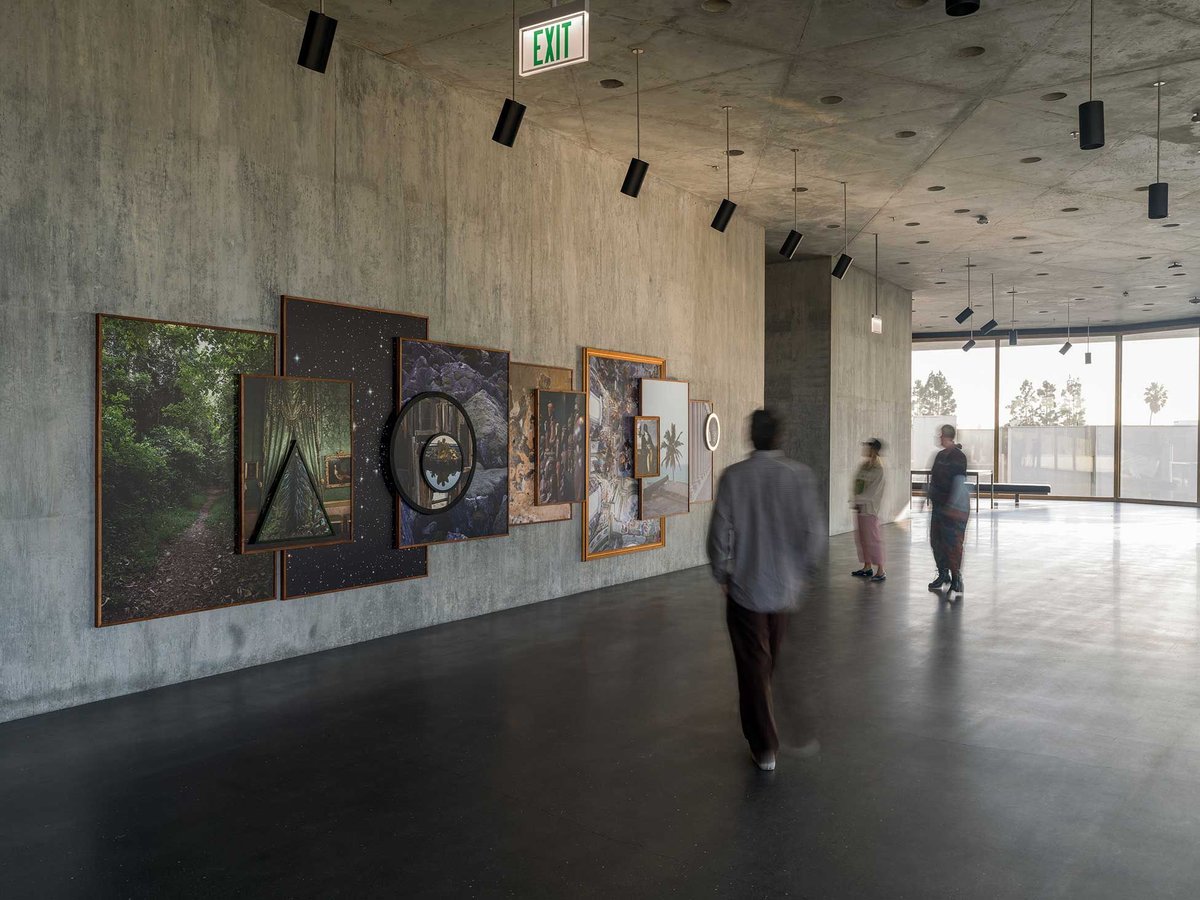
The Los Angeles-born artist Todd Gray is best known for his monumental assemblages of framed photographs that interrogate dominant Western art-historical narratives. This 27ft-long sculpture, commissioned by LACMA for one of the entrances to the new galleries, establishes the installation’s terms of engagement. Within overlapping gilded and wooden frames of varying shapes and sizes is a range of portraits (among them the Pasadena-born science-fiction writer Octavia Butler), landscapes, museum interiors and architectural details. Conceived for a spot facing a row of floor-to-ceiling windows overlooking Wilshire Boulevard, the images were printed using UV-cured aluminium technology developed for commercial signage, allowing them to withstand sustained exposure to natural light. The work’s merging of multiple times, places and aesthetics foreshadows the curatorial principles that organise the galleries. Its siting between galleries devoted to African and Latin American art draws a transatlantic connection. Gray was the first artist outside the institution to hear about the oceanic framework. His response has stayed with the curators: “You’ve got the critique, but you haven’t sacrificed the beauty.”
Elsewhere, Reiko Sudō’s glimmering, plated chrome curtains, designed to prevent direct exposure while still allowing diffuse light to pass through the translucent weave, protect more sensitive works. Described by the curators as works of art in their own right, the curtains will feature in Sudō’s LACMA retrospective this autumn.
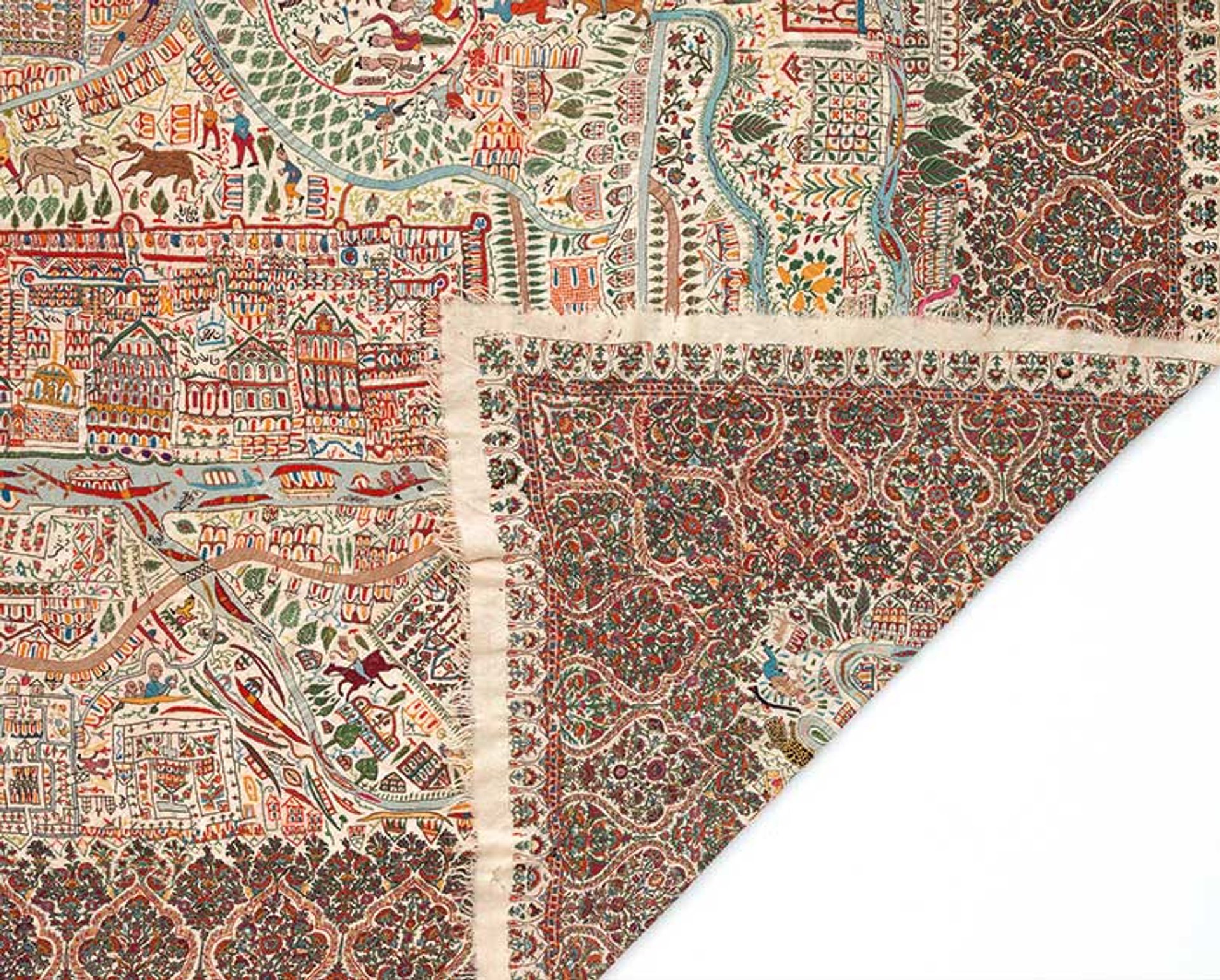
Photo: © Museum Associates/LACMA/Jonathan Urban
Kashmir Map Shawl (second half of the 19th century)
One of a handful of known examples worldwide, this densely embroidered shawl maps the city of Srinagar under Mughal rule with fastidious care. The Jhelum River structures the composition; bridges, a central mosque and a palace are all labelled in Kashmiri script, while animals, bathers, religious congregants and athletes animate the surface. Worked in fine stitches that mimic twill-tapestry weave, the image appears on both sides. The shawl is a recent acquisition and on view at LACMA for the first time, alongside other textiles that trace how Kashmiri garments travelled westward throughout the 19th century to become luxury fashion accessories in Europe. Curator Sharon Takeda describes textiles, from costumes to quilts, as connective threads running across the permanent collection galleries and even into the museum’s new restaurant, where a large-scale woven commission by Sarah Rosalena (see p6) continues the material conversation.
© 2026 Ruth Awawa Lanier Inc; photo: © Museum Associates/LACMA
Ruth Asawa, Untitled (1954)
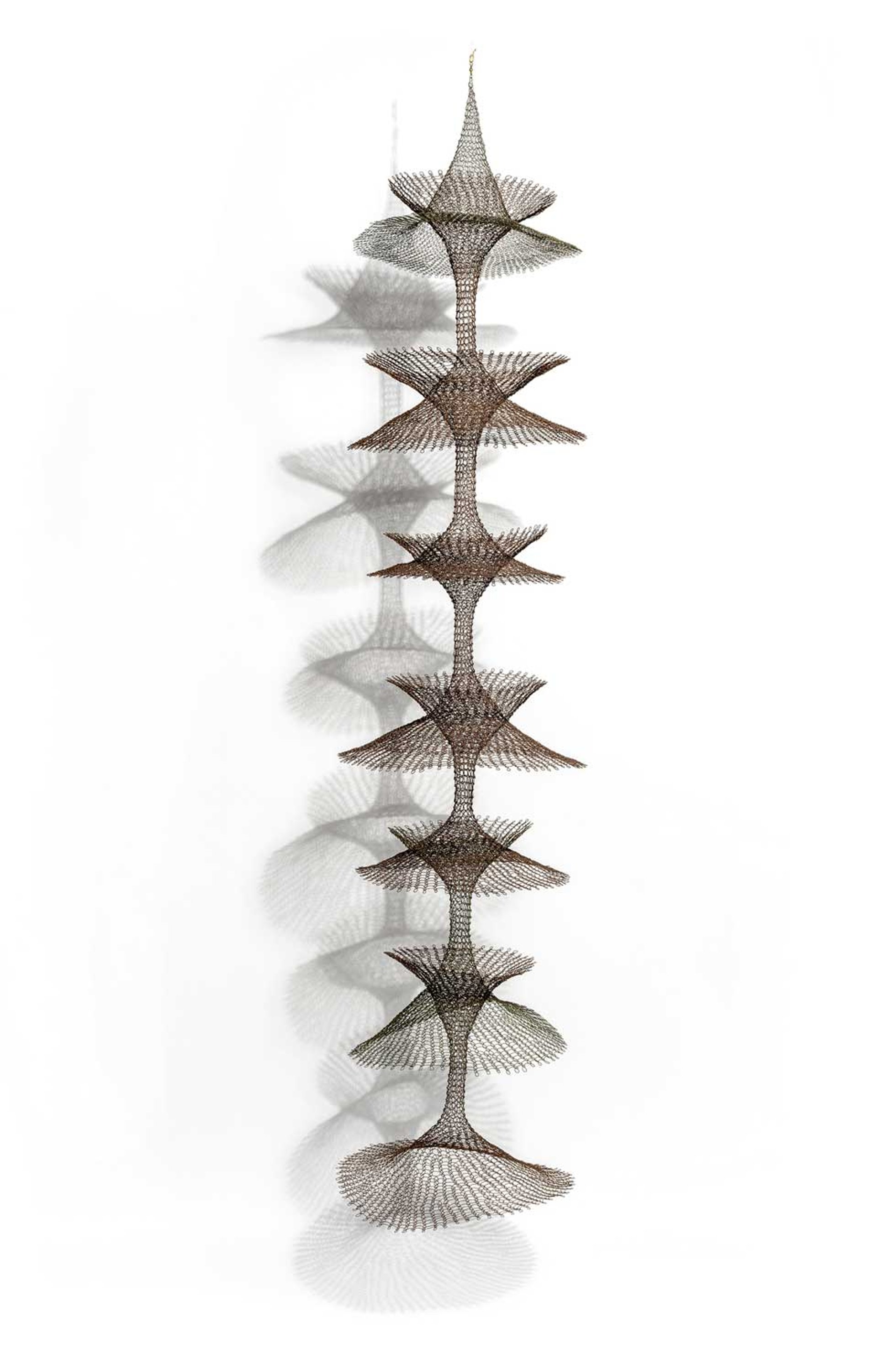
Ruth Asawa’s tied-and-looped-wire sculpture, more than eight feet tall, hangs in In This Light, a Pacific Ocean-inspired gallery dedicated to the interplay between light and shade. As natural light filters into the north-facing space, the sculpture’s diaphanous, cascading forms cast intricate shadows across the concrete, causing the work to register simultaneously as a physical object and an immaterial projection. Asawa, born in California in 1926 to Japanese immigrant parents, was unjustly interned, along with her family, during the Second World War. She later studied under the pioneering modernist Josef Albers at Black Mountain College and developed her signature crocheted wire technique after learning basketry from local artisans in Mexico. She turned the inexpensive, industrial material, which is evocative of entrapment, into a means of describing interior and exterior space as a single continuous plane. The sculpture shares the space with other works that leverage surface illumination and transparency, including pieces by Larry Bell and Roni Horn. LACMA’s decorative arts and design curator Bobbye Tigerman hopes the gallery will encourage slow looking and return visits to see it in different seasons and times of day.
© El Anatsui; photo: © Museum Associates/LACMA
El Anatsui, Fading Scroll (2007)
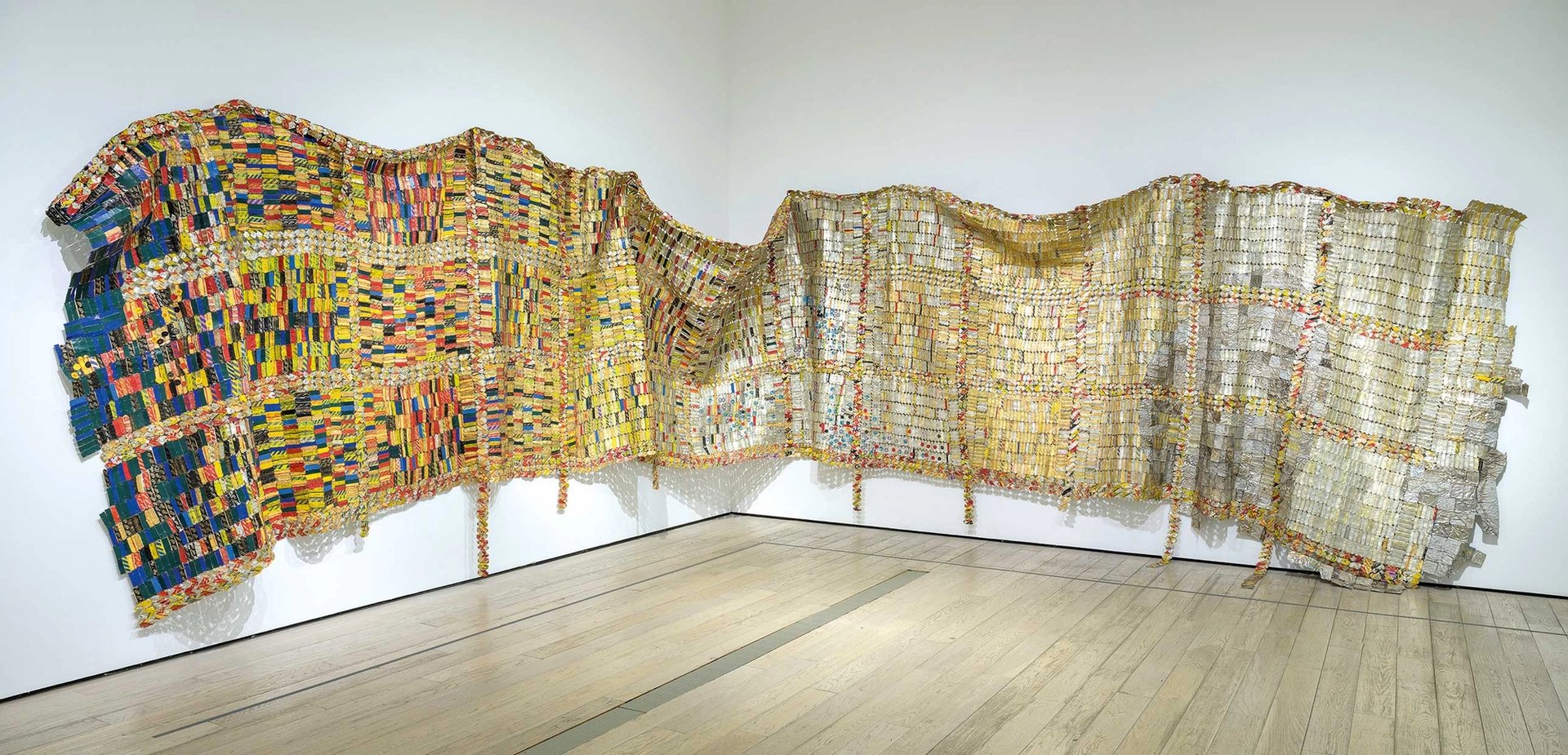
In the Atlantic section, the Ghana-born, Nigeria-based artist El Anatsui’s Fading Scroll hangs beside a Ghanaian prestige cloth, drawing attention to the ways the contemporary artist both extends and subverts inherited craft techniques. Substituting the thread and yarn that his father used to weave Ewe Kente cloth, Anatsui uses copper wire to stitch together discarded materials. Fading Scroll is composed of thousands of unfolded bottle caps that together give the illusion of a shimmering, metallic tapestry. Its rows of reflective gold, blue, yellow and red tones can be arranged and draped differently for each installation. The commercial detritus is not incidental: for centuries, European traders exchanged textiles and alcohol in West Africa for gold and enslaved peoples. “My work can represent links in the evolving narrative of memory and identity,” the artist has said, an observation that resonates with the installation’s representation of the Atlantic Ocean as a place of ongoing negotiation, rupture and resolution.
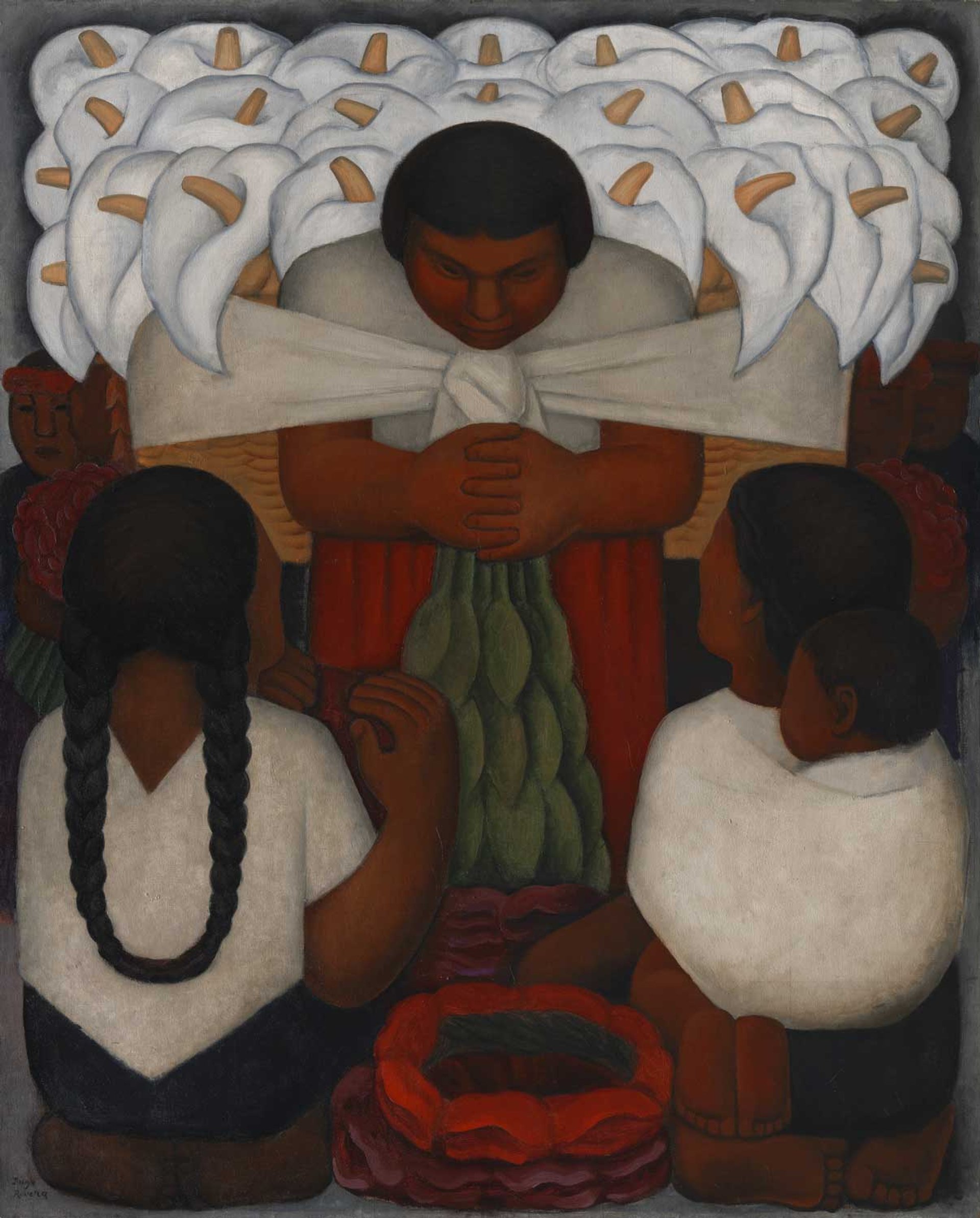
© 2026 Banco de México/Diego Rivera and Frida Kahlo Museums Trust, Mexico, D.F./Artists Rights Society (ARS), New York; photo: Museum Associates/LACMA
Diego Rivera, Flower Day (1925)
One of LACMA’s earliest acquisitions, Diego Rivera’s Flower Day, introduces visitors to a wide selection of objects by Indigenous artists from across the Americas and 20th-century works by Latin American artists who integrated early mythologies into their portrayals of modern subjects. In the earth-toned oil painting, a flower vendor obscured beneath a massive basket of paper-white calla lilies bows before two kneeling women. Rendered in block-like volumes, the figures recall Mesoamerican sculptures, such as Goddess with Temple Headdress (1325-1521), on view nearby. The calla lilies themselves are transoceanic: native to southern Africa, the flowers arrived in Mexico by way of European trade routes and were so thoroughly absorbed into the country’s visual culture that they became an emblem of Indigenous identity. Sharon Takeda, head of the departments of costume and textiles and Japanese art, says the building’s poured grey concrete walls can alter the perception of both the pigments and compositions. “You look inward,” she says, “instead of toward the outline or the frame, which entirely changes its appearance.”
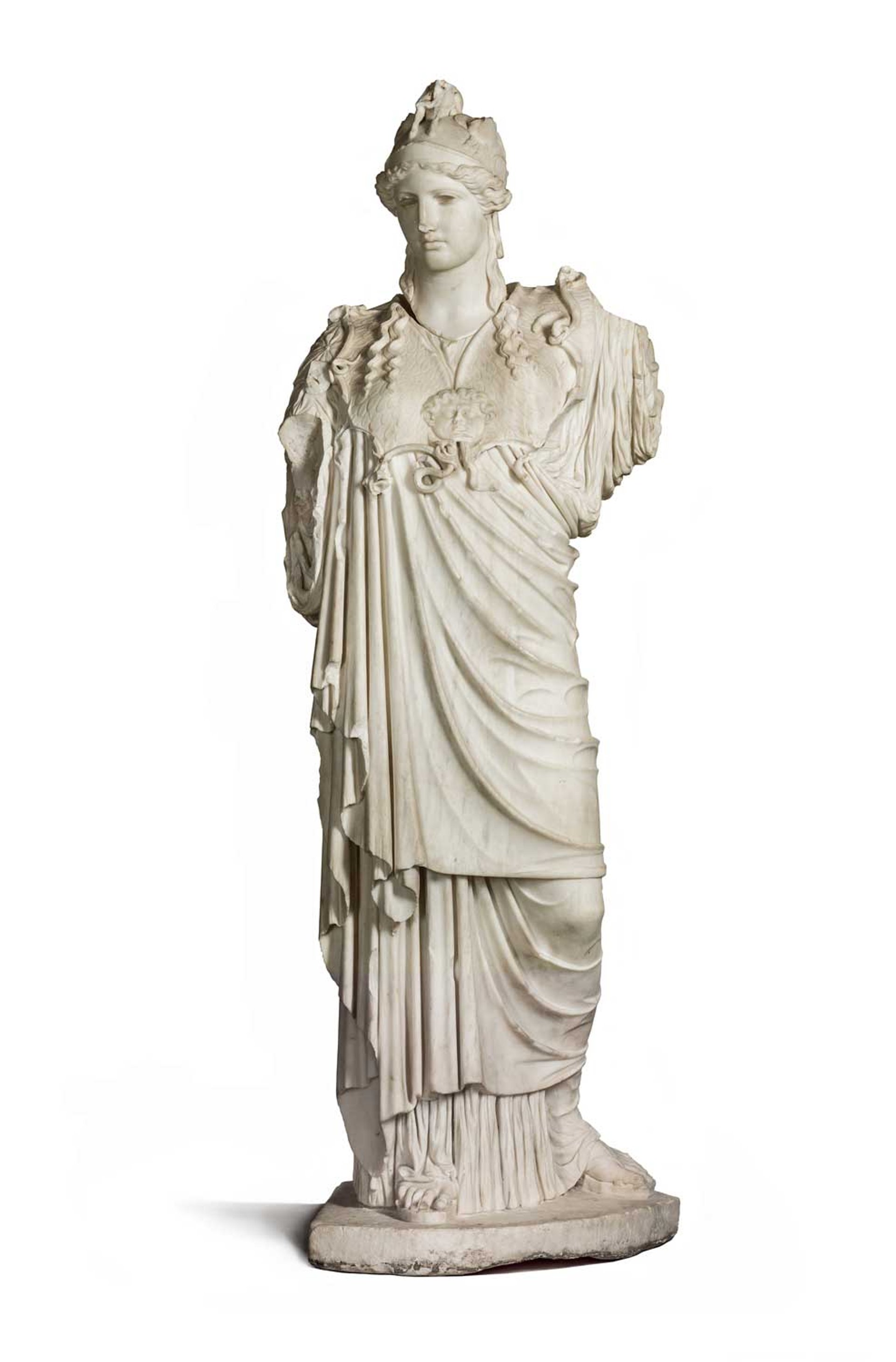
Photo: © Museum Associates/LACMA
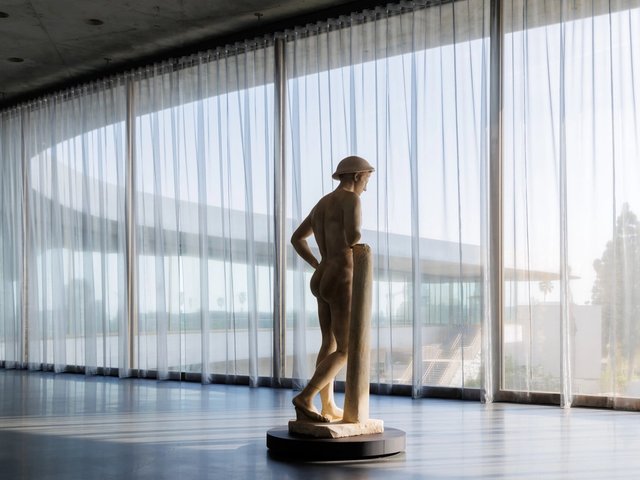
The Hope Athena (2nd century AD)
A copy of a Greek original, the larger-than-life marble Athena—with a helmet adorned with a sphinx and griffin, a snake-fringed aegis and a breastplate with a Medusa medallion—presides over a section of the Mediterranean Sea galleries organised around cosmologies across the ancient world. The deity’s likeness is transfigured across the featured artefacts: from a Greek vase to a Roman bust to a Macedonian coin. Nearby, a case of miniature Isis and Aphrodite statuettes foregrounds resonances between Egyptian and Greek traditions, upending the strict curatorial divisions that have typically kept them separate. Extending the lineage further, Lehmbeck says that the goddess of wisdom and war can be approached from three sightlines within the gallery,
and seen from theIris and Gerald B. Cantor Sculpture Garden below, where Auguste Rodin’s antiquity-inflected bronzes stand. At night, her commanding figure stands illuminated, an enduring presence outside of space and time.
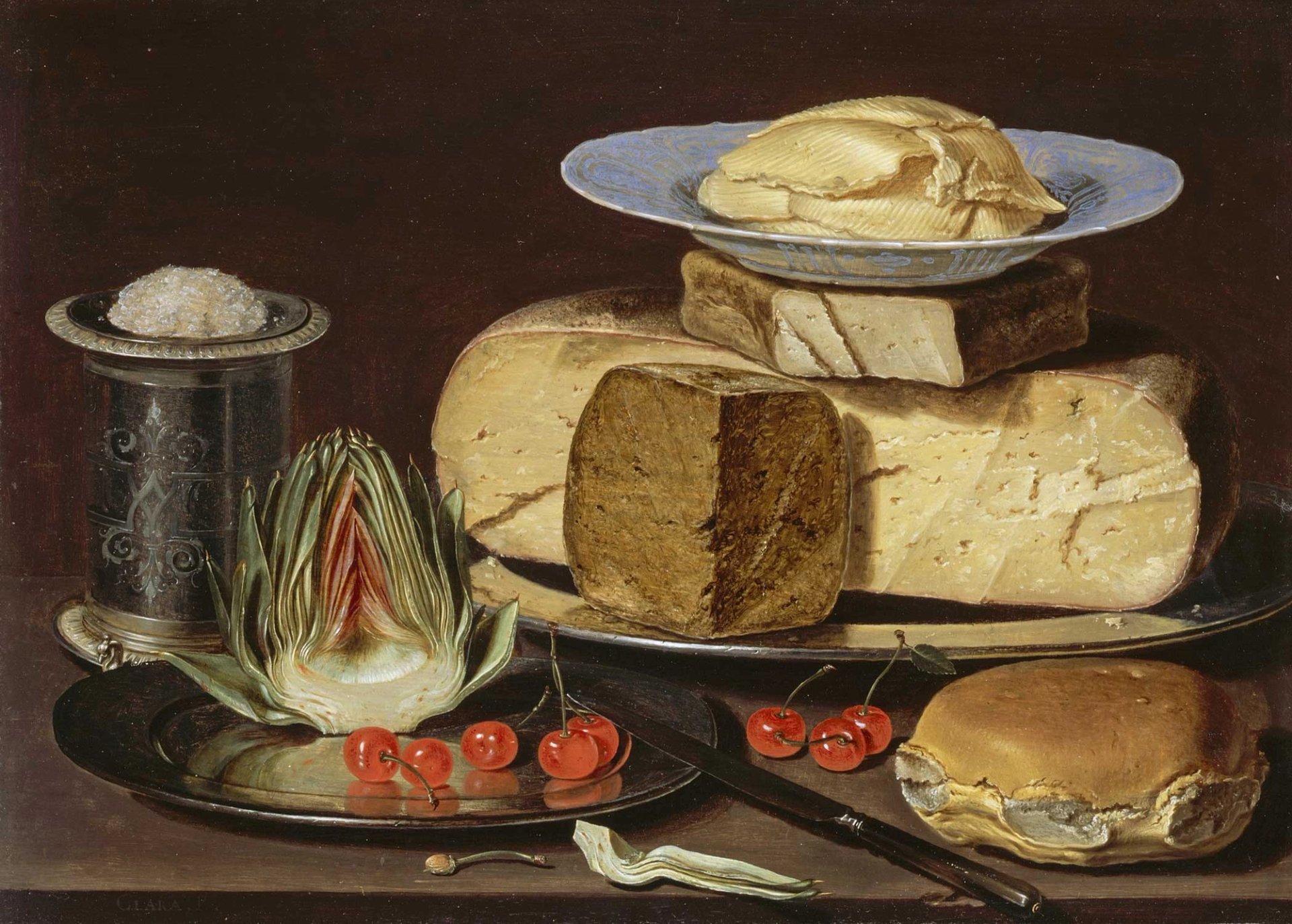
Photo: © Museum Associates/LACMA
Clara Peeters, Still Life with Cheeses, Artichoke, and Cherries (1625)
The light in 17th-century Flemish painter Clara Peeters’s still life appears to emanate from within the oil paint. The gleaming silver surfaces of the salt cellar and banquet tray bend light back toward the bisected artichoke and glossy cherries. The thick curls of butter stacked on a patterned plate glow against the dark carmine ground. Her ontbijtje, or breakfast piece, documents global exchange as much as Dutch prosperity: the blue Chinese porcelain records the reach of the Dutch East India Company’s trade routes, while the salt speaks to northern European commerce moving in similar currents. Peeters was among the few women working professionally as painters anywhere in Europe at the time, navigating a guild system that excluded her from membership and formal training. The placement of her work in an Atlantic gallery encourages visitors to read her virtuosity within the art-historical tradition that constrained her and the economic system that filled her radiant compositions with a wide range of luxury items.