Total star rating: ★★★★★
The works: ★★★★★
The show: ★★★★★
In the hushed, monastic cells of Florence’s Museo di San Marco, Mark Rothko’s canvases pulse with spiritual intensity. The permanent works of art in these small abodes, within a former Dominican convent, are Fra Angelico’s frescoes, designed to engross their inhabitants in quiet contemplation. Rothko’s paintings are a new arrival, part of the city’s latest major exhibition. Seen alongside the early Renaissance works, they are like abstracted distillations: a beam of yellow light on rich red next to an angel in prayer or forbidding layers of blue and brown alongside a brooding crucifixion. In dialogue with Fra Angelico’s works, they also help to invest otherwise plain rooms with awesome emotional weight.
Mark Rothko is, of course, an artist at the height of his posthumous fame
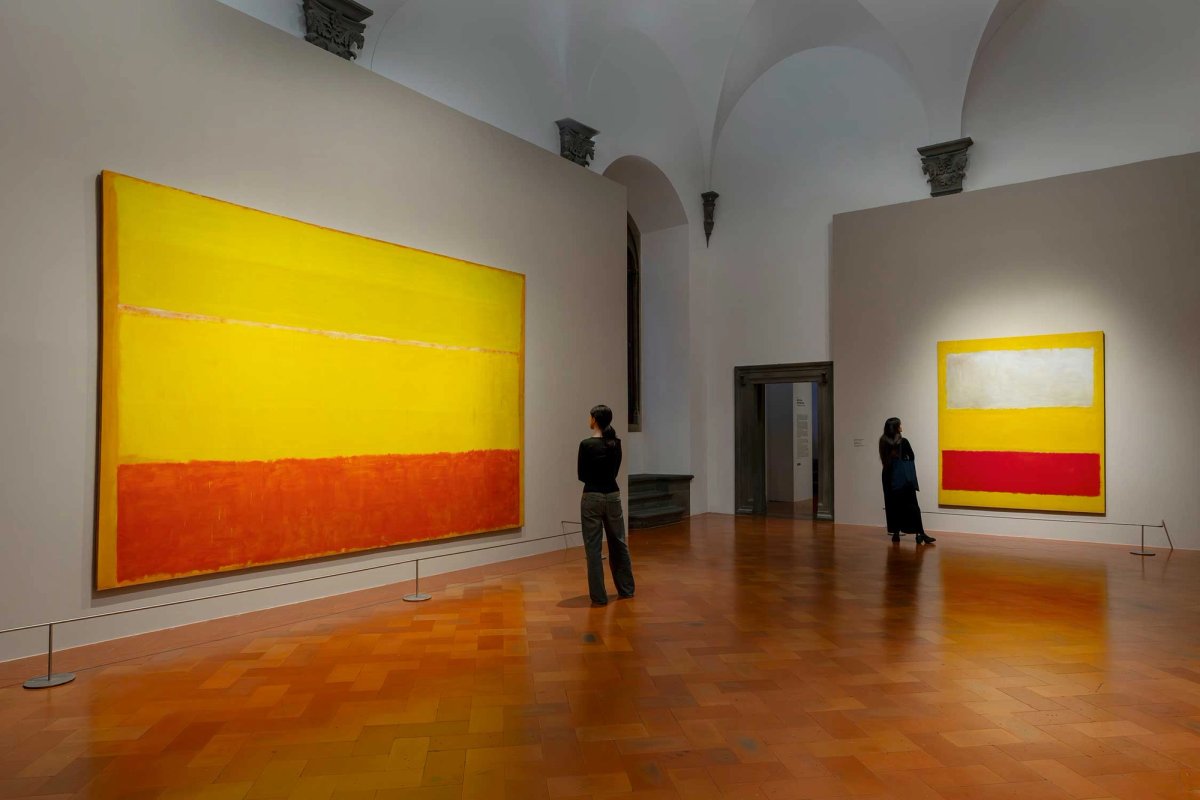
Rothko in Florence is the Palazzo Strozzi’s new exhibition exploring how the Tuscan city and its art shaped the American artist (1903-70), who visited three times in the 1950s and 60s. The show is co-curated by Rothko’s son, Christopher, and stretches across three locations. The bulk of the 70 works—a fine selection from private collections and major museums including New York’s Museum of Modern Art, Tate in London and the Centre Pompidou in Paris—are shown at the Palazzo Strozzi, offering a focused account of Rothko’s creative evolution. A handful displayed elsewhere—five at San Marco and two in the Michelangelo-designed vestibule of the Biblioteca Medicea Laurenziana—provide the exhibition’s key.
You might question whether the world needs another big Rothko exhibition, especially after the mammoth retrospective featuring more than 100 of his works at Fondation Louis Vuitton in Paris in 2023. Rothko is, of course, an artist at the height of his posthumous fame, with one of his works recently offered at Art Basel Paris for $40m. Yet Rothko in Florence does something new through the originality and force of its thematic focus. If placing his works alongside Fra Angelico makes them radiate, hanging a pair of 75cm by 55cm studies for the Seagram Murals (commissioned in 1958 for New York’s Four Seasons restaurant) in Michelangelo’s vestibule is almost suffocating. Their black columns on bright red mimic how the Renaissance artist’s austere stone stairwell entraps you in a narrow, vertically arranged space. More than simply conveying the expressive power of his works, the installation reveals how Rothko, inspired by the masters, devised a new language by thinking spatially.
Accompanied by his wife, Mell, the near penniless artist first visited Italy on a tight budget in 1950. During his time there, he feasted on artistic wonders that he had only ever contemplated in books, such as the Roman Forum, perfectly preserved buildings in Pompeii, and Giotto’s enveloping frescoes at the Scrovegni Chapel in Padua. Later, in his unfinished book The Artist’s Reality, Rothko wrote at length about the golden age of the Italian Renaissance. His Rothko Chapel in Houston, completed posthumously in 1971 with 14 dark canvases displayed inside, shows he was thinking of art as something that defined space, much as Fra Angelico had at San Marco.
Rothko was sometimes explicit about the influence of Renaissance art. “He achieved just the kind of feeling I’m after,” he once said of Michelangelo’s vestibule at the Biblioteca Medicea Laurenziana, in reference to his own Seagram Murals, which were never hung in the restaurant (Rothko eventually withdrew from the commission) and are now displayed in major museums including Tate Modern. “He makes the viewers feel as though they are trapped in a room where all the doors and windows are bricked up, so that all they can do is butt their heads forever against the wall,” he added.
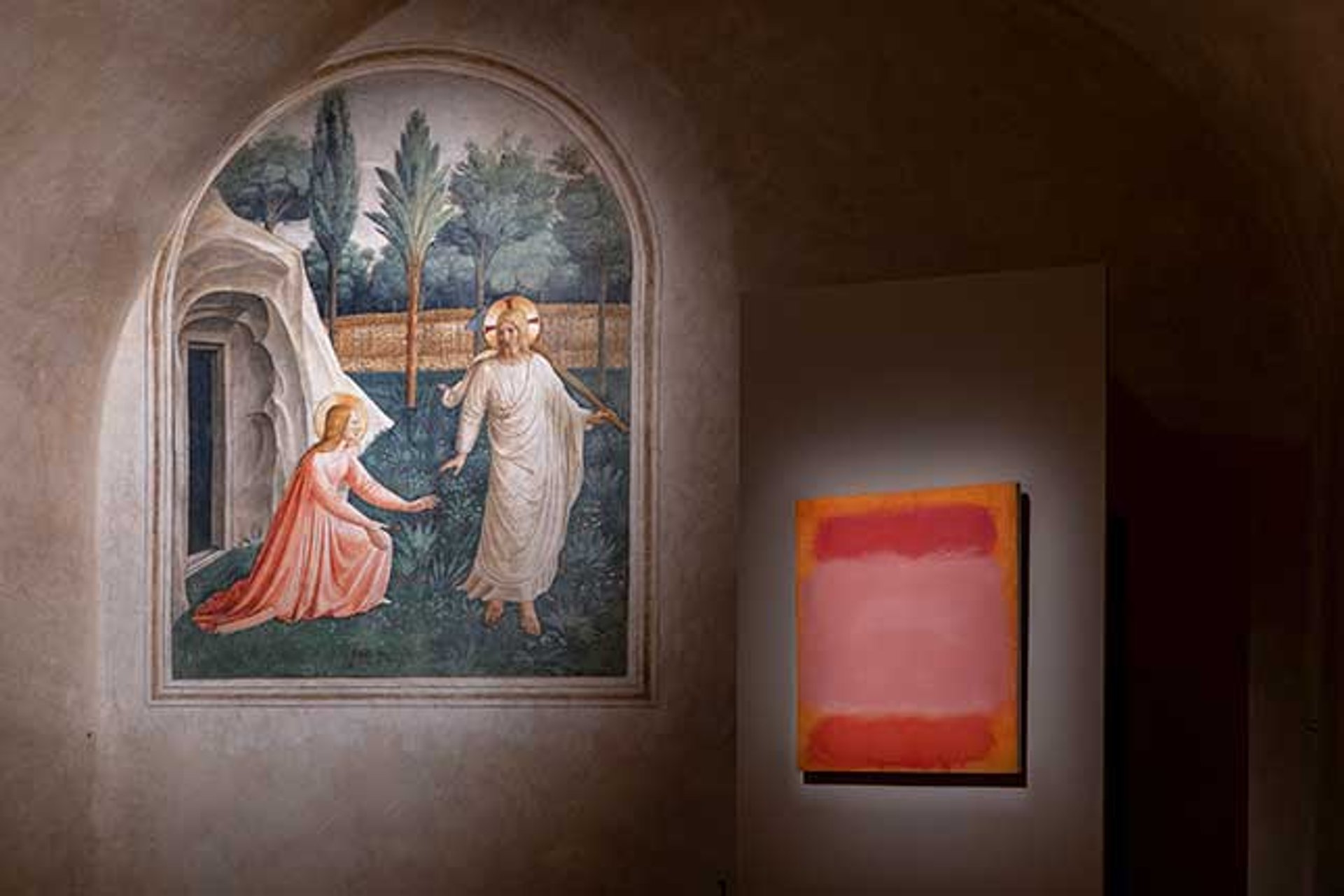
The show is taking place at three venues, including the Museo di San Marco (pictured) Photo: Ela Bialkowska, OKNO Studio
The show is a typically ambitious undertaking by the epoch-straddling Palazzo Strozzi, which ended a blockbuster Fra Angelico show in January and has also shown contemporary artists like Ai Weiwei and Tracey Emin in its 16th-century halls and courtyard. An awkward ticketing system—visitors must buy separate entry for each of the three venues—means some effort is required to see the exhibition in full. But the rewards are considerable; a carefully thought-through layout and meticulous attention to detail helping make this a revelatory show (Christopher Rothko, who has shared curatorial duties with Elena Geuna, has been trying to bring the project to fruition for 15 years).
Blistering colours
It would be easy to read the core showing at the Strozzi—the site of impressive canvases like a blistering yellow-on-red from the Guggenheim Museum Bilbao—as a simple chronological exposition. It sets us up with the artist’s geometric figurative works, such as Interior (1936), with grey pilasters, blocked-in windows and lithe statues that hint at the Medici Mausoleum in Florence’s New Sacristy—a place Rothko could have only seen from photographs. From there, we pass through his fluid neorealism and the muted blotches of his transitionary multiform phase, followed by the throbbing yellow and orange blocks of the 1950s, the more meditative earthiness of the following decade and the cool greys on blacks created shortly before his untimely death in 1970.
More than a plain retrospective, however, the thesis of Rothko’s preoccupation with space emerges with greater ease and power than the authoritatively insightful programme essays can convey. Walking through the Strozzi’s halls, you can feel the artist interacting with that dimension in different ways as he searches for a new artistic language, from works that are simply concerned with space to ones that essentially create it. Standing in front of the large, rough-surfaced canvases of the 1960s—with layers of reds that could have been inspired by Pompeii—the viewer feels invited to step into the painting. Careful hanging just inches from the floor accentuates its surroundings, as if turning the works into thresholds. Curatorial precision helps create the overall effect. At the San Marco, Rothko’s paintings glow in soft spot-lighting, showing how these works, like Fra Angelico’s frescoes, appear to emanate the very moods and emotions the viewer perceives. Darkened windows and calibrated lighting at the Strozzi allow for a similar result. In a room entirely filled with large red canvases, the simmering rage of Four Darks in Red (1958) hangs heavily in the air.
The Seagram Murals were not decorations but installations that would have morphed the restaurant they were conceived for (“I have made a place,” Rothko once said of them). Part of that effect lies in the way the paintings were created to speak to one another. The curators cleverly guide us through his vision, closing the exhibition with an octagonal room—reminiscent of Florence’s Baptistery, or even the Rothko Chapel—where a chorus of assorted works surround the viewer like brilliant stained-glass windows. Within the Renaissance walls of Palazzo Strozzi, the exhibition has created a chapel of its own.
- Rothko in Florence, Palazzo Strozzi, Museo di San Marco and Biblioteca Medicea Laurenziana, Florence, until 23 August
- Curators: Christopher Rothko and Elena Geuna
- Tickets: €7-€15
What the other critics said
The New York Times’s Elisabetta Povoledo suggests it is appropriate to stage an exhibition in a city Rothko loved. “Sixty years after his last trip to Florence, Rothko is back in a way he might never have imagined,” she writes. In Domus, Maria Cristina Didero lavishes praise not only on the exhibition—describing it as “compelling”, and singling out the “exceptional” and “rarely seen”preparatory drawings—but also the venue. The Palazzo Strozzi “stands out for the scholarly quality of its programme,” she writes.