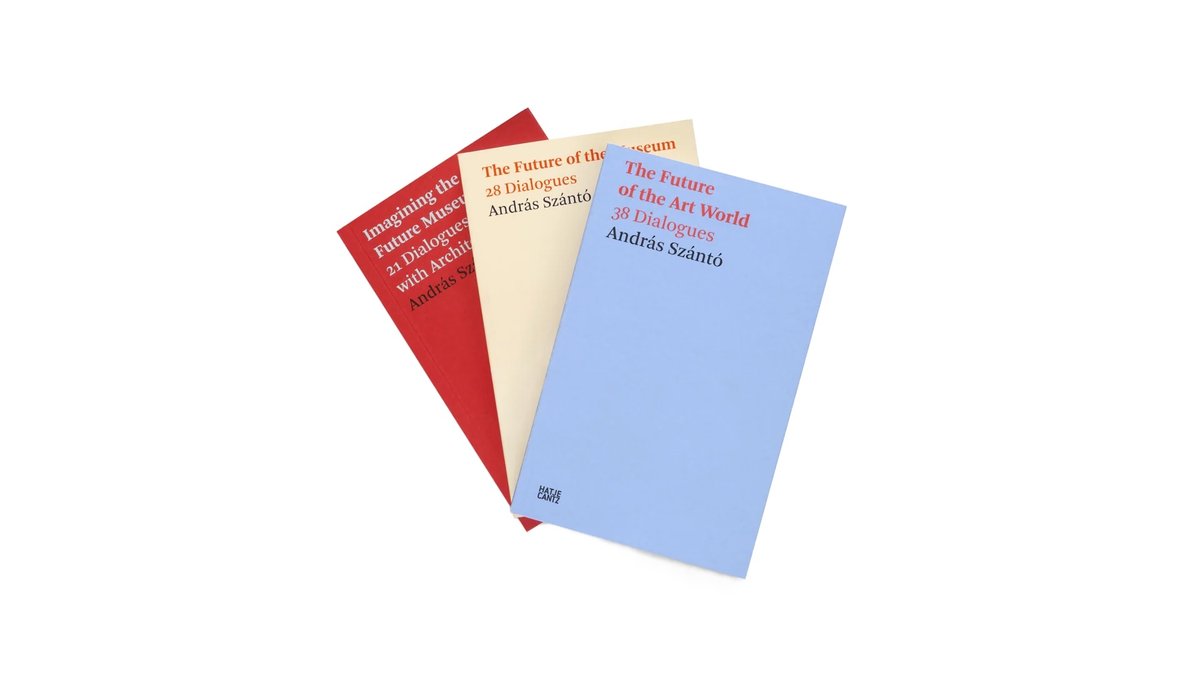
The cultural strategist András Szántó is fascinated by museums: what their mission is, how they are evolving, and notably, what their future looks like. In this, the third and final volume of a trilogy devoted to this topic, he surveys the wider cultural, organisational, technological and market environment in which museums are embedded.
As with the previous books, his format is a series of dialogues—with museum directors in The Future of the Museum: 28 Dialogues (2020) and with architects in Imagining the Future Museum: 21 Dialogues with Architects (2022).
This time he has broadened the scope, by interrogating a wide variety of art world luminaries and discussing topics from “how do you define the art world?” or “what are the rules of art today?” leading up to the heart of the subject: “What is the art world’s future?”
Impressive interviewees
The range of his interviewees is impressive. Among them are gallerists such as José Kuri and Atsuko Ninagawa; collectors Alain Servais and Sylvain Levy; artists such as William Kentridge and Holly Herndon & Mathew Dryhurst; curator Fatoş Üstek; academic Albert-László Barabási; art professionals such as Marc Spiegler, the former director of Art Basel; public relations consultant Calum Sutton; and Sheikha Al-Mayassa Al Thani, the sister of the Emir of Qatar, who has propelled the vast cultural ambitions of the tiny Gulf state over the past two decades.
So, what do they say? Their points of view reflect their own position in the art world, and as a result vary. Indeed, as he writes in the introduction: “There is no clear consensus among those interviewed about whether the art world, after decades of frothy expansion, is continuing to advance or has moved into a phase of slowdown or stagnation. Different regions move on divergent trajectories.”
Network scientist and artist Albert-László Barabási says: “Value in art is not an objective quantity. It is determined primarily by a largely invisible network that ties the artist and her work to everything else in art history… Ultimately, how does the work relate to art history and the institutional network in general?”
Joshua Citarella, a writer and artist, expands on digital culture: “If you were to imagine ‘contemporary culture in 2024’, the vision you might conjure in your mind would probably be a Gen-Z kid dancing on TikTok. In the eyes of my generation and peer group, the interests and priorities of museums do not reflect that contemporary life. Many of us were hopeful that the museums could participate in digital culture… But social media, which has been leading culture for nearly 15 years now, just doesn’t seem to be a priority for the art world.”
You might have thought that Thomas Girst, the head of cultural engagement at BMW, would defend the art world to the hilt—not so. “Only one out of 100 art students will ever live off their art,” he affirms: “Everybody wants impact, wants a gallery to represent them at 30. But when artists do that, they’re oftentimes giving up the struggle of the studio, the chance to fail. They’re marketed and guided to simply re-create what they’re already doing, because each buyer wants exactly what they see on the walls of other collectors.”
Sheikha Al-Mayassa, asked about “cultural diplomacy” and how to define it, says: “For me, cultural diplomacy is about creating avenues for dialogue and exchange between nations, allowing their people to connect. Political discussions often follow rigid agendas, but culture offers a more open and inclusive way to engage—even with those who may think differently.”
Catalysts for change
Szántó, when summing up, underlines what he calls the “change catalysts”—how art itself is mutating, tastes are morphing and globalisation has, as he writes, “ushered in a reappraisal of the canon”. The diverse people he speaks to throw up manifold interesting ideas, and the advantage of the book is that you can dip into any part without reference to the other dialogues. His conclusion? “I lean towards hope,” writes Szántó: “after asking more than 640 questions.”
• The Future of the Art World: 38 Dialogues, András Szántó, Hatje Cantz, 424pp, €30/$40, published, 28 October 2025
• Georgina Adam is the art market editor-at-large at The Art Newspaper and a contributor to the Financial Times