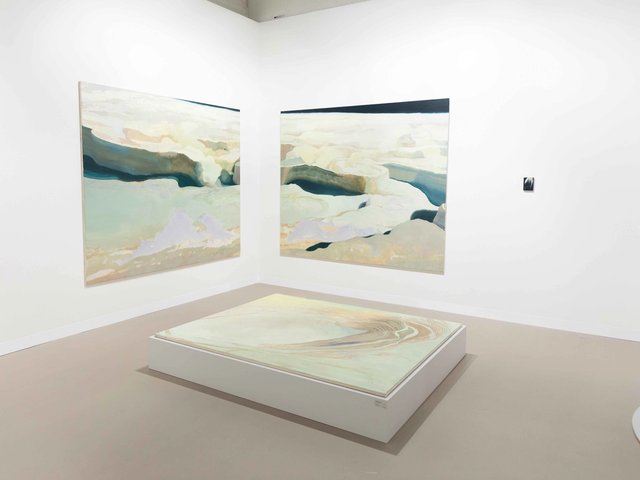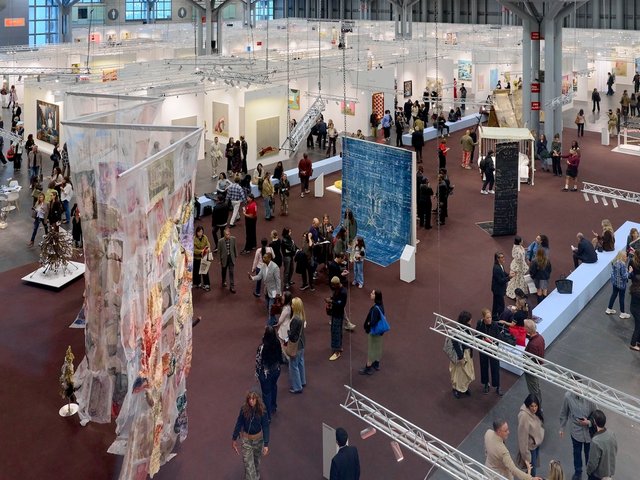
Few art-historical moments are eulogised quite like New York’s Downtown scene in the 1970s and 80s. At Frieze New York (until 17 May), the city’s late-20th-century history of experimental artistic production anchors a number of gallery presentations: a monumental linear abstract painting by the veteran New Yorker Virginia Jaramillo dominates Hales’s stand, while Champ Lacombe is showing archival footage and artefacts from Antoni Miralda’s Gesamtkunstwerk restaurant-cum-art project El Internacional, which operated in Tribeca between 1984 and 1986.
As the city’s dealers and collectors reach back to this radical recent past, the realities of a more commercially-minded present are front of mind, thanks in part to the artist Josh Kline’s widely discussed essay “New York Real Estate and the Ruin of American Art.” Published this February in the academic journal October, it argues that the city’s prohibitively high rents have entirely eliminated the potential for its artists to foster risk-taking practices.
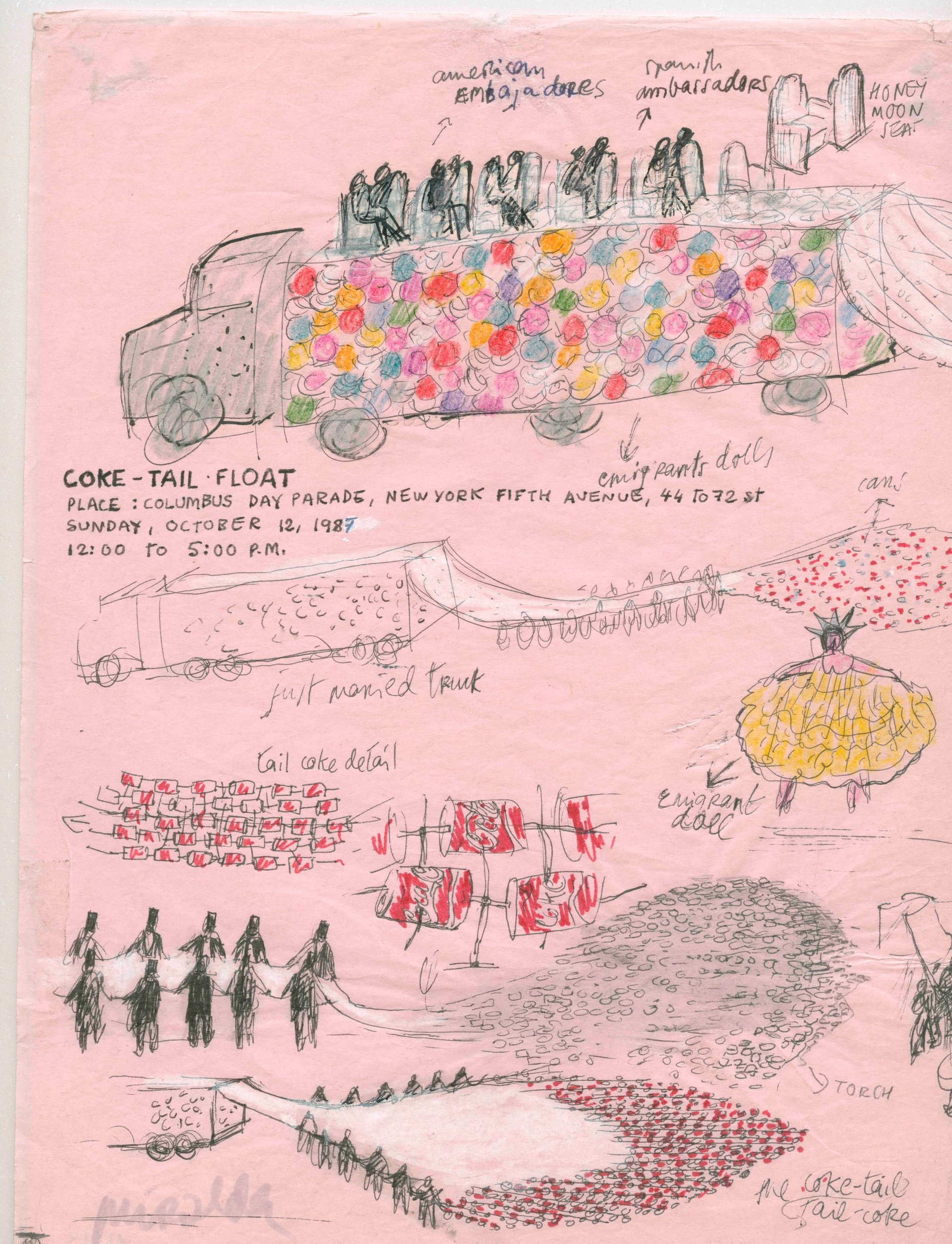
Antoni Miralda’s Coke-Tail-Float (1985), from his restaurant-cum-art project El Internacional, is on the stand of Galerie Champ Lacombe Courtesy Antoni Miralda and Galerie Champ Lacombe
Kline hardly articulates a new phenomenon by decrying New York’s exorbitant costs, and his polemic belongs to a long tradition known as the “Why I’m Leaving New York” essay. But the article has nonetheless gripped art world discourse. Published a few months after the democratic socialist Zohran Mamdani won the New York City mayoral election on a platform of affordability, its central question is poignant as ever: what must be sacrificed in order to live here? If mounting financial pressure is corroding the imaginations of New York’s artists, it is also forcing young galleries to stretch themselves during the city’s turbo-charged May art season.
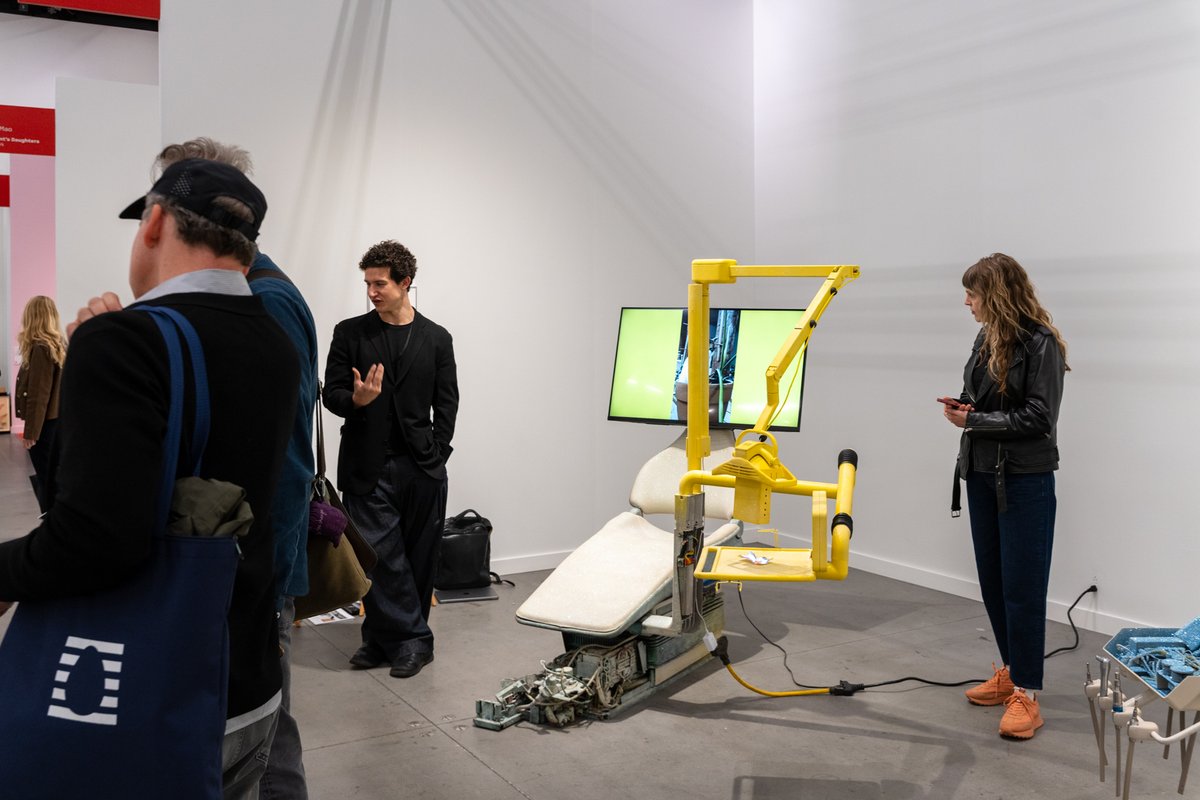
For several small New York galleries, this means simultaneously participating in multiple art fairs. In Frieze’s Focus sector for galleries under 12 years old, the Lower Manhattan space Europa has brought an eye-catching installation by Aki Goto, consisting of a dentist chair and tools covered in glitter, in which she has embedded a screen showing a video of her family. Focus encourages less commercially minded presentations in exchange for lower stand costs ($12,000), so to ensure a healthy sales week, Europa is also showing paintings at Independent New York.
“We have to be resourceful but also strategic,” says Pali Kashi, the gallery’s director. The risk is likely to have been rewarded: Goto’s installation is on hold to an Asian museum. Priced at $28,000, its sale would cover the gallery’s stand costs for both fairs.
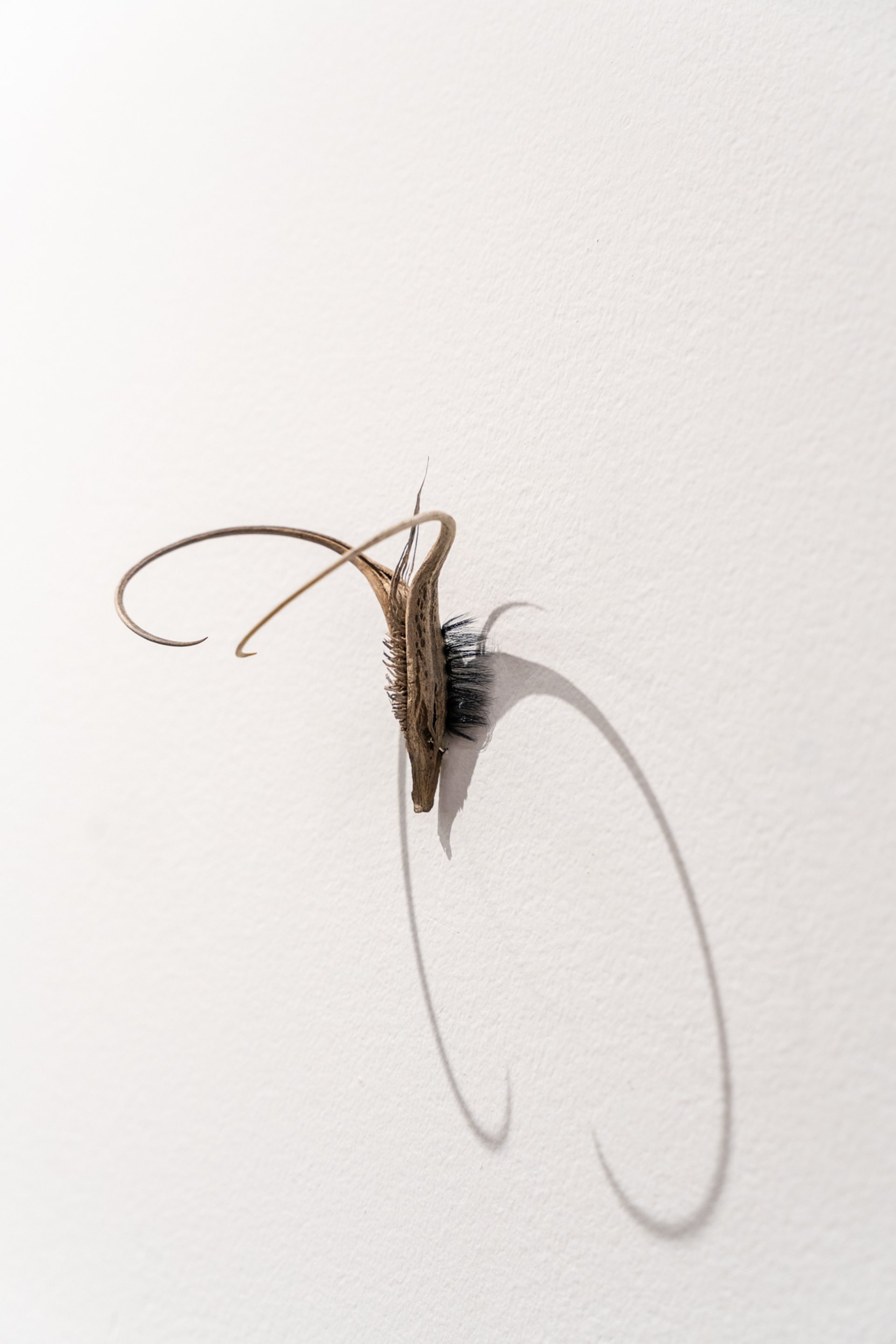
A number of sculptures by Deondre Davis are on the Gordon Robichaux stand in the Focus section Photo: Steven Molina Contreras
Across town at Esther, the boutique, booth-less fair that is holding its third and final edition in the historic Estonian House (until 16 May), the Tribeca-based dealer Silke Lindner is exhibiting wall sculptures by Gozié Ojini (priced between $7,500 and $11,000), consisting of lightly tarnished brass instruments mounted on burgundy velvet. Not content with staging one show when she could do three, Lindner is also presenting sculptures by Nina Hartmann at Independent and in her eponymous space on Broadway.
“Most of my sales are to New York collectors,” Lindner says. “Maximising in-person interactions in this city is important. You need to maintain a physical presence to cut through the noise of images online.”
While younger galleries work at a frenetic pace, they are equally conscious about expanding too quickly. “Our friends in the middle are really struggling,” says Sam Gordon, who co-founded the New York gallery Gordon Robichaux nine years ago. This year, in Frieze New York’s Focus sector, the gallery is exhibiting a standout presentation of grid drawings and paintings on unprimed canvas and small sculptures by Chicago-based artist Deondre Davis.
Gordon has no desire to grow from his boutique space in Union Square, or to join the exodus of galleries to Tribeca. “A mid-sized gallery I know needs to sell $60,000 each month to break even,” he says. “Our key is to not incur any debt. We will stay lean, mean and precise.” He adds that dealers in New York are typically under “some sort of illusion” about the realities of doing business in the city.
Kline’s essay concludes by encouraging artists to abandon New York for cheaper cities (he cites Philadelphia as a prime example) in order to sustainably develop more experimental studio practices. For dealers, though, New York appears a tough drug to quit, and its young gallerists usually maintain they would rather stay near a dense pool of collectors, than chase or help cultivate potential sites of artistic production emerging across the country.
‘More freedom and fun’
Breaking this mould is Hans Goodrich, a gallery founded in 2024 in Chicago, which runs a programme more akin to a European kunstverein than a small US commercial gallery. Its recent shows included works by the late experimental filmmaker Edward Owens and a scarecrow-like sculpture made of discarded clothing and kombucha fungus by Nole Giulini.
The gallery’s co-founder, Daisy Sanchez, says that the relatively low overhead in Chicago—she estimates the $2,800 monthly rent for two separate spaces is around one-tenth of comparable costs in New York—allows for “so much more freedom and fun”. The gallery also benefits from a “less saturated commercial scene”, where “fewer artists we are interested in are represented”.
Yet at this moment, the gravitational pull of New York still feels undeniable: numerous artists Hans Goodrich shows are associated with the city. Sanchez cites Chicago as the birthplace of two influential galleries, Queer Thoughts and Feature Inc, both of which eventually moved to New York and have since closed. (Hans Goodrich is not in any of May’s New York fairs but did participate in both Barely Fair and Neighbors last month in Chicago, and will be at Basel Social Club in Switzerland next month.)
For some gallerists, New York is not just a reliable source of buyers, but foundational to their identity. “Call it ‘Manhattan syndrome’, but New York forms the core of our project,” says Alexander Fleming, who co-founded Ulrik gallery in 2021. It is making its debut in Frieze’s Focus sector with works from the estate of Bettina, priced from $6,000 to $40,000. A longtime resident of the hallowed Hotel Chelsea, Bettina died in 2021, leaving behind a vast archive of unexhibited work, despite much of her early art being lost to a fire in 1966. Ulrik began working with the estate in 2023 and is its sole commercial representative.
On the stand are Bettina’s geometric tapestries; small, modular wooden sculptures; and black-and-white photographs from her Phenomenological New York series, which uses the city’s vertiginous architecture as a tool of abstraction. Two of these photographs were acquired on Frieze’s opening day by the Brooklyn Museum.
Ulrik is not the only young gallery mining the past in response to a precarious present. A growing number of fledgling dealerships now work with artists’ estates: Gordon Robichaux represents the estate of Jenni Crain, while Ortuzar, exhibiting in Frieze’s main section, works with the estates of Ernie Barnes (in collaboration with Andrew Kreps Gallery) and Anita Steckel. While qualifying that the gallery’s archival focus stems from “scholarly interests rather than commercial ones”, Fleming adds that “it is easier to tell a story to a collector of a practice that has developed, rather than one that is a shifting target”.
Like many of its ambitious peers, Ulrik situates its younger artists with older or dead ones to generate cross-generational discourse. This also provides useful context for a moment in which New York’s cultural future is being put to a referendum. Certainly the economic realities for the city’s artists have shifted—but so have their expectations.
“In the 1970s, even with its cheaper rents, artists lived on the line. It was a time of real austerity,” Fleming says. He cites an interview given by Bettina in which she told an acquaintance that some days she ate only “an onion and bread” and routinely slept in a chair in her hallway because her home studio was too full of works. Under such circumstances, then as now, it is not entirely surprising many of the city’s artists contemplate leaving New York—but do not expect their dealers to follow anytime soon.