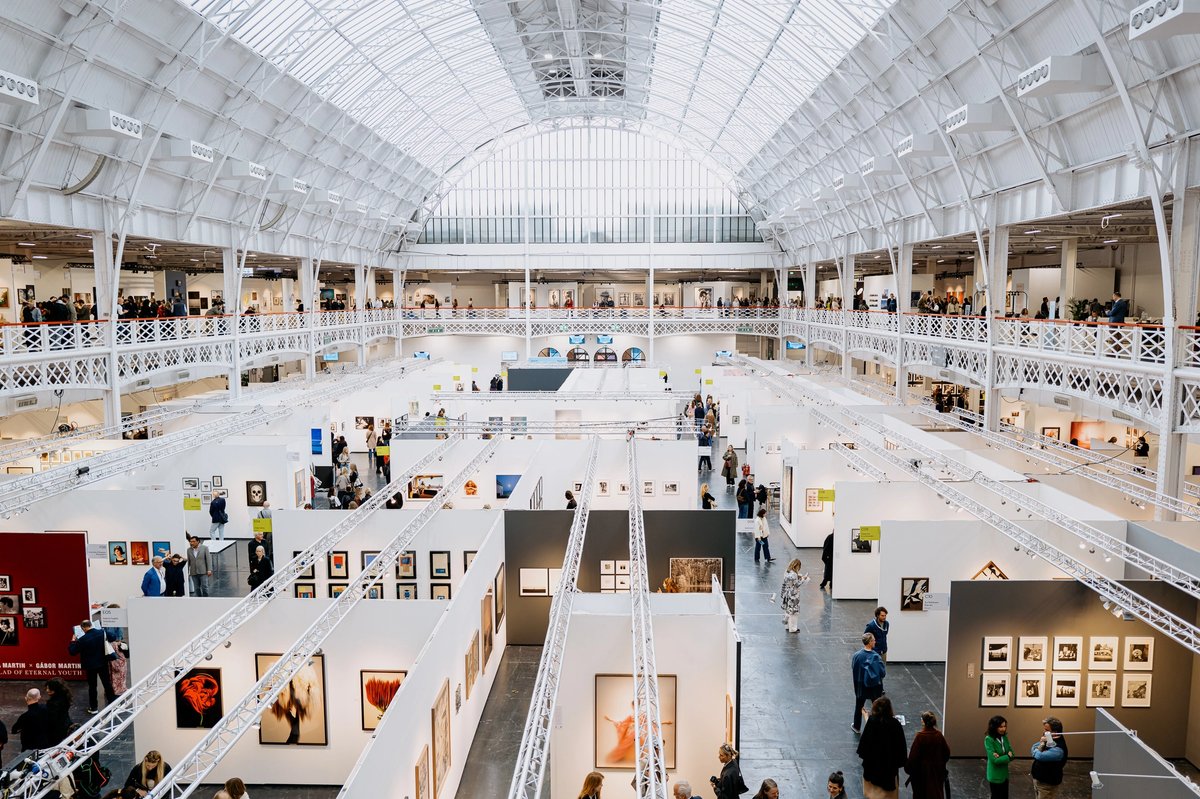
A hailstorm rattled against the 85 tonnes of glass that make up the vast curving roof of Olympia’s Grand Hall, while dark clouds cast shadows across the booths below. Yet the mood was light—giddy, even—as Photo London (until 17 May) opened for previews on Wednesday (13 May) at its new home in West Kensington. And that mood was reflected in some lively sales by Thursday afternoon, the first of four public days, by which time the weather had switched between late winter and early summer and back again, changing by the minute.
Paris-B Gallery reported a sale of three works to one buyer coming to £100,000, including two by Chinese artist Yang Yongliang. In Camera, also from Paris, sharing a booth with L Parker Stephenson Photographs from New York, had sold both the vintage and the modern print of Jane Everlyn Atwood's Auto Portrait (Serpent)—the hero image used for the fair’s promotion—for £13,000 and £2000 respectively.
Robert Hershkowitz was having a strong fair, including sales of works by PH Emerson and Frederick Fiebig, just a couple of months after the eponymous dealer in early European photography had died. Radius Publishing had sold 40 percent of its stock by Thursday lunchtime. And there was anecdotal chatter that pointed to the beginnings of a good fair for many others too, where prices range from £100 to £400,000, but where the low-to-mid-thousands is the norm.
It’s not the location that has raised the cheer. This traffic-choked corner of the capital, described by the Evening Standard as “an unwelcome slab of London real estate to all but the lanyard-wearing classes”, is attempting a revival, including the £1.3bn refurbishment of Olympia’s exhibition halls, which is ongoing into 2027.
Somerset House, the fair’s home for the previous decade, was marmite to galleries and visitors alike. The Thames-side setting and its stunning courtyard, so often bathed in sunshine during previous fairs, are fondly remembered. But its warren of small rooms spread across various wings and floors of the historic neoclassical building complex was not. Photo London was maddeningly difficult to navigate.
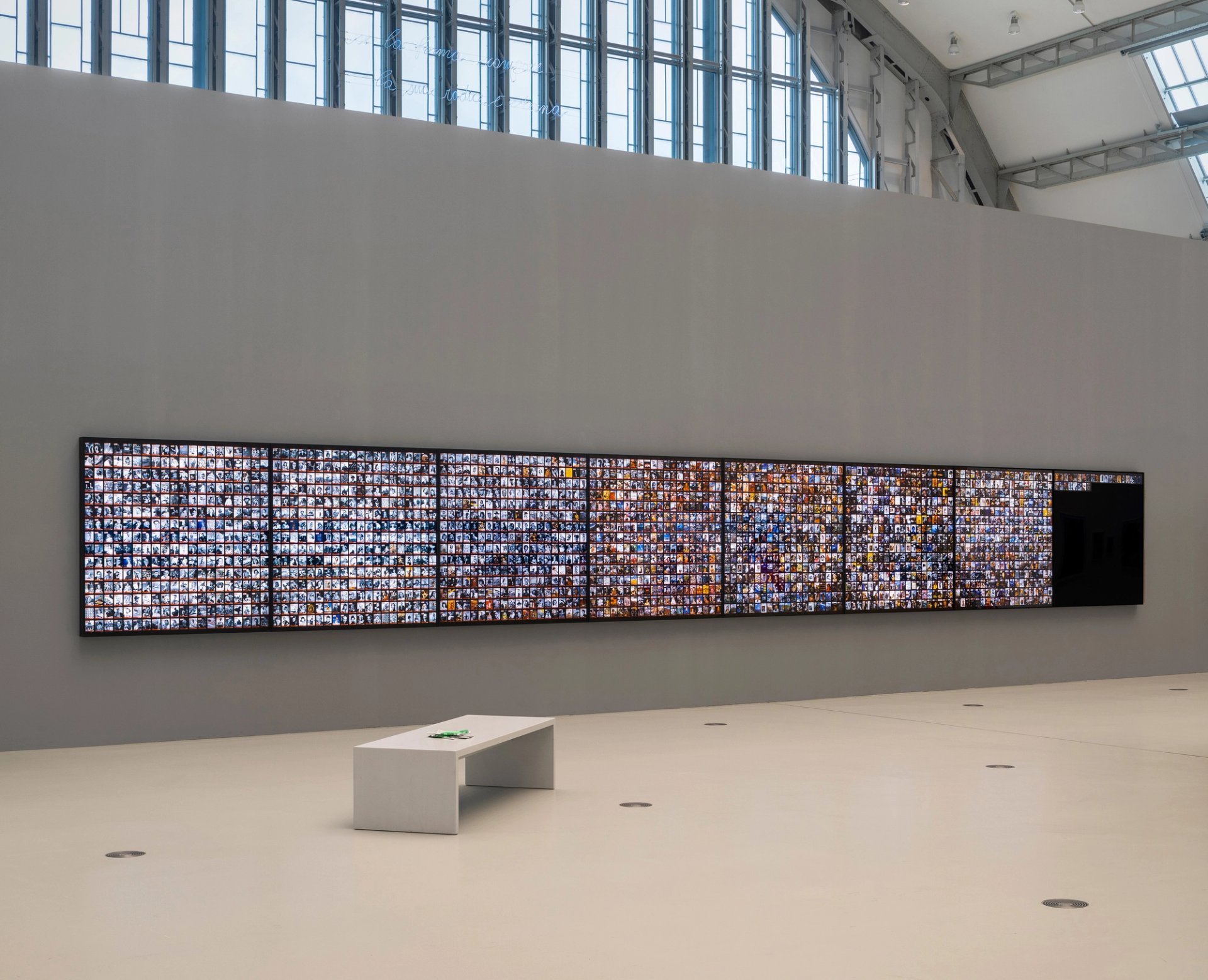
Alfredo Jaar, Searching for Africa in Life
Courtesy the artist and Goodman Gallery
This week, no one seems in any doubt that Olympia is the superior venue, providing a more business-like atmosphere, and the light and space to be seen. It’s such an obvious observation that it risks understatement, says Michael Benson, one half of the husband-and-wife team that founded the fair a decade ago. “We need to listen to what our galleries are saying to us, and they were beginning to say, quite seriously, ‘We can't come back to Somerset House. It's just too difficult for us to do business’.... We would get people saying, ‘I got missed. I saw [film producer and collector] Michael Wilson walking past my booth, and he never came in.’ It's very difficult to miss anyone at Olympia. It’s a much more democratic way of doing a fair. There's no part of it that feels like it's not getting its fair share.”
It doesn’t do any harm either that London’s collector class tends to live West. But it is still a gamble. When the first iteration of Photo London (launched by dealer Daniel Newburg in 2004, before its takeover by Reed Exhibitions, owner of Paris Photo) relocated from the Royal Academy of Arts to Old Billingsgate three years later, it was a disaster. But the reason wasn’t the location alone. And a large part of the success of the current fair’s relocation in the other direction was the opportunity to inject new energy and, under the directorship of Sophie Parker, bring in some much-needed quality control.
In the past, the popular end of the market—music, fashion, celebrity portraiture—felt overrepresented, while more ‘serious’ work shown by institutions was absent, perhaps presumed unpalatable for market tastes. It resulted in a confusing rift for visitors, and the sense that Photo London was not the place to measure the pulse of the medium. The fair has done much to address this, with an expanded Discovery section devoted to young galleries, and much more space given over to the independent book publishers that are the beating heart of contemporary photography.
Notably, two of this year’s Deutsche Börse Photography Foundation Prize shortlist are present at the fair—the aforementioned Atwood, and Weronika Gęsicka, shown by JEDNOSTKA from Warsaw, who were selling works from the Polish artist’s acclaimed Encyclopedia series for between €4800 and €10,000, although the winner, Rene Matić, announced Thursday evening at The Photographers’ Gallery, is not.
Both booths are part of a new initiative, titled Source, to encourage solo artist booths. Tristan Lund, an independent art advisor who had previously curated the fair’s Discovery section, and who has been on the curatorial committee since, pitched the idea after learning about the planned move to Olympia.“We have an increasingly art fair-literate crowd who are looking for something more substantial, and solo booths give you the best chance of getting under the skin of an artist's practice,” he says. Lund hopes that it might eventually woo the blue-chip “mixed media galleries who represent some of the biggest names in photography, but don't have enough of a reason to do a photography art fair”, such as Gagosian, Pace or David Zwirner. Perhaps they would, he says, if it was about taking one of their artists and curating a solo booth.
Goodman Gallery already has a sizeable presence with Alfredo Jaar’s Searching for Africa in Life [For Koyo Kouoh], which brings together all 2128 covers of Life magazine published between 1936 and 1996 as an enormous lightbox. It is presented in collaboration with the Prix Pictet, which was initiated by Photo London’s founders, Benson and Fariba Farshad, and which the Chilean artist won at its latest edition in September 2025.
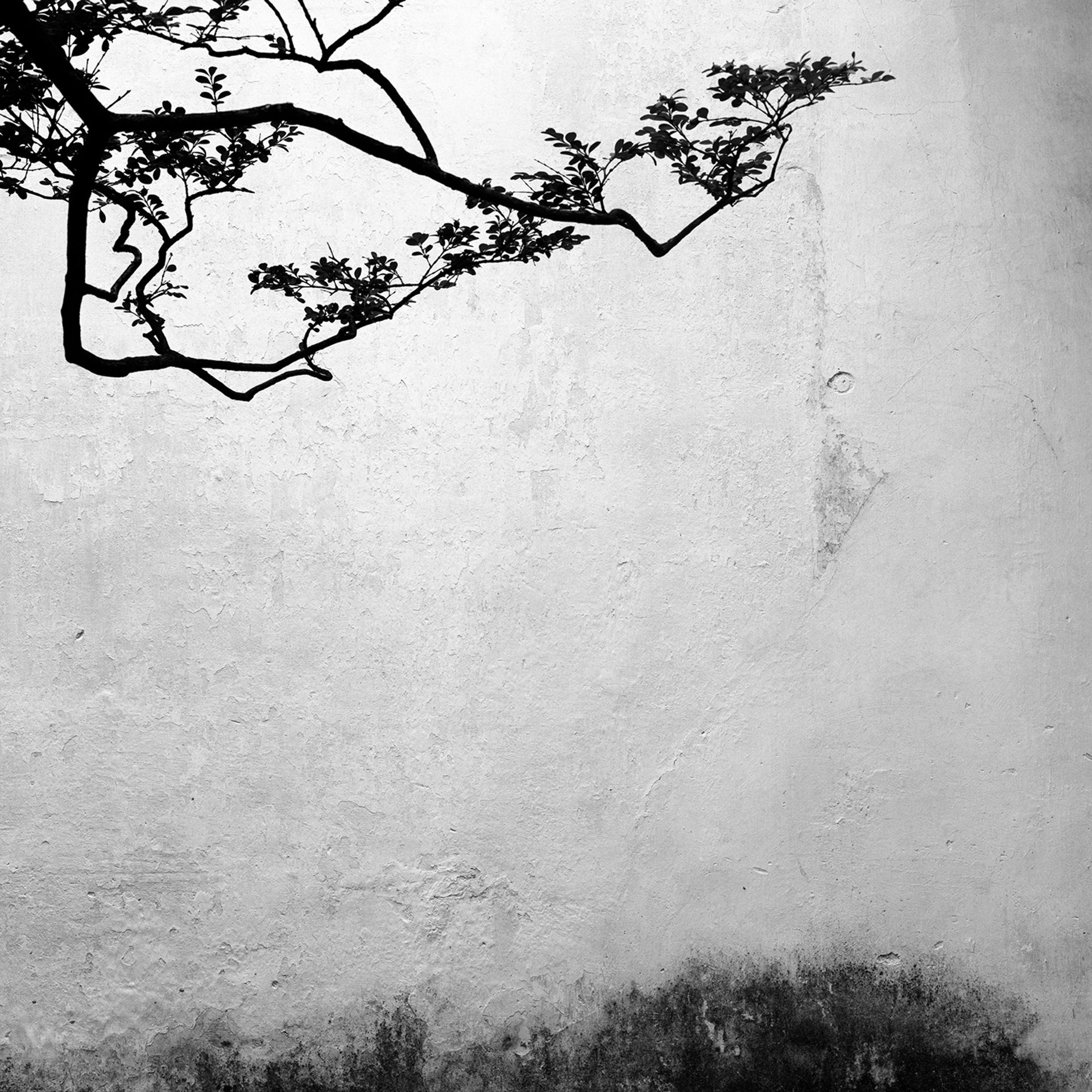
Hélène Binet, Bruder Klaus Kapelle, Peter Zumthor (from the Zumthor series), (2009)
© The artist and Large Glass, London
These solo artist presentations, which have been given the space and some financial incentive to take the risk, were mentioned as highlights by many of the visitors that The Art Newspaper spoke to. Among them is a wonderful series of vintage prints by Ute and Werner Mahler presented by Frankfurt gallery Peter Sellem, priced between £5,000 to £8,000. They include a selection of their fashion photographs from behind the Berlin Wall in the days of the GDR, alongside their first collaborative project, Mona Lisas of the Suburbs, made up of adolescent portraits from Liverpool, Minsk, Berlin, Reykjavik and Florence. Other standouts include Galerie Julian Sander’s presentation of Rosalind Fox Solomon, who died last June, and London-based architectural photographer Hélène Binet, shown at Large Glass.
“Doing a solo booth is always a bigger risk,” says Charlotte Schepke, the owner of Large Glass, who has works ranging from £2000 to £15,000. However, she trusts Lund. “He got us to Photo London in the first place, when he was curating the Discovery section. We listened to him, because I feel he's discerning, not just putting things together. Of course, you need to sell. But, at the same time, it helps when you can focus on one person. It gives people who are visiting a much better idea about an artist. It's almost like an exhibition, but it is in this [fair] situation.”“I never did the fair before. I didn’t like the architecture,” says Sander, great-grandson of the photographer August Sander. “Tristan asked me to come, specifically with the work of Rosalind Fox Solomon, and I saw him in the space [Olympia], and I agreed to come do it.” His experience so far is positive, finding that most visitors are pretty knowledgeable about photography.
“It is a connoisseur field. It's very much a willing buyer, willing seller market. People involved in photography are interested in all aspects of it: the camera, the situation, the process, the development. You go down a rabbit hole looking at how these objects are created. The people who don't know a lot are happy to learn. They're as interested in the story of the photograph and the person as they are in the object itself and the technology.”
This chimes with a trend identified by Parker, who took over as the fair’s director in 2024, having joined Photo London in 2018. I put it to her that there has been a loss of connoisseurship about photography in London – people with a deep appreciation of the object qualities of prints – in part with the absence of photography auctions in the capital, which is where the market first took off in the 1970s.“I feel like it's actually swinging back,” she says. “During the pandemic and post-Covid, it was very bright stuff that translated very well onto a digital screen, because that's how people were consuming art. But now, as people go back to seeing work physically, wanting to really understand photography as an object and not just an image that can be viewed anywhere, people are much more interested in the craft… When people start to look at the big names, they become interested in vintage processes and traditional techniques. And now emerging artists are starting to go back to those processes as well.
“There was big concern around AI a couple of years ago, and, as a result, young artists are wanting to hone these traditional techniques that have this human element to them; those little discrepancies, the little mistakes that show you that there's been a human hand involved. And that's brilliant to see.”