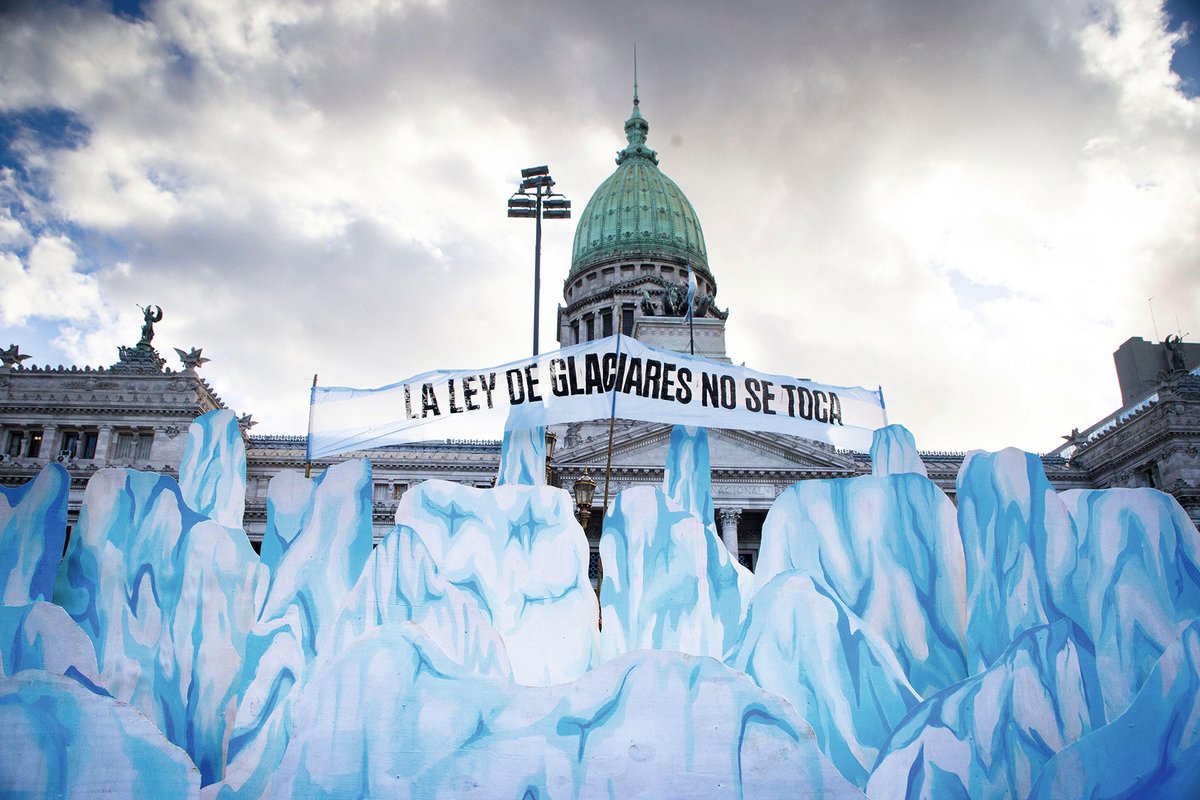
Days before Argentina’s congressional approval on 9 April of an amendment to the country’s glacier law to facilitate mining in glacial regions—which, according to environmentalists, weakens the protection of these freshwater reservoirs—president Javier Milei’s government removed a monumental painting depicting the Perito Moreno Glacier from one of the halls of the Casa Rosada, the presidential palace.
The work’s disappearance did not go unnoticed, due to both its poignant subject matter and enormous size. The Triumph of Nature (2006), by the Argentina-born, Austria-based photorealist painter Helmut Ditsch, measures 1.3m by 4m and depicts the ice fields of Patagonia, which are part of Los Glaciares National Park, a Unesco World Heritage site.
The painting was loaned to the government and had been on display in one of the halls of Casa Rosada since 2012, remaining on view throughout various administrations of different political affiliations. A spokesperson for the government’s communications office tells The Art Newspaper that Ditsch’s painting was removed “for maintenance reasons” to address “structural damage”, but did not elaborate.
No notice
Ditsch says he has not received any official notification about his work’s removal or whereabouts. “I found out through the news that the government removed my work, which they cannot do without notifying me, since that was the agreement when I loaned it,” he tells The Art Newspaper. He says his attempts to contact the government’s heritage office have gone unanswered and he has contacted his lawyers. Ditsch adds: “My first reaction was to think of the glaciers law that was about to be debated.”

Helmut Ditsch, The Triumph of Nature, 2006 © Helmut Ditsch. Courtesy the artist
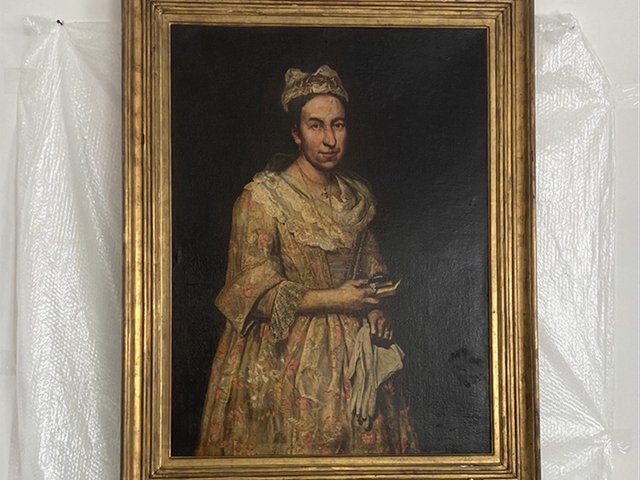
In addition to the glacier painting, a portrait of Juan Domingo and Evita Perón, two figures who continue to divide Argentine society, was removed from the same room at Casa Rosada on the same day. The work is a 1948 copy by the painter Numa Ayrinhac. Asked the reason for its removal, a spokesperson only stated: “Maintenance.”
Since Milei took office in December 2023, his administration has pushed a series of changes at Argentina’s public institutions in line with an agenda that is openly critical of what it deems “woke”. On 8 March 2024 (International Women’s Day), the “Women’s Hall” at Casa Rosada was renamed the “Hall of Heroes” and its portraits of historical women were replaced with portraits of men. Once again, the timing drew particular attention. The same month, the government announced the renaming of Buenos Aires’s Kirchner Cultural Center (after former president Néstor Kirchner) to Palacio Libertad.
History repeating
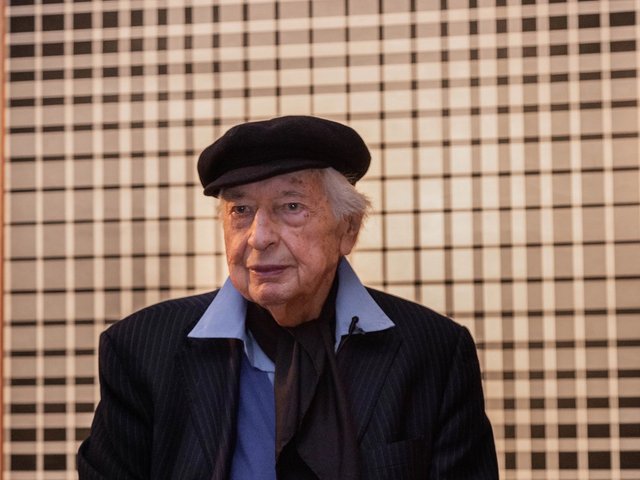
For the historian Felipe Pigna, one of the country’s most widely read authors, these types of actions have troubling parallels with Argentine history. “These precedents date back to military dictatorships,” he tells The Art Newspaper. “The idea of removing paintings to deny the past, as if trying to erase it from history, is a classic move. It happened in 1955 with Peronism. It happened during the last dictatorship, which went so far as to burn over one million books. This kind of behaviour is typical of the far right.”
In Pigna’s view, the removal of images is part of a broader logic. “It’s a way of imposing a new narrative, often lacking in historical basis. It’s about wanting to erase from view whatever is uncomfortable,” he says. “The message is clear: I remove what I don’t like.”
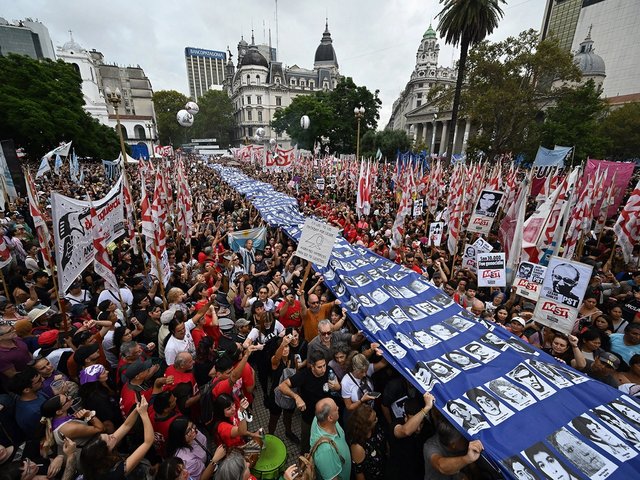
The string of erasures has reached even beyond the country’s borders. In February, at the Maison de l’Argentine—a university residence and cultural centre in Paris run by the Argentine government—a plaque honouring the 30,000 people disappeared during the last military dictatorship was removed from the facility’s entrance, according to the Assembly of Argentine Citizens in France. The plaque had been installed in 2022 and was taken down just days before the 50th anniversary of the 1976 coup d’état, a date that in Argentina prompts large demonstrations under the slogan “Memoria, Verdad y Justicia” (memory, truth and justice).
On 24 March, the Cité Internationale Universitaire de Paris installed a new plaque directly in front of the Argentine residence, bearing a nearly identical inscription: “In tribute to the 30,000 disappeared and victims of state terrorism in Argentina between 1974 and 1983.” Representatives of the Maison de l’Argentine did not respond to The Art Newspaper’s enquiries.