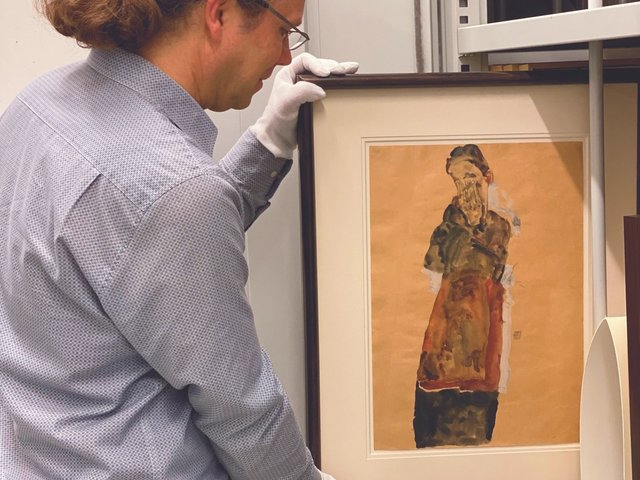
A watercolour on show in the Fondation Beyeler’s recent exhibition devoted to Paul Cezanne once belonged to a Jewish businessman who lost it due to Nazi persecution, according to a researcher working for the heir of Gustav Schweitzer, a Jewish businessman who fled Berlin in 1935.
The provenance researcher, Willi Korte, unearthed documents in the Basel public archives chronicling Schweitzer’s loan of the around 1888 watercolour depicting the Montagne Sainte Victoire to the city’s Kunsthalle for a 1936 exhibition. Correspondence between the curator in Basel and Schweitzer or his secretary continued until 1939, when she wrote from Paris to confirm the watercolour’s safe return. How Schweitzer lost ownership of the work is not known, Korte says.
“But this means it was either sold under duress after Schweitzer had fled Germany, or it was looted in Nazi-occupied territory,” he says. Korte urged the Fondation Beyeler to keep hold of the watercolour. “The Fondation Beyeler should live up to its historical obligation to actively contribute to a fair and just solution,” he says.
The watercolour was one of 79 works on show in the Basel exhibition Cezanne, which ended Monday (25 May). Its lender is listed in the catalogue only as an unnamed private collector; according to the Cezanne catalogue raisonné, the current owner is US-based. A spokesperson for the Fondation Beyeler said in a statement that it will return the work to the lender.
“The lender of the watercolour will be informed of the suspicion that has been raised,” the spokesperson stated. “As a matter of principle, a Swiss museum has no authority to retain artworks without an appropriate legal basis.”
Responding to Korte’s accusations that the museum should have been more diligent in examining the provenance of works loaned to its exhibition, the foundation’s spokesperson said that “it is not possible to research the provenance histories of works loaned to temporary exhibitions with the same depth as works in the museum’s own collection”. The spokesperson added that the work was not listed on lostart.de, a German database of Nazi-era losses.
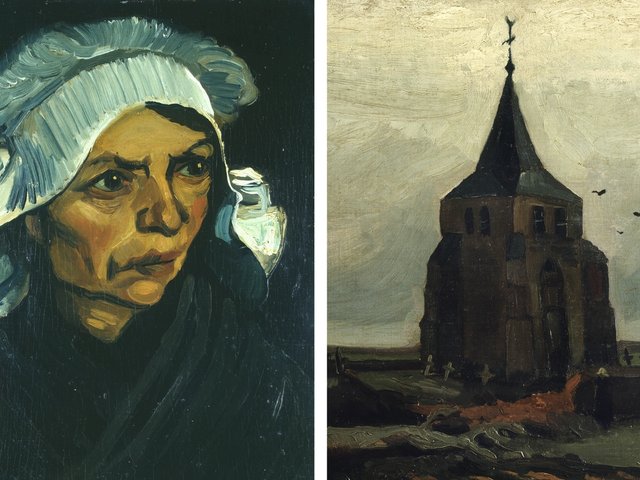
Research into Schweitzer’s collection and biography has begun only since his grandson became aware of the lost art in 2024, thanks to the publication of a report on the controversial Bührle Collection on loan to Zurich’s Kunsthaus. Led by the president of the German Historical Museum, Raphael Gross, the research team investigated Vincent van Gogh’s Head of a Peasant Woman (1885), which was also owned by Schweitzer. The report recommended further research into the painting’s history, saying a loss due to persecution could not be ruled out.
The correspondence Korte discovered in the Basel archive reveals that Schweitzer asked the Kunsthalle curator to keep the Cezanne watercolour safe after the 1936 exhibition there and enquired whether he might be able to find a buyer for it. The curator had the work restored at Schweitzer’s expense. But after no sale came about, he sent it back to Schweitzer’s secretary in 1939.
By that time, Schweitzer had left Paris for Asia on a business trip from which he never returned—he died of a heart attack in Manila in 1939. His secretary was deported from Paris in 1942 and was killed a week later at Auschwitz. Schweitzer’s wife fled to the US in 1938 and was joined by their son after the war; the sole heir, the couple’s grandson, lives in the US.
Georg Kreis, a historian who has been a member of a number of expert panels investigating Switzerland’s role in the Nazi era, suggested that the Fondation Beyeler should serve as a mediator between Schweitzer’s grandson and the current holder of the watercolour.
“With a heavy cloud of suspicion hanging over it, this work will become unsaleable,” Kreis says. “A solution by mutual agreement must lead to the acknowledgement that the original owner lost it due to Nazi persecution. And rather than empty words, the descendants of the original owner should receive compensation, in line with common practice.”