Stoke-on-Trent city council has issued an urgent appeal to save dozens of historic industrial buildings, warning that without immediate intervention, heritage bearing witness to Britain’s once world-beating ceramics manufacturers could be lost forever.
The Stoke-on-Trent area—known as the Staffordshire Potteries—was home to legendary names such as Wedgwood, Spode and Royal Doulton. From the 18th century onwards, these manufacturers drove global innovation in ceramics, producing everything from fine bone china and tableware to decorative vases, figurines, earthenware and tiles.
But decades of decline, factory closures and underfunded heritage preservation have left many once-grand buildings in a state of disrepair, and the city’s illustrious ceramics history risks slipping into obscurity.
“We have to act now before our heritage is lost forever,” says Jon Rouse, the council’s chief executive.
Stoke-on-Trent houses more than 275 listed buildings, 22 conservation areas and over 1,500 locally significant sites, many tied to ceramics production. In a recently published prospectus, the council declared a “heritage emergency” affecting Stoke’s crumbling built environment, with at least 16 major sites formally designated “at risk” and many more in advanced states of decay.
The emergency appeal is aimed at central government, national funding bodies and private investors. The council estimates that around £325m will be required over the next decade to stabilise and restore key sites, including up to £150m for the vast Chatterley Whitfield colliery complex alone.
Rouse says the decision to declare an emergency followed the city’s centenary year in 2025, which raised Stoke’s international profile and prompted comparisons with other global ceramics centres.
“As we looked at places such as Sèvres and Limoges in France, Incheon in South Korea, Delft in The Netherlands and Jingdezhen in China, it was clear they were achieving much greater national recognition, protection and investment than The Potteries, he says. “We had reached a tipping point—if urgent action was not taken, the unique value of the landscape could be lost forever.”
State support
In France, Sèvres and Limoges are embedded within a state-backed national institution under the culture ministry, combining manufacturing, museums and research. Limoges has also built a Unesco-recognised creative economy around porcelain. South Korea has invested in ceramic clusters and cultural districts to position ceramics within a wider creative economy.
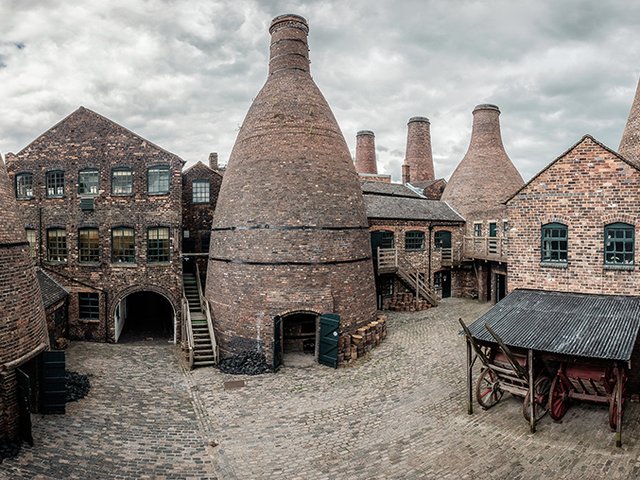
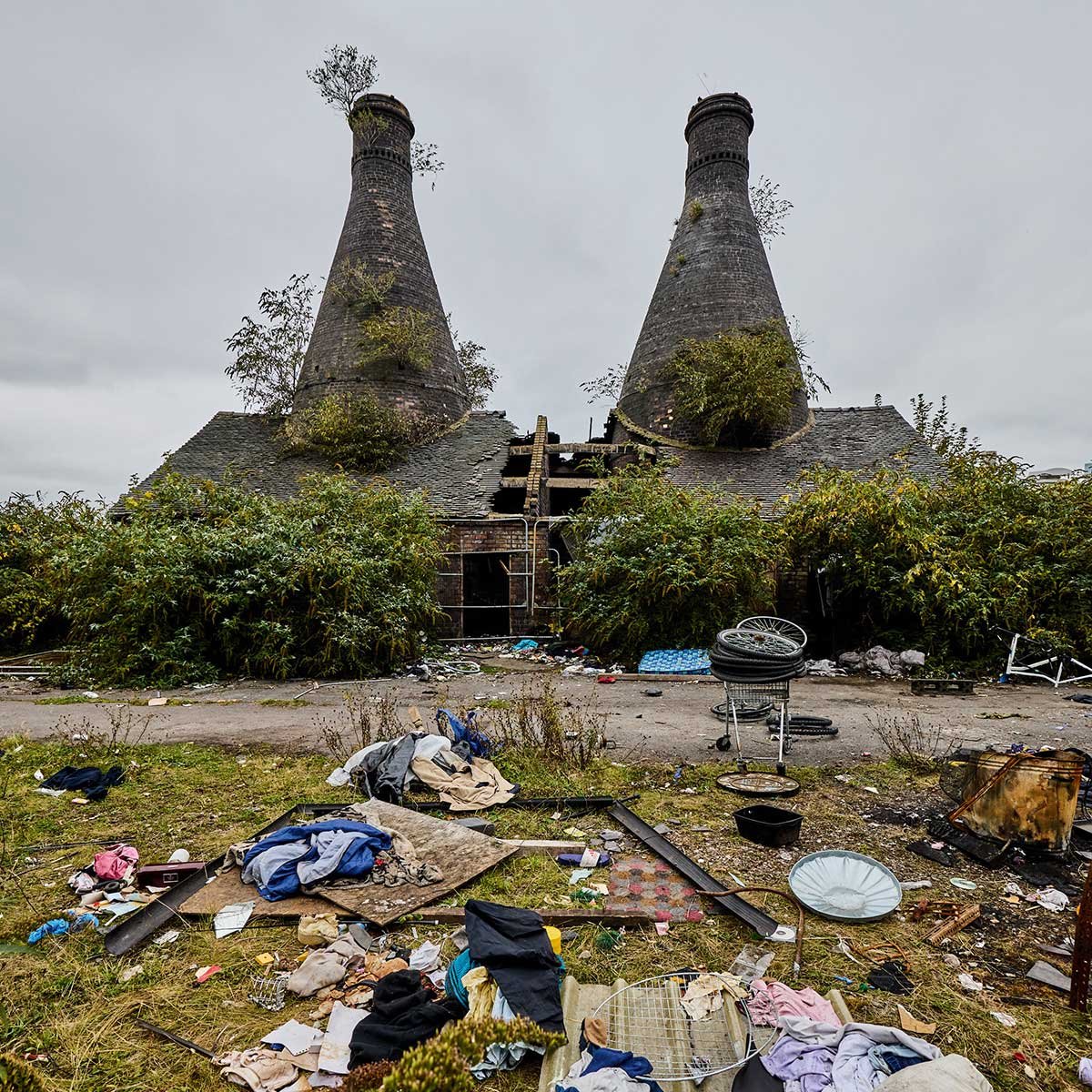
In Stoke, twin brick bottle ovens rise above bushes like Mayan temples in the Amazon jungle, their tapered forms still commanding the skyline. Built to fire the ceramics that once travelled the world, they retain a quiet grandeur: soot-darkened bricks and elegant curves which gave the Potteries its distinctive skyline.
But up close, the scene tells a different story. The roofline has collapsed in places, vegetation pushes through mortar joints, and the area is strewn with discarded belongings and debris. What was once a centre of industry and craft now looks abandoned, exposed to the elements and to neglect.
Many of the pot banks, bottle ovens, markets, theatres and civic buildings that once underpinned one of the world’s most important manufacturing economies are now vacant, structurally unstable or vulnerable to vandalism and fire.
Chatterley Whitfield, described as the most complete surviving deep mine complex in England, is classified by Historic England as being at “immediate risk of further rapid deterioration”.
Elsewhere, The Leopard Hotel in Burslem—where Josiah Wedgwood dined—remains partially destroyed following a fire in 2022. The Burslem Market Hall is in severe disrepair, while numerous former pottery works face uncertain futures. The city’s bottle ovens once numbered around 2,000 but just 47 survive. Many stand isolated and deteriorating.
The photographer Phil Crow has documented the ovens and pot banks for his photo book and exhibition Fortyseven: The Last Bottle Ovens and Kilns of The Potteries. Crow’s family ran a pottery business in Stoke-on-Trent, and his recent project grew out of walks taken during the pandemic, when he began systematically photographing the remaining sites.
“The condition of the buildings varies greatly,” he says. “Since beginning the project, there have been fires and other damage at some sites. One muffle kiln was even demolished last year, with no clear explanation.”
Crow points to structural challenges in preserving listed industrial heritage, particularly when assets are in private ownership. “Private owners are limited by regulations surrounding Grade II status and often cannot afford the necessary repairs,” he says, citing the high cost of specialist conservation work such as lime mortar repointing and scaffolding.
Andy Perkin of the Potteries Heritage Society hopes to see a role for residents. “This is a step in the right direction,” he says of the emergency appeal. “But for it to be sustainable, it needs to have the involvement of local people who are there for the long-term, not people who come into the city because they realise there is funding sloshing about.”
The council says consultations with the community have taken place before the launch of the appeal and it is keen to engage local people. “We’ve already seen what can be done by local organisations with the dedication and passion to get things done,” Rouse says.
Successful restorations
The council’s prospectus highlights recent projects that offer some hope. Developments at the Spode factory site, Middleport Pottery and the Goods Yard have demonstrated how industrial buildings can be repurposed for housing, creative industries and tourism. The council has also committed more than £6.5m to safeguarding three key buildings, including the Wedgwood Institute and Burslem Indoor Market.
Further plans include a potential music and arts venue at the Queen’s Theatre in Burslem and proposals to convert Hanley Town Hall into an apartment-hotel and co-working space. More broadly, the city is seeking to position itself as a cultural destination, building on its recent designation as a World Craft City and ambitions to secure Unesco Creative City status.
All this could do much to lift morale among inhabitants. Stoke-on-Trent lost more than 60% of its employment base in the late 20th century with the decline of ceramics, coal and steel industries, and the deterioration of heritage sites is widely seen as a visible reminder of that loss.
“People are proud to be Stokie and proud of their heritage,” Crow says. “Most people simply want an infrastructure they can be proud of, rather than a town of empty shops and derelict pot banks.”
For Rouse, successful restoration carries symbolic as well as economic weight. “When heritage is restored, it signals that the outside world cares about the future of the city,” he said.
Whether that message translates into the level of national support the council is seeking remains uncertain. “It is a choice for the nation, not just the city,” Rouse says. “The stewardship of a national treasure needs a national response.”