Zhaobo Yang has recently made a surprise addition to his growing art collection. Unlike the dozens of works by living artists he owns, this new piece is old: a palm-sized bronze incense burner dated from the Qing dynasty (1644-1912). Priced at £1,000, the work he acquired in April may not be the most valuable piece he owns, but it is certainly significant. It is his first acquisition of Chinese antiquities after five years of studying the category. He is living with the work, burning agarwood incense in it every day.
“Initially, I thought my first piece of antiquity would be porcelain. But I wanted to start with a piece that I can use and be embedded in my daily life,” says the 29-year-old London-based sculptor and collector. Antiquities embodying his Chinese cultural heritage have inspired his contemporary practice, he notes. Collecting them aligns with his philosophy of “collecting the future”, he adds, as he sees traces of the future in the past from older works, which also have solid values.
Yang, who comes from a family that collects Chinese classical paintings and calligraphy, is among a young generation of collectors with a growing interest in traditional Asian works of art—antiquities such as ceramics, bronzes, crafts and artefacts, a market segment that has been growing quietly in recent years.
According to ArtTactic’s China Art Market Report published in March and tracing the auction activities of Christie’s, Sotheby’s and Phillips in Hong Kong, despite the 2.2% decline in overall auction sales (from 2024’s $1.4bn to $1.38bn in 2025), traditional works of art saw a dramatic 32.4% increase year-on-year from $389m in 2024 to $515m in 2025. It represents a stark contrast to the 32.5% contraction in the fine art category in the same period (from $548m to $370m). Traditional Asian art sales accounted for 37.2% of Hong Kong’s overall auction sales last year, surpassing that of fine art (26.7%) for the first time since 2017. Although the category is sold across London, New York and Paris, Hong Kong remains the leading location, accounting for more than 80% of the global sales.
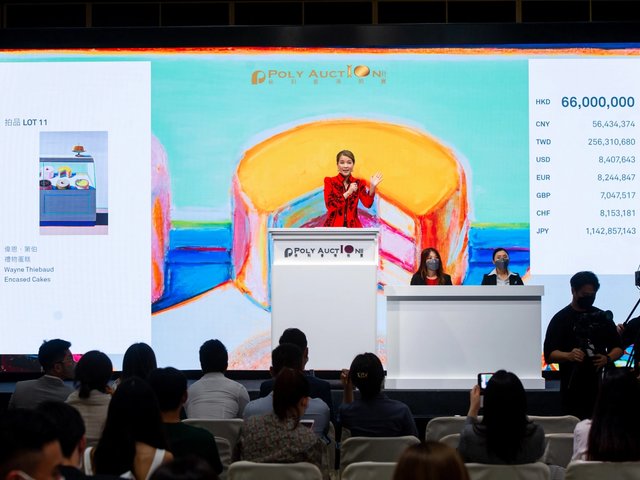
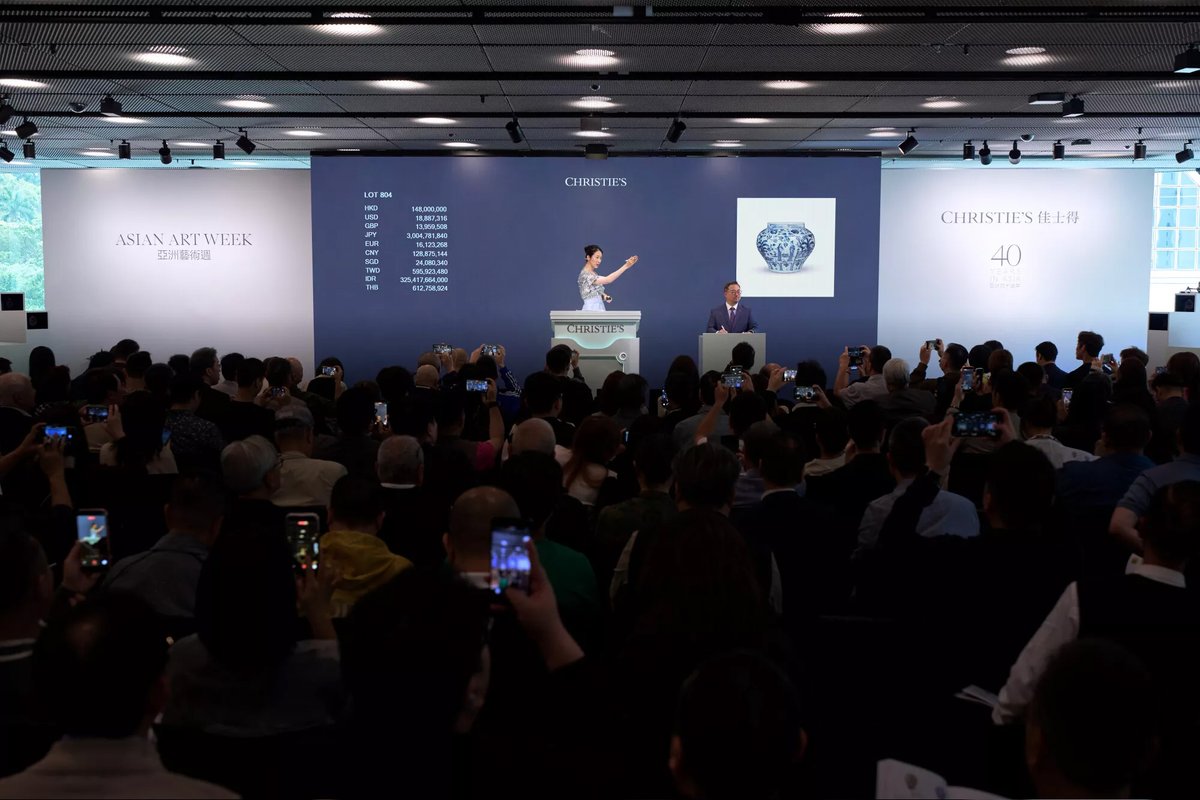
The upward momentum of Asian works of art continues in recent sales. During Asia Art Week in New York in March, for example, Christie’s Chinese works of art sale totalled more than $34m, a year-on-year increase of more than 50%. The house’s Hong Kong Asian Art Week spring sales in April raked in a total of HK$872.2m ($111.3m), a 54% year-on-year increase and the highest spring total since 2018. Chinese ceramics and works of art across three sales totalled HK$613m ($78m), boasting a 79% year-on-year increase and the highest seasonal sale total since 2017.
Rival Sotheby’s introduced Asian art to its Hong Kong Modern and contemporary evening sale for the first time at the end of March, with most pieces selling above presale estimates. Its May Asian works of art series of sales totalled HK$630m ($80.5m), with 12 works selling for more than HK$10m ($1.3m) each.
China Guardian Hong Kong auction house, a key player in this category, achieved a sale total of HK$330m ($42m), a record seasonal high in this category since the house was established in the city in 2011. In 2025 China Guardian recorded an annual total of HK$578m ($73.8m) in this category, a 40% jump year-on-year, the highest increase ever.
A long-term perspective
The strong sales demonstrated a renewed confidence in traditional Asian collecting categories amid volatile market conditions, according to Marco Almeida, the head of Chinese ceramics and works of art at Christie’s Asia Pacific. The categories’ long-term market resilience, intellectual depth and proven historical performance appeal to collectors as they offer greater certainty compared to the speculative market for contemporary art, Almeida says. Christie’s says that more than 80% of its bidders were from Asia Pacific, with the rest coming from the US and EMEA (Europe, Middle East and Africa) regions. Southeast Asia also saw a 29% year-on-year increase in the number of buyers.
Both houses observed a surge in Millennial and Gen-Z bidders in recent years. Sotheby’s says that, since 2022, these age groups have represented more than one-third of global Asian art bidders, up from 25% in previous years. In 2025 they also doubled what they spent in 2021. Christie’s notes that 40% of the new buyers for Chinese ceramics and works of art came from these age groups this season, with mainland China registering a 173% year-on-year increase in spending, followed by Taiwan and Hong Kong. Many are self-made individuals, Almeida says, with some coming from collecting families. They approach these works of art “with a research-led, long-term perspective”, he adds.
“The average age of buyers in this category now is early 40s,” says Nicolas Chow, the chairman of Asia and worldwide head of Asian art at Sotheby’s, noting that more clients who have been active in Modern and contemporary art are pivoting to antiquities, with some as young as in their 30s or even late teens. Greater China has the greatest concentration of buyers, and works sold in the West will also likely travel to the region eventually, Chow says.
While quality antiquity pieces can be seen as solid assets during volatile times, Chow believes that the appeal of antiquities will grow further in the age of artificial intelligence (AI). Antiquities and artefacts have a special appeal in that you can touch and hold them and in some cases—such as Yang’s incense burner—even use them. “With everything accelerating, the real luxury for people will be taking the time to slow down,” he explained. “You are meant to touch them.”
Despite the rosy picture, the bar to collecting Asian works of art remains high, according to several collectors. “With contemporary art, the metrics are quite simple. With ancient art, you can’t use that model,” Chow says, noting that buyers must pay more attention to issues of provenance, condition and quality, which do not have “fast rules”.
As for Yang, he will maintain his contemporary practice while continuing to explore the realm of antiquities. An advocate for Buddhist philosophy, Yang is already planning his next purchases: palm-sized Buddha statues and Buddhist artefacts. But he is cautious, with full awareness of issues such as authenticity and provenance. He will take his time. “I am still learning,” he says.