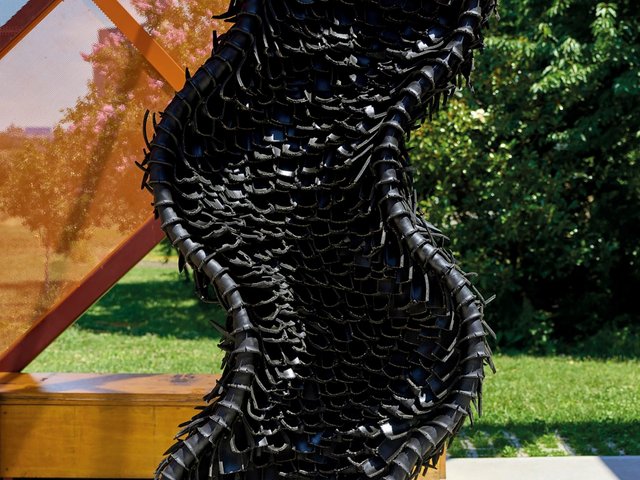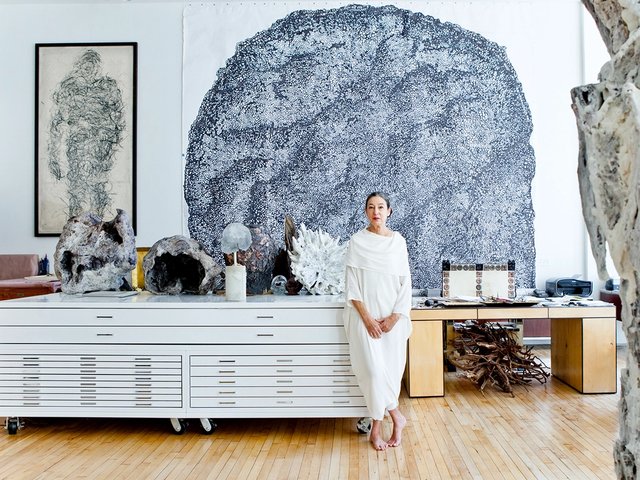
When the glass artist Nisha Bansil relocated from the Catskills to New York City in 2017, she went from an environment dense with trees to one crowded with humans. “In the forest, the individual leaves are not discernible and instead become a collective background,” she says. “In my neighbourhood, it is the people who disappear.”
These observations informed her new work, UNSEEN (2026), for the Cathedral of St John the Divine in Manhattan’s Morningside Heights neighbourhood, the world’s largest Protestant cathedral. The sculpture, made up of more than 50,000 glass ginkgo leaves set on the stone steps of one of the nave’s 14 bays, draws attention to the city’s often-ignored unhoused citizens—more than 100,000 sleep in shelters and on the streets of New York nightly.
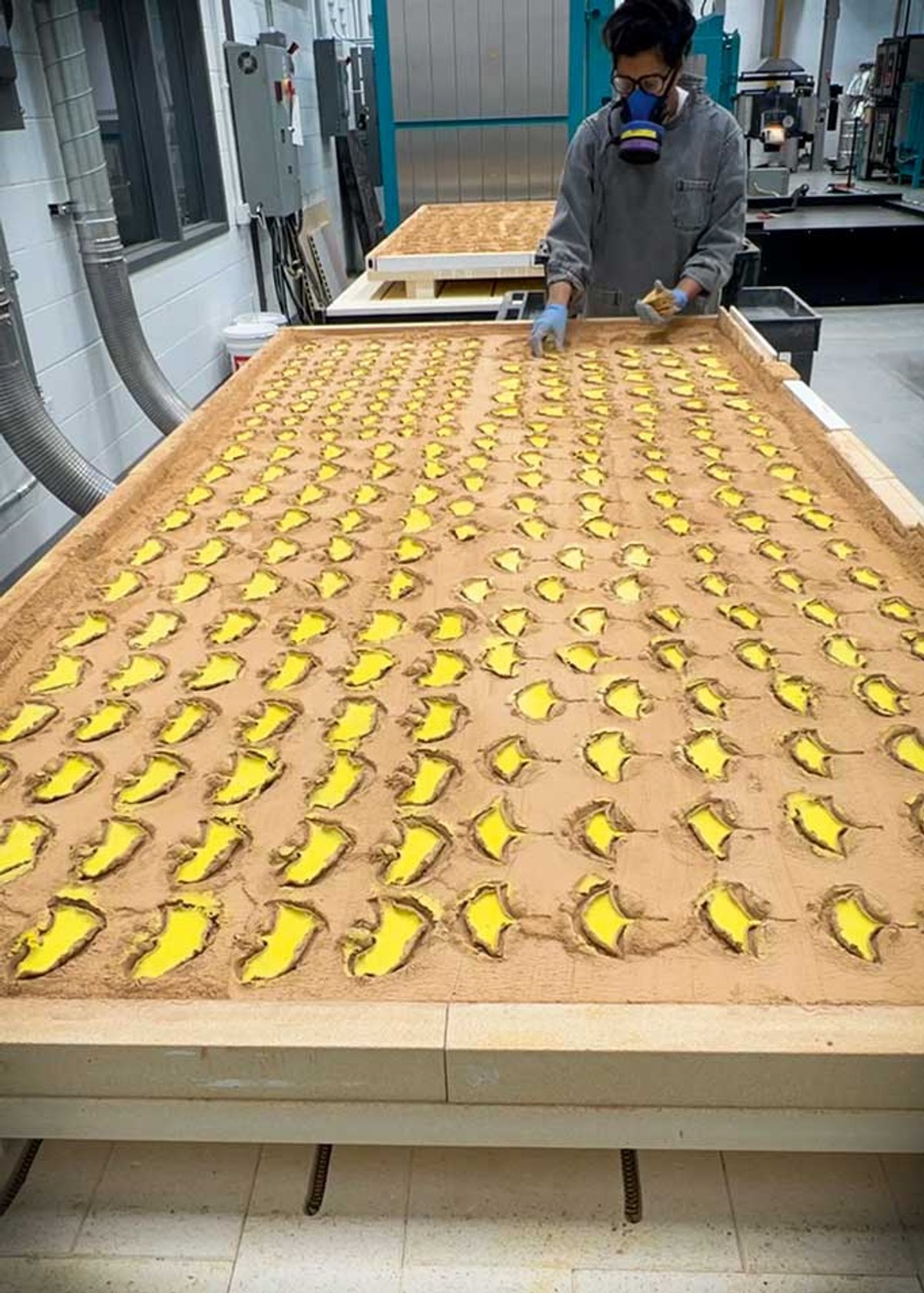
The leaves were fabricated over 14 weeks in the studio at the Corning Museum of Glass in upstate New York, a glassworking centre for artists, students and visitors. The studio’s 5,000 sq. ft casting centre, built as part of a $55m expansion in 2024, is the only facility in North America equipped for producing large-scale works in cast glass.
Bansil and her assistants made rubber moulds of ginkgo leaves collected on the grounds of the cathedral, used the moulds to stamp impressions in kilns filled with talc, then sifted glass powders into the impressions before firing. Between 600 and 850 pieces were produced daily, of varying transparency and tints of yellow, with technicians at the centre using a crane to remove the kiln lids each morning and replace them at the end of the day. While Bansil has often used the pâte de verre technique, where a binder forms a paste with glass powder, she chose to omit binders here to speed up the process.
Harnessing invisible forces
Bansil, who now splits her time between New York City and the Catskills, explores natural phenomena in her art and makes sculptures based on invisible forces like sound and motion. With UNSEEN, which she proposed after receiving a $100,000 Maxwell/Hanrahan award from the grant-making nonprofit United States Artists, she seeks to make visible an underserved segment of society. Another project in New York on the same theme is Public Address (until 26 July), an outdoor installation in Brooklyn’s Columbus Park by Alex Strada, the artist-in-residence at the city’s departments of homeless services and cultural affairs.
The Cathedral of St John the Divine has long had a robust art programme, commissioning temporary installations such as Divine Pathways (2023) by Anne Patterson, in which more than 1,000 ribbons hung from the ceiling, inscribed with the hopes and dreams of the community.
Works on permanent display in the art-forward church include an edition of Keith Haring’s final work, Altarpiece (1990), a bronze sculpture with white-gold patina, and Memorial to September 11 (2012) by Meredith Bergmann, a sculpture that incorporates fragments of the collapsed World Trade Center.
For more than 40 years, St John the Divine’s Cathedral Community Cares programme has provided food, clothing and resources to the city’s poor.
In time for UNSEEN’s unveiling on 30 June, 500 additional glass leaves were made available at the gift shop on a pay-what-you-wish basis, with proceeds going to the Cathedral Community Cares food pantry.