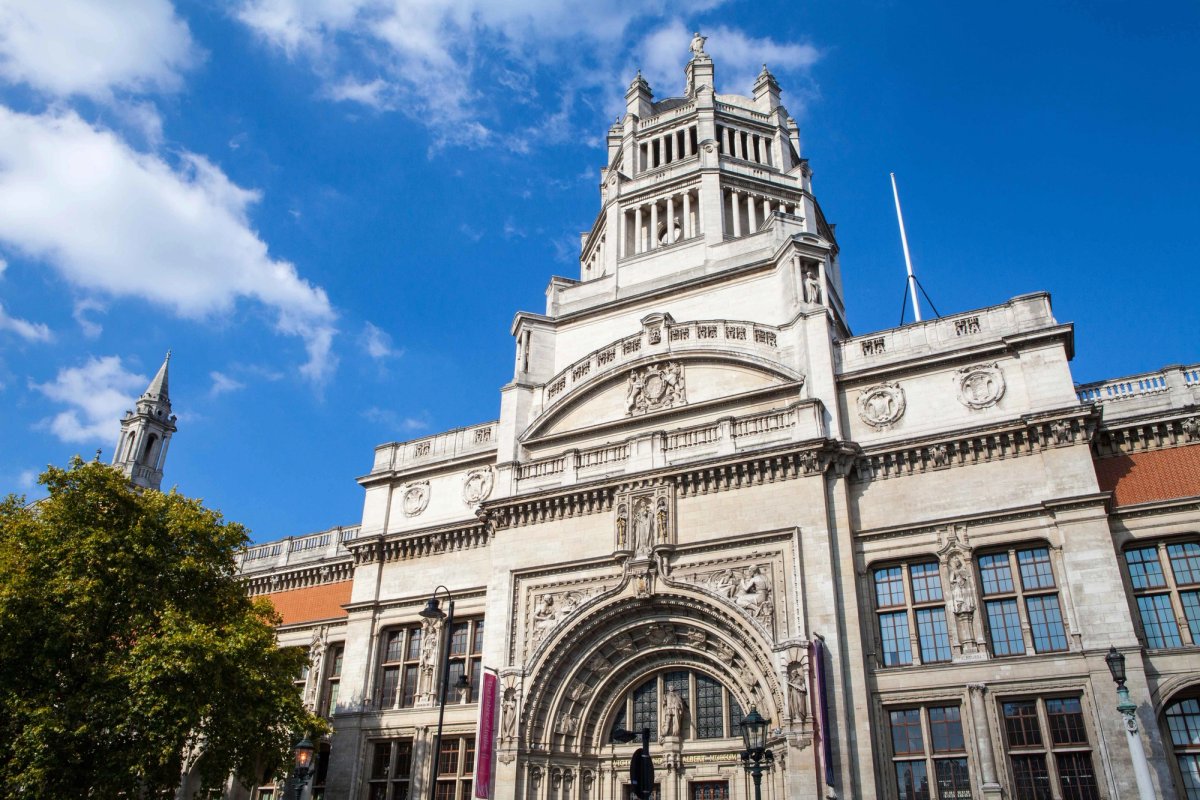
Yuko Kikuchi, the former head of academic programmes at the Victoria and Albert Museum (V&A) in London, stepped down from her position at the end of January. Shortly before leaving the institution, she wrote to its leadership, saying that “racist” and “culturally insensitive” behaviours by museum staff towards her and her students had contributed to her resignation.
In the letter dated 26 January and addressed to the V&A’s director, Tristram Hunt, and trustees of the museum’s research committee, Kikuchi—who is Japanese but has lived in the UK since 1989—said she felt the alleged behaviours “likely indicate a culture of systemic racism within the organisation, that I believe needs to be addressed”. She describes the letter, seen by The Art Newspaper, “as an act of whistleblowing”, and says she does not believe the “issues and evidence”, which includes student testimonials, would otherwise reach senior leadership. The letter was supported by 12 academics, including the artist Sonia Boyce, who is also the chair in Black Art and Design at University of Arts London (UAL), and Sarah Teasley of RMIT University. Teasley was formerly the head of programme at the Royal College of Art (RCA).
The V&A’s academic programmes comprise a variety of degrees and research initiatives delivered in collaboration with several universities. They include, for example, a module entitled "Thinking Through Materials: Can Science, History and Art/Design Illuminate Each Other?", run in collaboration with Imperial College London, and an MA History of Design run in partnership with the RCA—which Kikuchi co-led. The programmes are overseen by the V&A Research Institute (VARI), which manages projects and policies across the institution's various sites.
Kikuchi—a founding member of the Research Centre for Transnational Art Identity and Nation (TrAIN) at the University of London—arrived at V&A South Kensington to lead the academic programmes department in October 2023.
She tells The Art Newspaper: “I felt unwelcome almost from day one, and everything I brought to the V&A felt unappreciated or indeed unwanted.” She attributes that feeling to a series of experiences, including what she describes as microaggressions, exclusion from key meetings and repeated resistance to her proposals, despite her remit including the development of new content and collaborations. She also says that in meetings with senior staff she was “the only non-white person in the room”, which she believes contributed to her sense of marginalisation.
Kikuchi tells The Art Newspaper that when she introduced material focused on decolonisation to the MA History of Design, she faced pushback from the V&A tutors with whom content had to be agreed. For example, she says that in 2024 she introduced the optional course Postcolonial Identity, Museum Collections and Transnationalism to the V&A’s flagship first term unit, Artefacts in History. However, despite the course proving popular with students, she was asked to consider moving it to the second term, which is primarily led by the RCA, for the following academic year on the grounds that it “doesn’t fit”. She argues that the effect would have been to leave the V&A-led first term unit without her "decolonial teaching", effectively maintaining a more conventional, Eurocentric curriculum. She says the proposed replacement was a course focused on the textile industry and social economy in England and the Industrial Revolution. The other two optional courses offered to students, according to the course handbook, were Designing Colours: Industry, Nature, Geopolitics and Making Home in Early Modern England, c.1600-c.1750. Kikuchi says she rejected the suggestion to move her course.
The Art Newspaper approached both the V&A and the RCA about the allegations put forward by Kikuchi. The institutions said in a joint statement: “The V&A and the Royal College of Art are committed to celebrating diversity, eliminating discrimination and promoting equality of opportunity; we stand firmly against unlawful discrimination in all its forms, and take any incidents of discrimination or reporting of unsafe learning environments extremely seriously.”
They continued: “The History of Design MA programme, taught in partnership by the V&A and the Royal College of Art, necessarily engages critically with questions of social justice, decolonisation and global histories through its teaching and research.”
The V&A did not provide The Art Newspaper with data on the ethnic diversity of its senior staff. Its latest annual report, which covers all of its sites, shows that of the employees who chose to disclose their ethnicity, 65.8% identified as white, 8.6% as Asian, 5.3% as mixed, 3.4% as Black, and 1.4% as other.
The V&A and RCA’s joint statement added: “The subsequent V&A recruitment process [following Kikuchi’s departure] sought additional expertise in global design history, reflecting the programme's continuing commitment to broad geographical and cultural perspectives. Both organisations will continue to work together to support a global and inclusive curriculum.”
Kikuchi says she was also asked by a senior colleague to try and avoid using the terms “decolonial” and “post-colonial” in her interactions with other staff, including curators, and the V&A’s senior leadership. “The idea seemed to be something like, ‘other staff in the museum don't understand these terms, in the way you use them’ and ‘[these ideas] might upset patrons and donors, we must be careful’,” she tells The Art Newspaper.
The V&A did not provide additional comment on this claim.
The V&A has, as an institution, openly addressed the histories of colonialism within its collections. In 2018, for example, it hosted a display of Maqdala objects—sacred royal treasures stolen by British troops from Ethiopia during a punitive expedition in 1868—in which it directly addressed the violence through which the items were acquired. It has also engaged in “renewable cultural partnerships” with other institutions, leading to objects going out on long-term loan, as was the case with a 2024 agreement signed with the Manhyia Palace Museum in Ghana.
Students weigh in
An appendix attached to Kikuchi’s letter includes testimonials from MA students on the V&A/RCA History of Design programme, which is primarily taught at V&A South Kensington. In them, the students describe their own experiences of alleged racism, cultural insensitivity by teaching staff, a lack of diversity among the faculty and an “unsafe” learning environment.
One MA student wrote: “The textile curators shocked me with their lack of compassion and understanding relating to ‘exciting new acquisitions’—this was a disgusting way to describe the pieces featuring samplers of enslaved people.”
Another wrote: “During a lecture on the portrait of Francis Williams, in order to give context (of the time period/Jamaica at this time), the speaker chose to give accounts only of the feelings and lives of the white population, in 18th-century Jamaica; she described that during this time of slave revolt, that ‘people were fearful’—the only ‘people’ here being white people, people without prefix. There was no recognition or understanding that, perhaps, the people who had been enslaved would have obviously been fearful.”
Some students spoke to The Art Newspaper directly, on condition of anonymity, bringing up alleged resistance to conversations on decolonisation and repatriation. One example mentioned by several students was a discussion about the museum’s Maqdala objects during the Researching the Provenance of the Ethiopian Collection class held at the V&A’s National Art Library. Several students say that during a discussion about limited storage space and resources for further research on the objects, a student asked whether repatriation might be considered. They say the speaker shut the conversation down, pointing to the need for an Act of Parliament [the 1983 National Heritage Act] and further research on the objects. “I think the reason we all sort of found this disturbing is because the point of this course is to be a decolonial art history course and it seems like half of the institution, the V&A, doesn't seem to be interested in those kinds of conversations,” one student says. Another student adds: “I think when topics like that come up, it's always, 'here are the facts' as opposed to 'here are the solutions'.”
Hunt has spoken on multiple occasions about the 1983 National Heritage Act, which prevents the V&A from deaccessioning objects from its collections unless under very limited circumstances, and said it should be reviewed. Speaking to The Art Newspaper this month, he called the act “both outdated and infantilising for trustees of the national museums affected by it”, allowing institutions to “hide behind the legislation rather than engage with detailed provenance research and consider legitimate applications for the return of looted goods.” He suggested that the 2022 charities act, which contains “provisions allowing for the disposal of goods by charities”, could be extended to “national museums with contested objects”.
In an interview with the BBC’s Today Programme in 2023, Hunt also argued that museum trustees should have more control over what happens to the objects in their collections. He reportedly told the corporation: “I’m a strong believer that trustees of museum collections should have autonomy over those collections, and be able to make the case whether they should retain them within the UK or loan them to other museums around the world—or indeed begin a conversation around restitution and repatriation.”
The V&A and RCA’s joint statement meanwhile says: “The [MA History of Design] programme includes regular opportunities for student feedback and reflection on the equity, diversity and inclusion impacts of teaching and learning. The V&A and RCA have continued to engage with students through a series of dedicated meetings and follow-up discussions to address any concerns raised and have taken forward a range of actions to strengthen teaching, pastoral support and staff development.”
In her letter, Kikuchi references the testimonials, and a report pertaining to PhD students enrolled on Collaborative Doctoral Partnership co-run by the V&A. She wrote: “What is common across my own case, the MA students’ testimonies and the PhD students’ report is a systemic lack of understanding on the part of some V&A academics and curators regarding decolonial scholarship, which has developed extensively since the 1990s and is now embedded in museum practice internationally. There appears to be insufficient understanding of interrogating museum collections and practices, of the fundamental ethos of EDI [Equality, Diversity and Inclusion], and of the lived impact of discrimination and humiliation when enacted by those in positions of institutional power.”
Students spoke about feeling excluded during their time at the V&A, in both their testimonials and in conversations with The Art Newspaper. The Art Newspaper spoke to one East Asian student who says that although the V&A offers an “exceptionally high-quality education”, museum staff often appear “irritated” when she and other East Asian students approach them. She says impatience towards non-native English speakers has led many to remain quiet in class. “It feels like they don’t really like to talk to us,” she says.
Another East Asian student adds in an interview that the unwelcoming atmosphere extends beyond the classroom, and is across the V&A, including places such as the library and canteen.
The V&A did not comment specifically on the claims by the East Asian students.
Several point out a lack of diversity among the V&A’s senior teaching staff and say Kikuchi’s departure will deepen concerns both about representation and expertise. One Black student, says “there is hardly any Black British representation [on this programme] and throughout my time on this course it’s been frustrating”.
“There is a perception of the V&A being inclusive and diversifying. But the imperialistic and colonial origins of the institution are still very prominent,” another student says.
The V&A did not comment on these specific claims, however, its statement says: “The V&A is actively interrogating its colonial heritage through its public programmes, education initiatives and collections research.”
The letter includes a summary of a meeting held with students and representative tutors from the V&A and RCA in November 2025, which lists “points around which student voices coalesced”. Among them are: “Students noted an ‘offensive’ refusal or rebuttal of decoloniality with V&A curators that affected [students’] choices of object for their essay” and a line stating that “students have felt unsafe”.
‘Bouts of tears’
In her letter, Kikuchi, wrote that “in the case of behaviours towards myself, issues were raised with HR, which conducted an investigation and disciplinary procedure, the details of which, I was informed, must remain confidential”. She added that the process “failed to address the substance of the issues I had raised and instead left me feeling sanctioned. As a person protected under the Equality Act 2010, I believe this case required far more serious and careful handling.”
In response to The Art Newspaper’s questions about whether the HR case was handled appropriately, a V&A spokesperson said: “For confidentiality reasons, we would never comment on an internal investigation.”
In February, however, in a letter responding to Kikuchi and seen by The Art Newspaper, Hunt noted that HR had “apologised for aspects of the [internal] process which were not carried out as we would have hoped”. He added that the matter had “led to a subsequent review of processes to ensure learnings are acted upon”.
Hunt’s letter also said that the points raised by students would be reviewed with the RCA in order to put “in place concrete actions”, and that the V&A was reviewing aspects of the programme and its practices. He noted that staff were already engaged in work examining the colonial histories and legacies of the museum’s collections and addressing historic biases, while acknowledging that this was “work in progress” and that there was “undoubtedly more to do in developing staff understanding and knowledge across the V&A”.
Kikuchi tells The Art Newspaper the experience took a toll on her mental health, leading to bouts of tears, disrupted sleep and symptoms of depression, and that she ultimately concluded she could no longer carry out her role and resigned. “I was very, very excited about this job,” she says. “I really didn’t expect to quit after two years.”
This is not the first time the V&A has faced allegations of racism. In July last year, staff at the museum were accused of racially profiling a group of Year 10 students from a Bristol school during a visit. The incident prompted parents and staff at the school to call for a boycott of the museum.
On the allegations relating to the Bristol school visit, a V&A spokesperson says, “We work very hard to ensure everyone feels welcome during their time at the V&A and take feedback of this nature very seriously. In this instance, we remained in close and constructive dialogue with the school throughout and conducted a thorough review of what happened and whether we needed to make any changes to our own procedures as a result.”