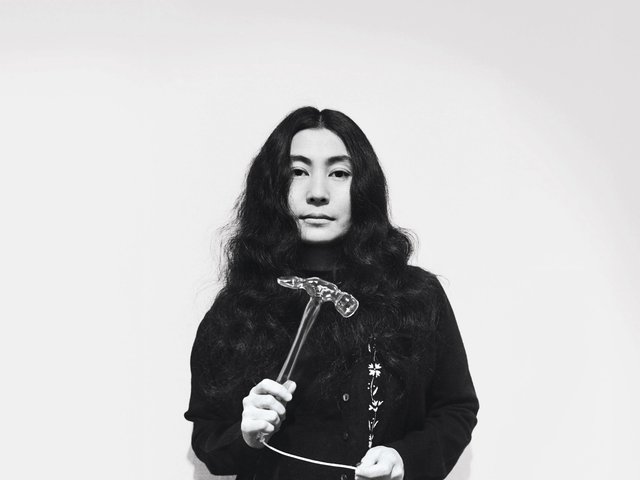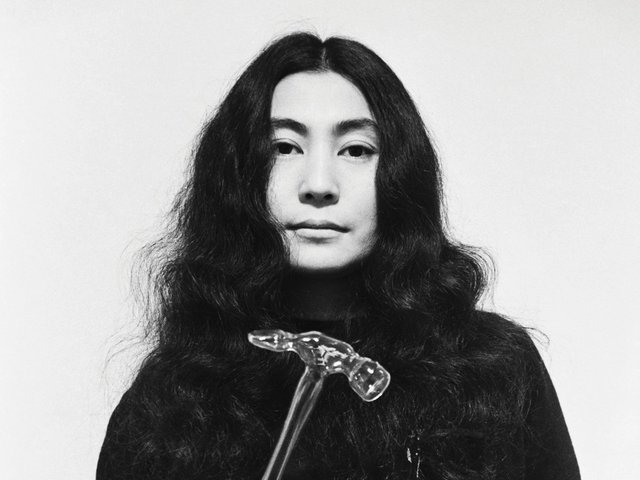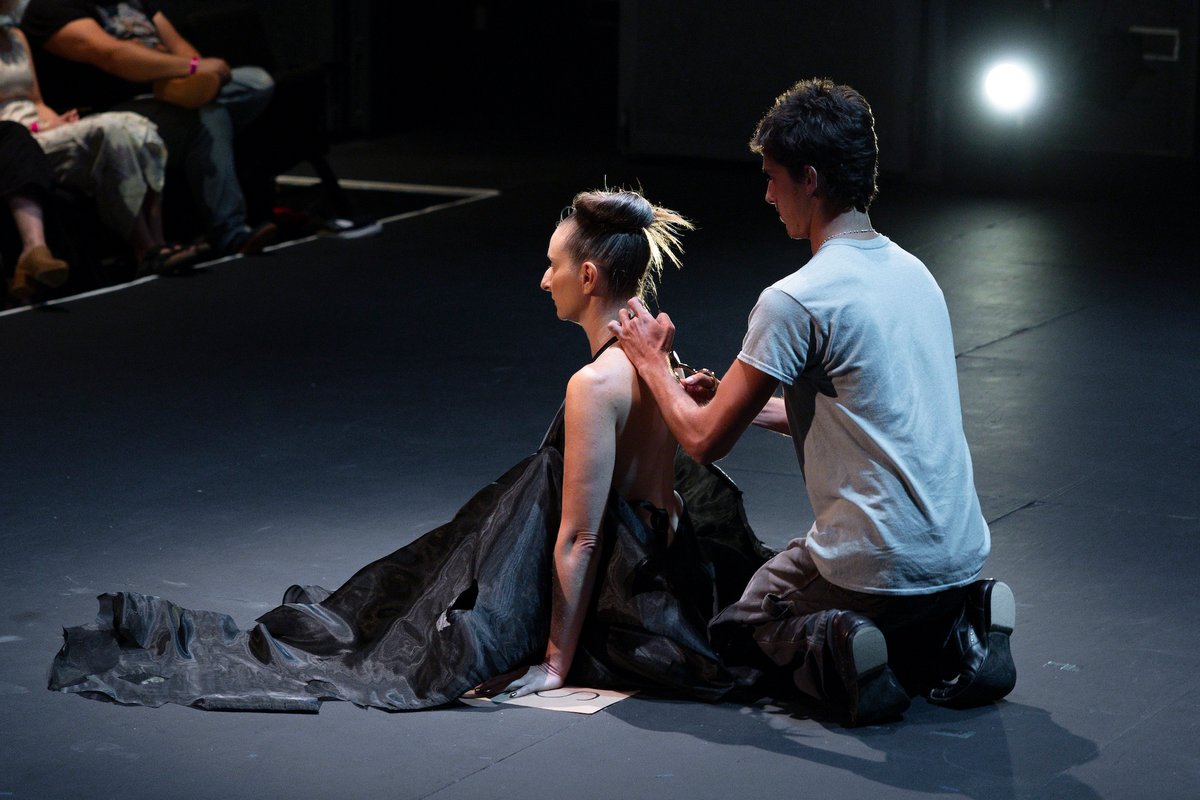
The latest version of Yoko Ono’s Cut Piece (1964), performed by the artist MPA in downtown Los Angeles on Sunday (19 July), turned out to be an example of mutual aid in the form of a trust fall disguised as a striptease. Like the original performance, a cornerstone of feminist art, it began with the artist sitting down quietly and silently on stage fully clothed, with a pair of scissors nearby. It ended when an audience member—one in a long line of spectators-turned-participants—snipped off the last shred of her clothes.
The potential for violence felt strongest at the start. As dozens of participants lined up on stage at Redcat to take a stab at cutting MPA’s gown, the unpredictability built into the concept and the threat inherent to scissors felt real. Would someone hurt the artist? Would men aggressively slice into her bra as they did to Yoko Ono in 1965 at Carnegie Hall in New York? Would audience members step in to protect her, as some have for Marina Abramović’s most dangerous rituals in the past?
Let’s just say a Los Angeles art crowd in 2026—perhaps especially one willing to miss the World Cup final for performance art—comes from a more empathic place. Most visitors seemed so gentle and respectful with MPA, who sat tall on the Redcat stage, her knees tucked under her, that their gender—and the artist’s—became less interesting, defined or distinct. The binaries of young-old and male-female largely disintegrated, as well-meaning people tended to her undressing carefully, thoughtfully and humanely, starting with small cuts into her gown’s hem.
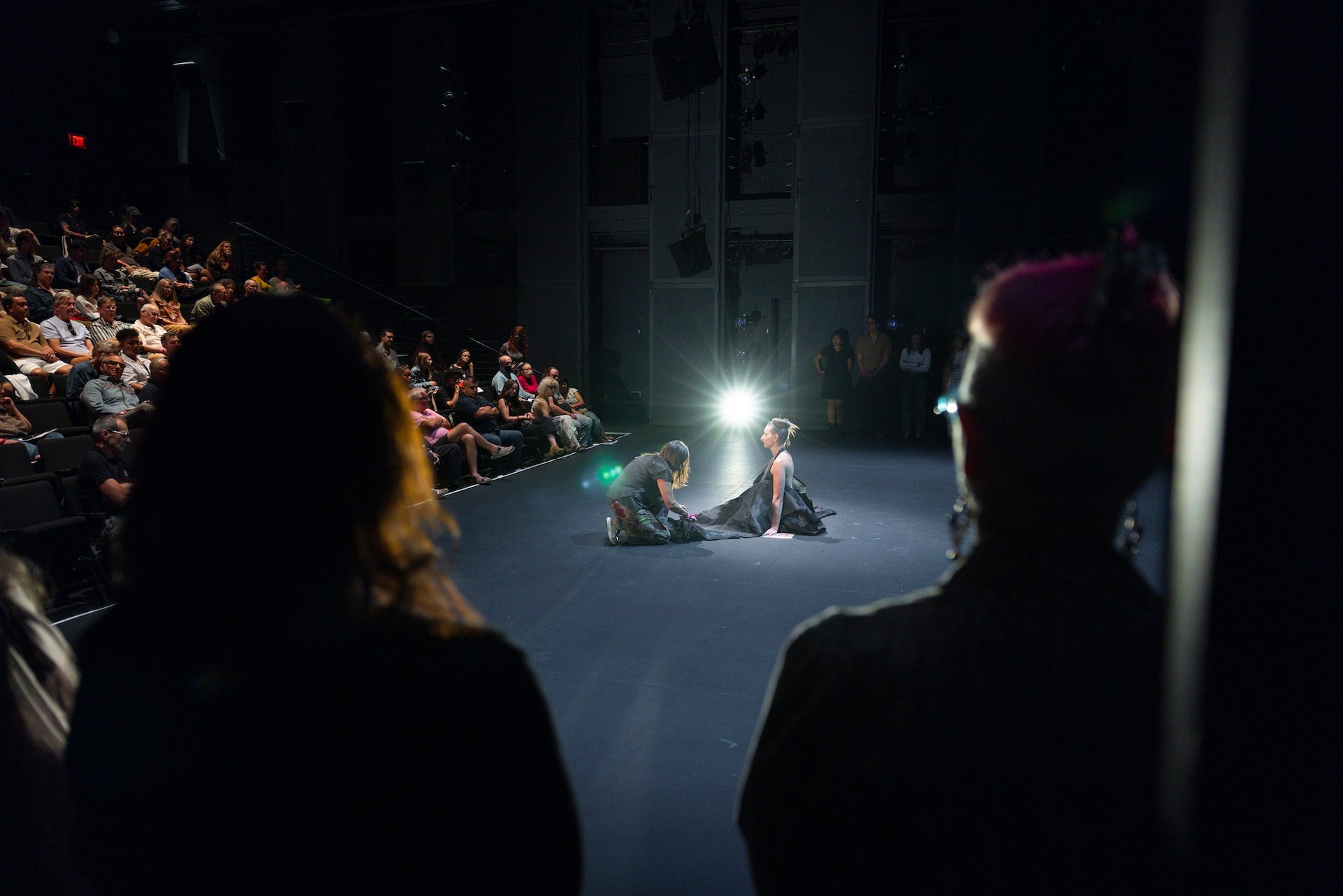
Artist MPA performing Yoko Ono's Cut Piece (1986) at Redcat in Los Angeles on 19 July 2026 Courtesy of The Broad, photo by Salvador Ceja Garcia.
A queer artist with a strong collaborative bent, MPA was commissioned to redo Cut Piece by the Broad, which is currently hosting Ono’s traveling retrospective Music of the Mind (until 11 October). For her second of two performances, on Sunday, she wore a sculptural black gown by Aliona Kononova featuring an asymmetric halter and heels by United Nude. Her hair was pulled tight into a high bun, perhaps to prevent anyone from trimming it.
In a brief introduction on stage, MPA noted that Cut Piece does not have a single score. Rather, Ono understood the performance differently over time, whether framing it as an exploration of gendered violence in the 1960s or as a peace offering in 2003, when she last performed it herself. By then, in keeping with the spread-the-love spirit of her recent work, she envisioned the scraps of fabric as gifts for people to share. MPA also read a 2003 statement from Ono on personal vulnerability in a post-11 September 2001 world that seems particularly prescient, mentioning the death of US peace activist Rachel Corrie in Gaza and the media relentlessly “assaulting our senses”.
“I don’t undress for performance art anymore,” MPA said. “But for this one I said yes.” She held up her right hand, making the “V” of a peace sign. Then, keeping the V intact, she rotated her hand to make a scissors gesture before returning to the “V” of peace. It was a simple and generous way to open the piece (or “peace”?) to both extremes: the threat of violence and the restorative or protective power of community.
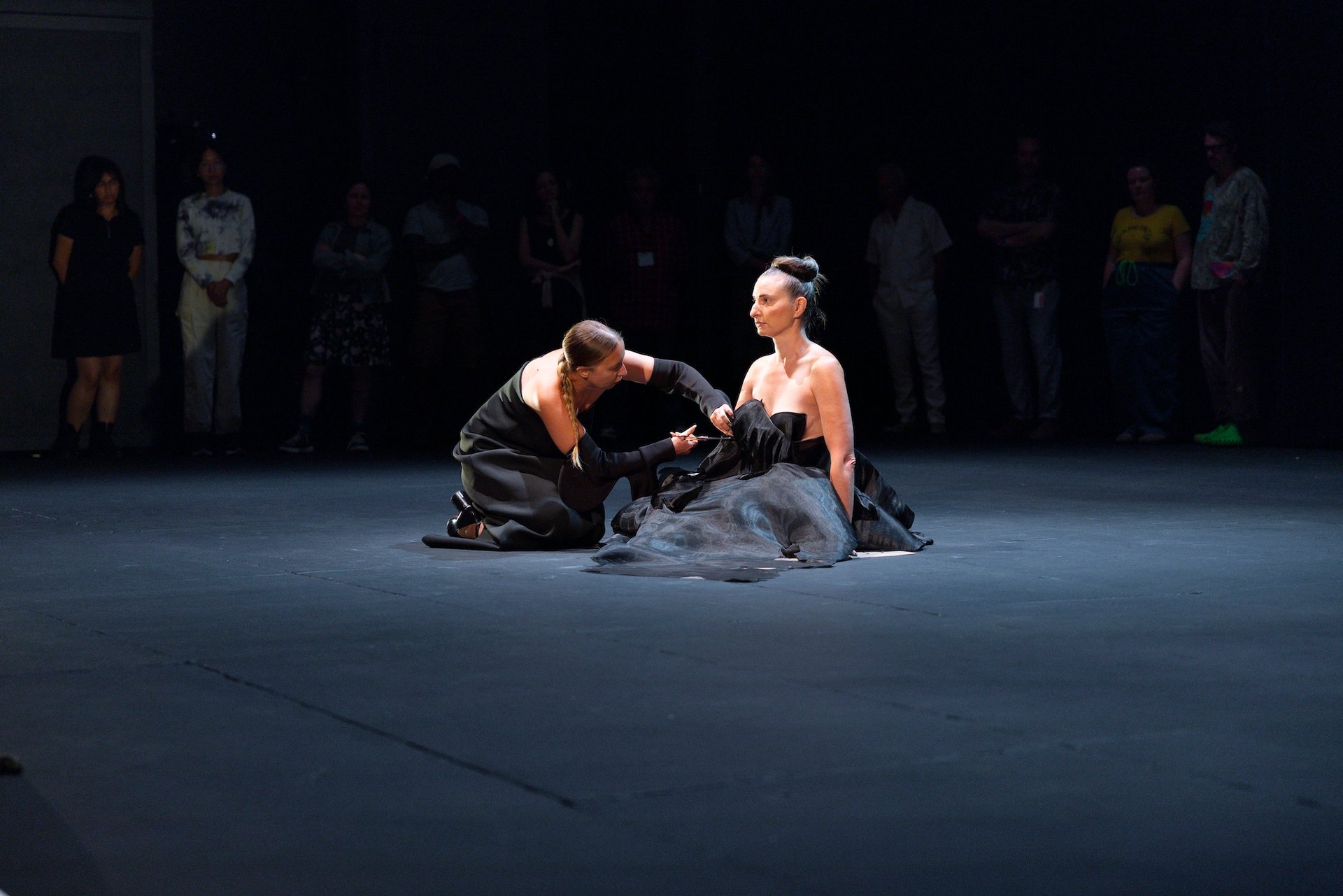
The designer Aliona Kononova makes a cut to the dress she designed for the artist MPA during her performance of Yoko Ono's Cut Piece (1986) at Redcat in Los Angeles on 19 July 2026 Courtesy of The Broad, photo by Salvador Ceja Garcia.
The overarching goodwill of the audience on Sunday became evident within the performance’s first 15 minutes. Participants typically kneeled or crouched at the artist’s level to find some fabric to cut. They replaced the scissors on the floor softly, parallel to MPA, not pointing at her. One woman cut off a small corner of her own button-down in solidarity, leaving a white scrap with the artist on stage. I joined the line midway through and found a loose flap of dress on MPA’s back to snip without compromising the structure of the gown.
Nothing disrupted this considerate and collaborative process, which made me suddenly and wholeheartedly wish that every single person in the theatre could take charge of our reckless government and its various cabinets, until a thin, angular man in dark jeans walked up briskly to the stage. The “music” of the performance up until that point consisted mainly of soft snipping and thudding steps. His walk was sharp and percussive, boots cleanly striking the ground, which read to me as male and dangerous.
It was a reminder that anything could still happen, and I found myself inadvertently holding my breath. But his cuts to the dress were efficient and not especially invasive. By this point the psychological loop of tension and release was growing a little tiring. When a snip of the scissors finally released her strapless bra, I felt a flush of arousal. By the time her thong was gingerly removed, I was lulled back into the safety of boredom.
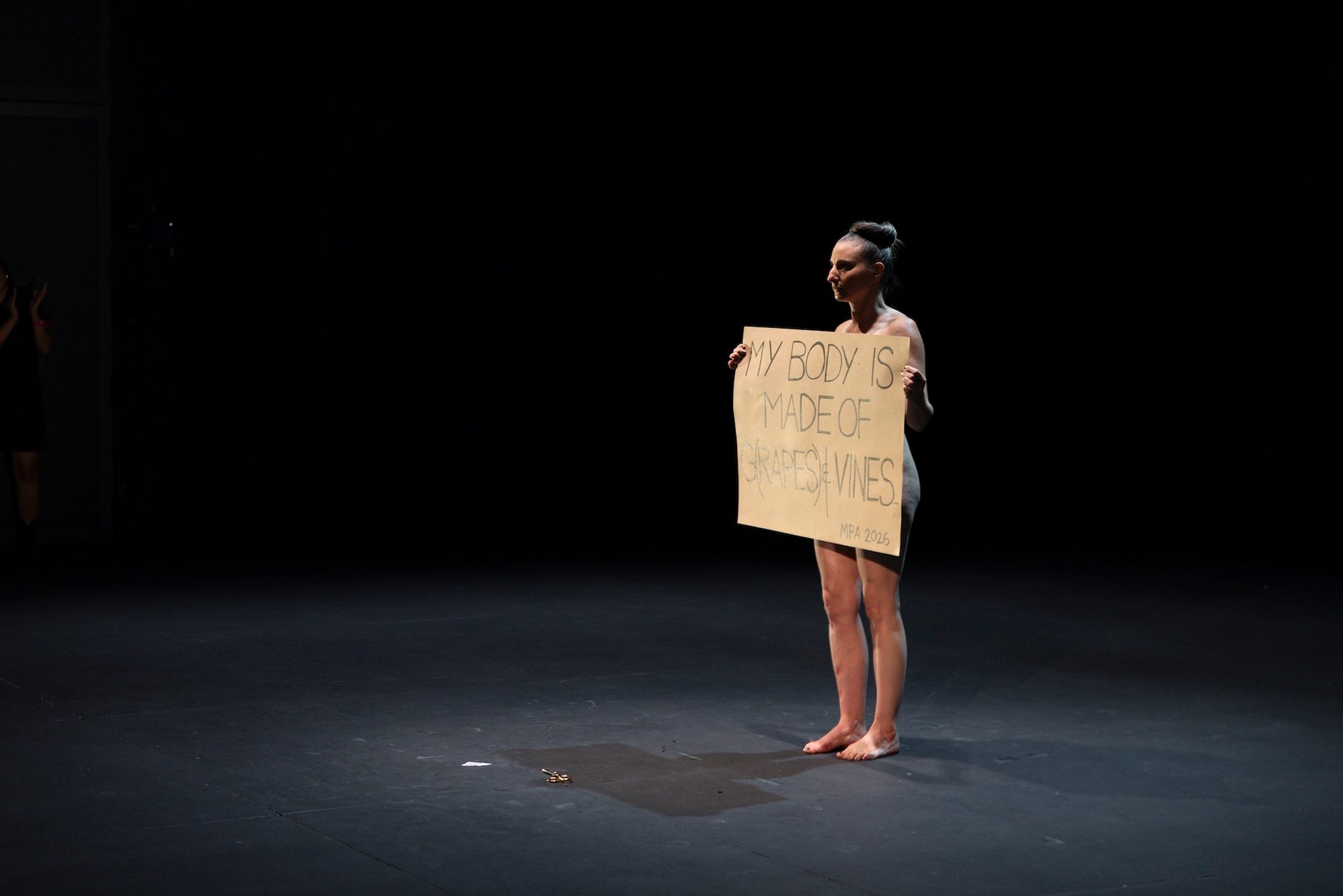
The artist MPA at the end of her performance of Yoko Ono's Cut Piece (1986) at Redcat in Los Angeles on 19 July 2026 Courtesy of The Broad, photo by Salvador Ceja Garcia.
Now naked, MPA stood up, 64 minutes after sitting down. She held up the mat she had been sitting on to reveal a quote from Ono: “My body is the scar of my mind.” She flipped the sign around to an aphorism of her own making—“My body is made of (g)rapes&vines”—before leaving the stage.
MPA’s flipping of the sign, showing two sides of the same coin, was another example of her binary-bashing, deeply dialectical process, which felt like the engine behind the performance. She clearly understands how an art—or life—experience can tip from nurturing to violating, like her grapes into rapes or her peace sign into scissors, and how it can go in the other direction as well. The power of her version of Cut Piece was to contain both possibilities at once.
- MPA performed Cut Piece at Redcat, Los Angeles, on 18 and 19 July
- Yoko Ono: Music of the Mind, until 11 October, the Broad, Los Angeles