Telling the story of an unusually thoughtful US president and the political shifts that brought him to power, the Obama Presidential Center on the South Side of Chicago has since opening in June served as a beacon for thousands of Americans depressed by the current administration’s corruption and perversion of democratic values. The monthly ticket drops have quickly sold out, and long lines form each day to visit the café, which is open to the public.
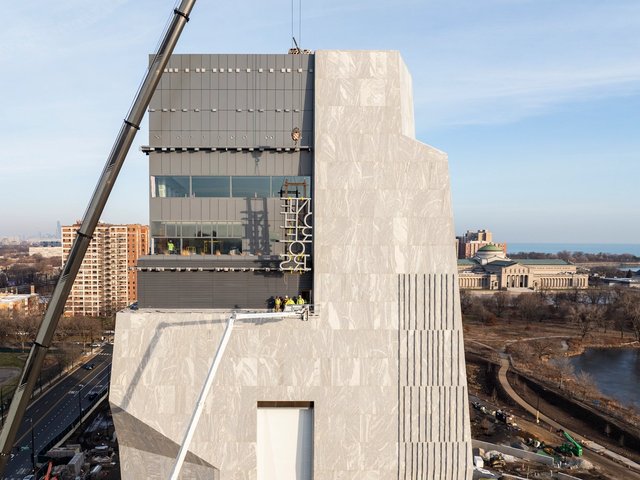
But so far responses to the “Obamalisk”, the nickname for the monumental, beacon-like tower designed by Tod Williams Billie Tsien Architects that looms over the $850m, 19-acre campus and contains the main exhibitions, have been mixed at best. Tsien cited the sculptures of Brancusi, one of President Obama’s favourite artists, as an influence. The Chicago architecture critic Anjuli Rao wrote that it looked like a monolith from the television show Ancient Aliens. The Guardian’s critic Oliver Wainwright compared it to a sci-fi villain’s headquarters and a mausoleum.
None of those comparisons prepared me for the uplifting, even soaring experience of being inside the space. Yes, from the outside the building looks a little phallic and pompous in the way that most obelisks do. But from the inside it functions like a modern-day version of a Gothic cathedral, where the integration of large-scale art into lofty architecture serves to draw our attention upward, towards a higher goal if not a higher spirit.

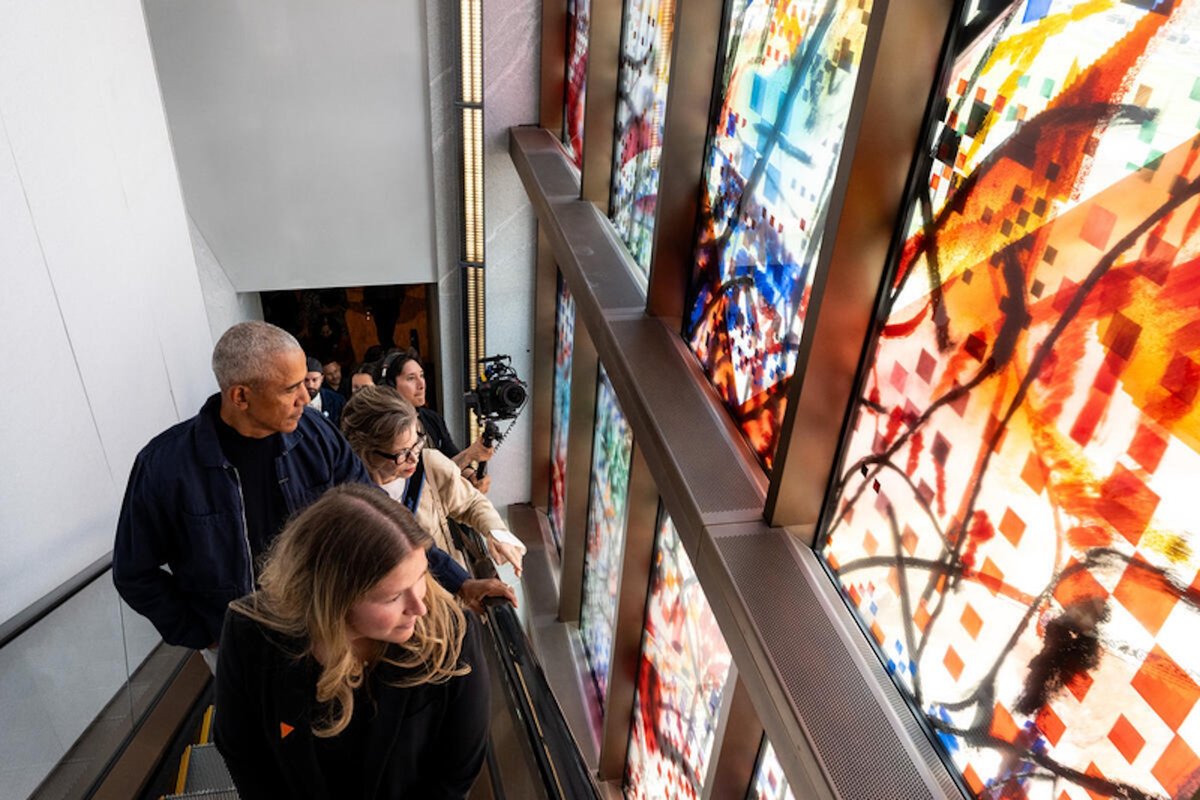
The building’s most direct reference to a cathedral comes from Julie Mehretu’s version of stained-glass windows, running up one side of the centre’s museum tower and reaching a height of 83ft. Called Uprising of the Sun, her work features an array of mark-making on glass panels, including painted streaks, stencilled squares and sprayed halos—a confetti-like explosion that colours, but doesn’t completely cover, the view of the city to the north. It’s an abstract, densely layered and urban-coded version of stained glass, which historically used light to express the presence of divinity and here carries some of that intensity.
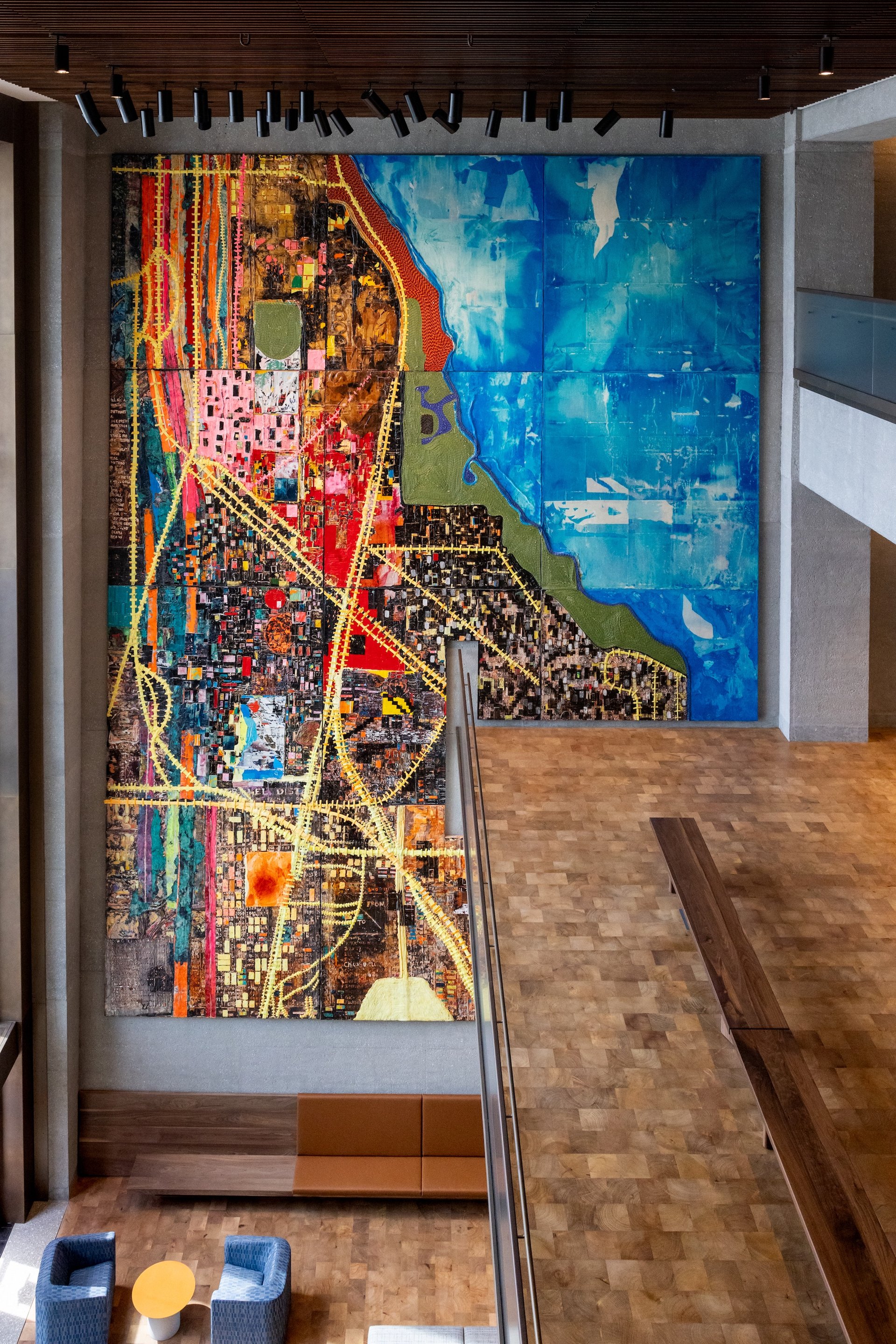
Mark Bradford, City of the Big Shoulders, at the Obama Presidential Center Courtesty The Obama Foundation
Mark Bradford’s City of the Big Shoulders, which was developed for the building’s atrium and reaches three storeys in height, also delivers a profusion of colour, rich with turquoise and cyan shades (unusual in Bradford’s work) meant to represent Lake Michigan. His work reads like a stratified map, where yellow rope marks railroad lines that have connected the city while also dividing it racially and economically.
Meanwhile, for This Land, Shared Sky, the Portland-based artist Marie Watt, who belongs to the Seneca Nation of Indians, teamed up with the Chicago artist Nick Cave, who is African American, to create a work that merges symbols from their respective cultural histories. They wove jingles used for Indigenous healing dances together with beaded nets associated with Black hairstyles into one big, unruly and glorious tapestry. Their collaboration was an inspired bit of matchmaking by Virginia Shore, who oversaw the centre’s commissions.
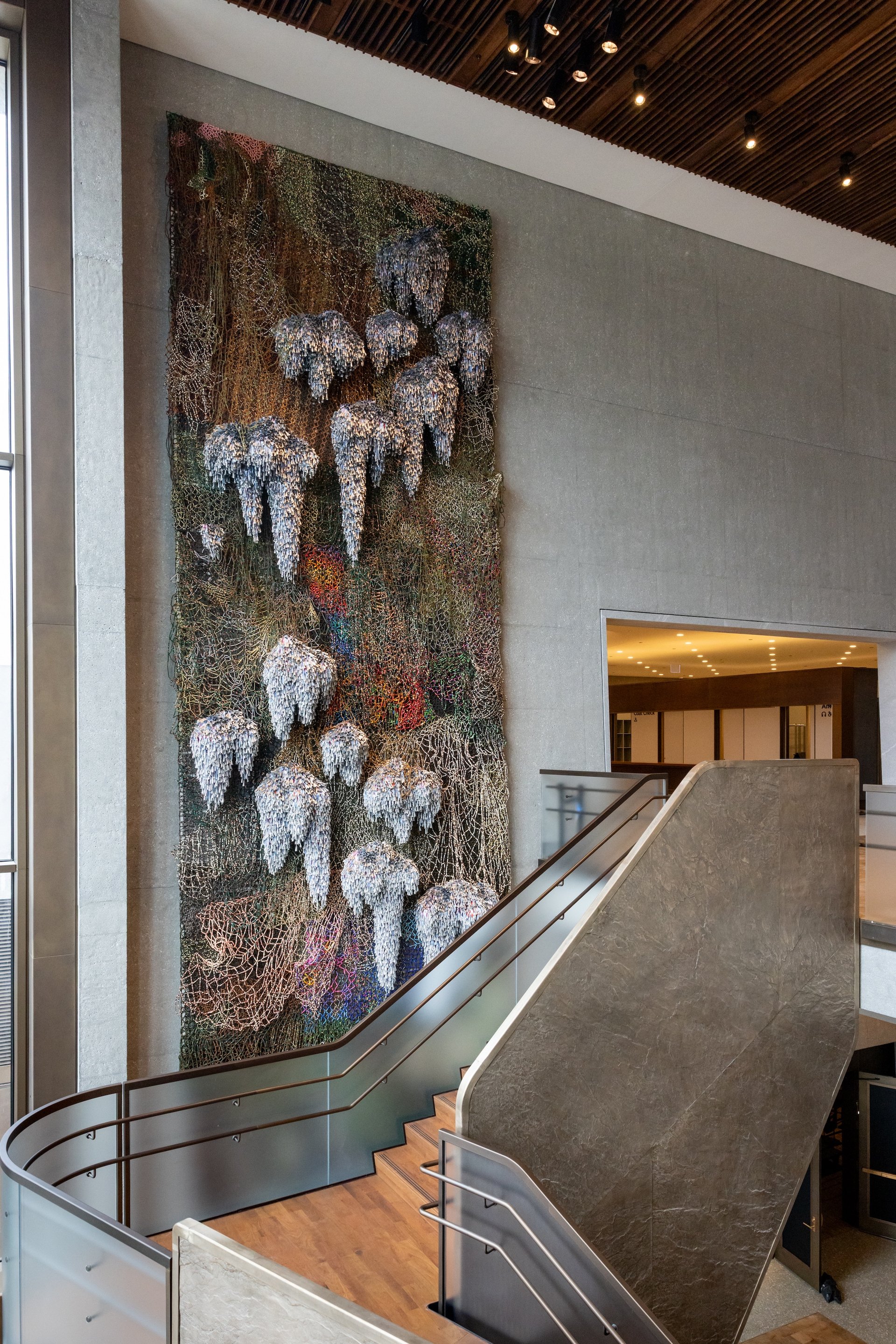
Marie Watt and Nick Cave, This Land, Shared Sky, at the Obama Presidential Center Courtesy The Obama Foundation
All three of these works span multiple floors, which has a powerful effect. Visitors are encouraged by signage and docents to start their journey at the bottom of the museum building and work their way up. As they do so, moving chronologically from a mini-exhibit on women’s suffrage to one on the Civil Rights Era, or from Obama’s time as the editor of the Harvard Law Review to his legislative accomplishments as president, they are drawn to the next floor not just by the unfolding political or personal trajectories but by the momentum created by ongoing art.
In other words, these works are so large and detailed that they become durational, much as Victor Hugo once described the Cathedral of Notre-Dame as “a vast symphony in stone”, too vast to take in at one glance. Visitors must move around to experience them, as Mehretu herself points out in a brief audio guide to her work, where she calls her piece a “constantly transforming image”.
Other architects have envisioned a visitor’s ascent within a museum as a means of coming into the light, as David Adjaye did with the National Museum of African American History and Culture in Washington, DC, and Daniel Libeskind with the Jewish Museum in Berlin. That is not exactly the case here, where the first floor has plenty of light and hope, including an already-celebrated portrait of Barack and Michelle Obama by Njideka Akunyili Crosby. But upon reaching the eighth floor, visitors are rewarded with a sense of openness and plenitude that could pass for hopefulness.
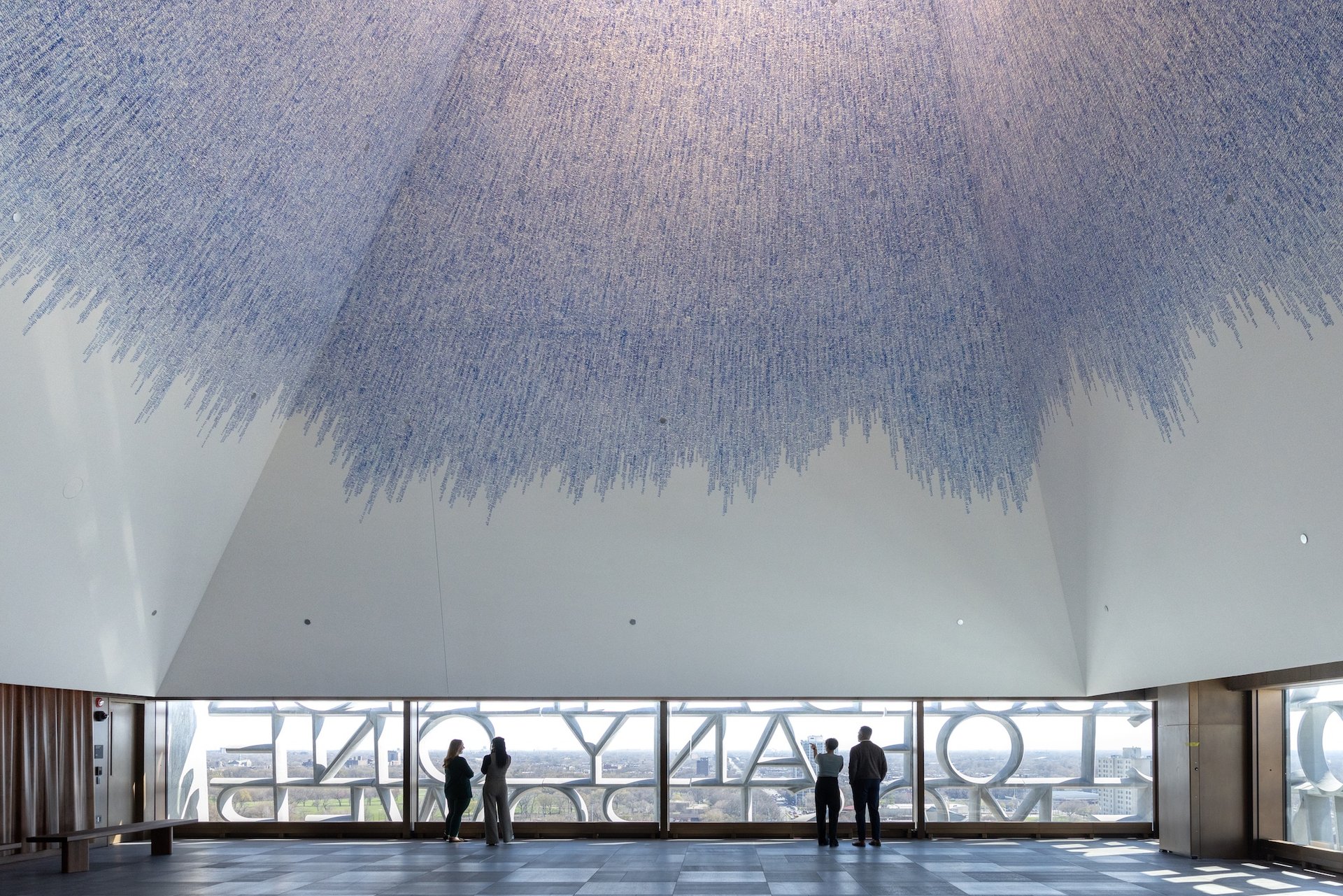
The Sky Room, featuring Idris Khan's text installation (inside) and Pentagram's large blocks of text (outside) Courtesy The Obama Foundation
The culmination of the museum tower is the Sky Room, which features expansive city views from wrap-around windows and one of the most recognisable features of a Gothic cathedral: the vaulted ceiling. Idris Khan has used the vaulted ceiling here so effectively for his work, Sky of Hope, that it is hard to say whether it was an original feature of the architecture or a design element added by the artist. The work consists of around 250 phrases from Obama’s celebrated 2015 “You are America” speech, given on the 50th anniversary of the “Bloody Sunday” beating of peaceful protesters in Selma, Alabama, which Khan hand-stamped in blue paint, the lines emanating from what looks like a skylight. (Unfortunately, on closer inspection, it turns out to be a bright white board.)
Several visitors have likened this work to a cascading waterfall, where only the closest drops are legible as words. My experience was not of water rushing toward me as much as this blue, fluid language returning to some ineffable source, like a collective consciousness where all ideas are born. The room seemed a meditation on the very fundamental and still mysterious process of birthing or giving form to thought.
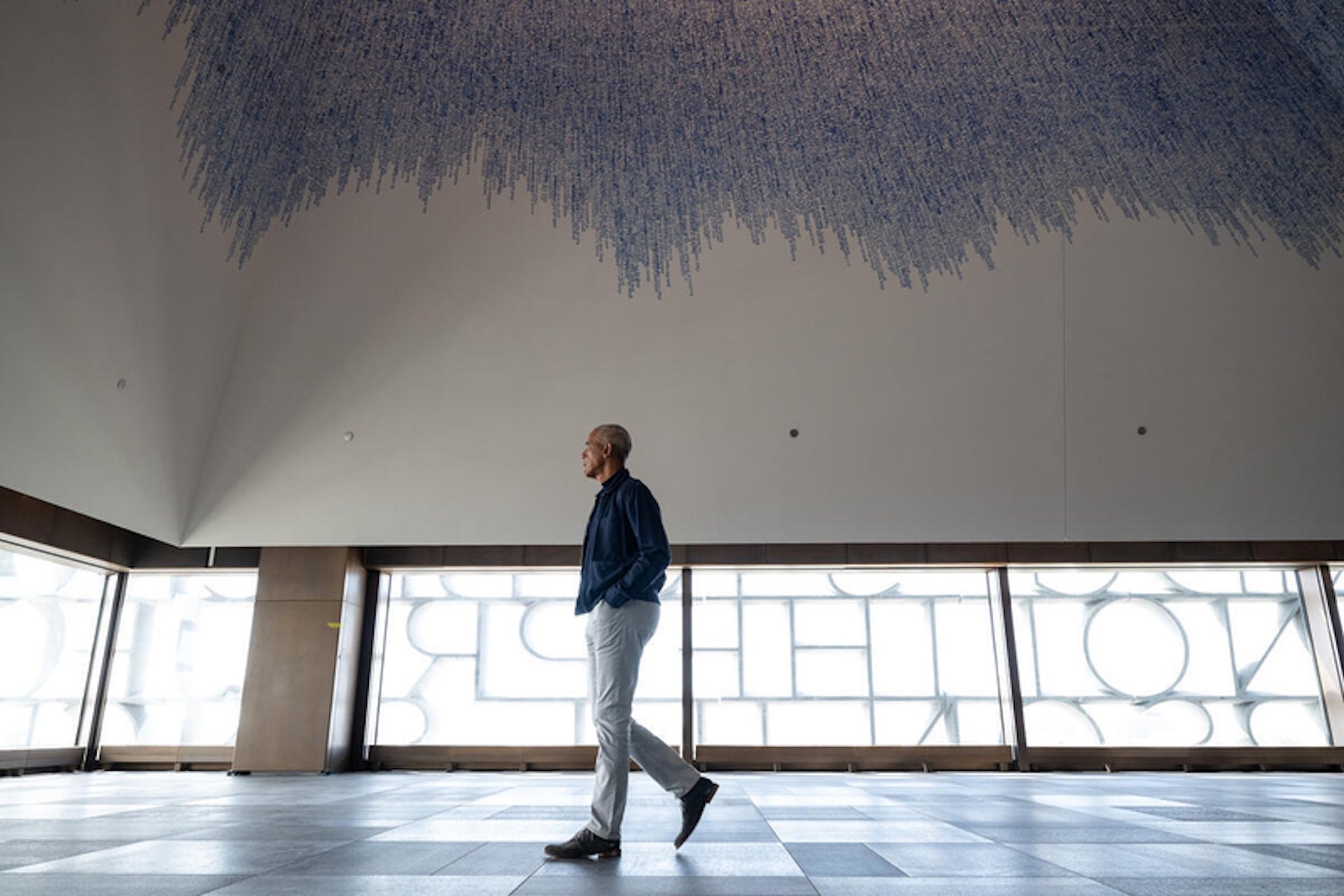
Former president Barack Obama explores the Obama Presidential Center's Sky Room Courtesy The Obama Foundation
Excerpts from the same “You are America” speech (such as “the single most important word in our democracy is ‘we’”) also appear in Pentagram’s large-scale typographic intervention, which wraps around one corner of the building façade. The phrases are hard to parse—Pentagram could have done better. But having language writ into the architecture serves as a reminder of how important speeches were to Obama’s leadership, even when dismissed by Hillary Clinton, his 2008 rival for the Democratic nomination, as “just words”.
On the campaign trail, Obama rejected this empty-rhetoric charge, whether insisting that “I have a dream” and “We hold these truths to be self-evident” are not “just words”, or articulating how speech can move people to action. Now, nearly a decade after he left office, this building might be his ultimate rebuttal to anyone who doubts the power of words. Between Pentagram’s work on the facade and Khan’s streams of consciousness inside, his presidential centre proves to be a shrine to language, celebrating its role in effecting large-scale societal change.