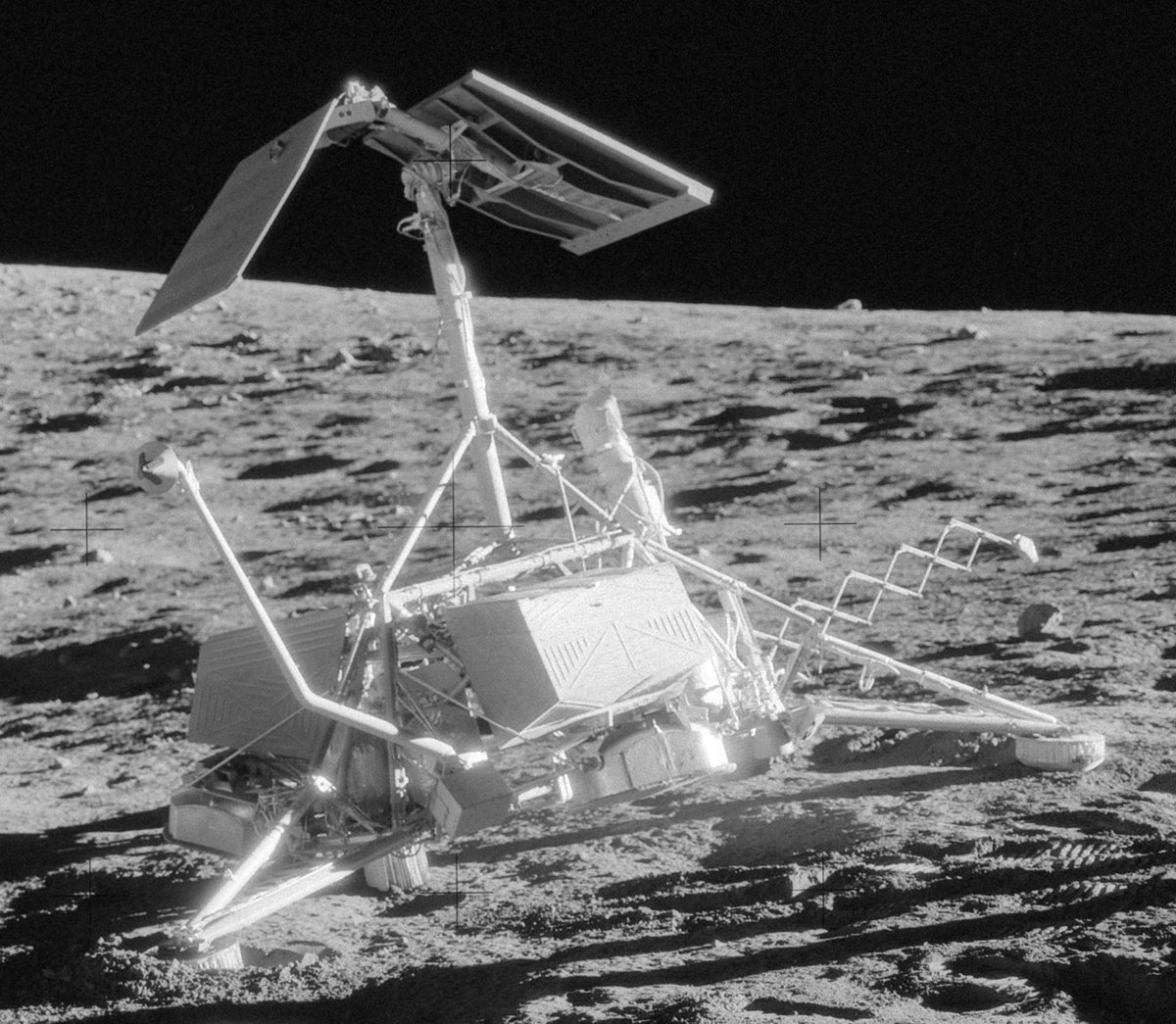

On 19 November 1969, Apollo 12 landed on the moon. Without the astronauts realising, the rocket exhaust that slowed their lander’s descent threw up moon dust with such intensity that it “sandblasted” the 1967 Surveyor 3 probe, 155m away, leaving parts of it pitted with craters. It is a striking example of how far and fast lunar dust is flung by landing spacecraft—and a warning that, even on the moon, cultural heritage is not safe.
Faced with such challenges, in 2011 Nasa published its recommendations for protecting US government lunar artefacts. Any descending spacecraft is advised to respect a 2km exclusion zone from their heritage landers—for example, keeping the site of Neil Armstrong’s “one giant leap for mankind” protected from dangerous high-velocity moon dust. But as experts have explained, this distance was always just a placeholder, meant to be revised after further research. The true safe distance might be much further.
And this is not the only problem. The many issues surrounding the preservation of lunar space heritage were recently summarised in a paper by Teasel Muir-Harmony of the Smithsonian National Air and Space Museum and Todd Mosher of the University of Colorado. Significantly, as they note in the journal Acta Astronautica, “There is currently no international heritage law that applies to historic or future sites on the moon.”
Heritage is unprotected
The Outer Space Treaty of 1967—a UN treaty with 118 parties—protects nations’ ownership of probes and other objects sent into space, but says little about cultural heritage. Since 2020, applicants for licences for lunar activities from US federal agencies are legally obliged to follow Nasa’s 2011 recommendations, but those without US links remain unaffected. Meanwhile, 67 countries have so far signed up to Nasa’s Artemis Accords, in which Section 9 is dedicated to preserving outer space heritage, but these are non-binding.
In short: space heritage remains almost totally unprotected. This urgently needs to be rectified. In April, I was glued to Nasa’s live YouTube broadcast of the Artemis II moon mission. It was the first time that humans had visited our cosmic neighbour since 1972, and is part of a long-term plan to build a moon base and eventually set foot on Mars. As exciting as this is for humanity, it’s a little worrying that the moon will welcome at least 100 missions over the next decade, leaving plenty of opportunity for irreplaceable lunar heritage to be damaged.
More space artefacts
On a more positive note, more space heritage may exist than previously believed. Writing in the journal Geoarchaeology, Luca Forassiepi, an independent researcher in Italy, and colleagues, have concluded that certain probes sent to Venus from 1965 to 1985—long assumed to have been erased by the planet’s harsh conditions—may still survive, albeit in a deformed state. These same Venusian conditions might ensure that the probes will forever be off the space-tourist trail, but their survival underlines that we should no longer be thinking just about world heritage, but interplanetary heritage.
Finally, Thomas Leppard of the US’s International Archaeological Research Institute, and colleagues, have studied island archaeology to provide lessons for future space colonists. In a paper published in Acta Astronautica, they suggest that how ancient settlers succeeded or failed to colonise remote islands can reveal the challenges that future space explorers might encounter during their own colonisation endeavours, and show them how to improve their chances of success.
Their survival underlines that we should no longer be thinking just about world heritage, but interplanetary heritage.
Among their lessons, the team write that the closer the target is to Earth (or wherever the settlers leave from), and the larger, the better; that target locations with a greater number of astronomical bodies nearby have a greater chance of success; and that any colony should begin with at least 1,000 people.
With these lessons in mind, Mars remains a good option, as are certain moons of Jupiter. Beyond our solar system, the star GJ 1061—a mere 11.98 light years from Earth—appears to be orbited by three planets that future space explorers could colonise. Perhaps these worlds will one day be home to humanity’s first interstellar heritage sites; if so, our existing space heritage may be what inspires colonists to take that first small step—but only if we guard it today.